The Firebugs of Kreuzberg

Kreuzberg Graffiti 1

Retain your memories
but détourn them
so that they correspond with your era.

Asger Jorn

We are in Berlin travelling on the U-Bahn to Kottbusser Tor in Kreuzberg. It is a gloriously warm April morning with fists of sunlight starting to punch through the clouds. From the elevated train tracks we can survey the sweeping spread of the city below. In the foreground, a graffiti inscribed, cubist assemblage written on to the earth. “How do they manage to get up there to paint it? asks R, pointing to a 3-D effect trompe l’oeil covering the entire gable end of a tall building. A and I marvel at the scale and ambition. An exploding riot of colour and illusion.  We both shrug our shoulders…

I had been in Kreuzberg the previous evening at a gig in the HAU 2 theatre complex. (As an aside, I was delighted to discover later that this building was the original site of the Zodiak Free Arts Lab formed by Conrad Schnitzler, Hans-Joachim Roedelius and Boris Schaak in 1968. More on this below if interested. (1)).  I didn’t have much time to stroll around the streets beforehand but picked up a little of the night ambiance. Clearly the zest to inscribe almost any available surface with graffiti and street art was alive and well.  I realised that my previous visit to Berlin had been when the Wall was still standing and  Kreuzberg was the beating heart of a chaotic, edgy, alternative radicalism.  An enclave of squatters, artists and musicians, living cheek by jowl with the, largely Turkish, immigrant population.  At the time it felt like some bunkered interzone within the island of Berlin. A city trapped and adrift in topography, history and cold war paranoia. Inter-railing around Europe, I remember having to scrape up the Deutschmarks to buy a ticket and visa to allow travel through the DDR from Hamburg.  Walking out of Zoo Station with a head full of Berlin tropes: Bowie, Iggy, Lou Reed and Christiane F.  I could imagine witnessing scenes of Blixa Bargeld and Nick Cave holding court in the bars of SO36 underneath the watch towers.  On reflection, a romanticised, pop-culture depiction of the city shaped more by the NME than by any history or guide-book.

Around twenty-five years later I’m walking out of Kottbusser Tor station with the family still carrying these ghosts of memory.  It feels a bit surreal to experience the bright sunshine and languid air of the street as we set off in search of the Turkish market down on the banks of the Landwehrkanal. We pass the grocery stores and a few cafes where groups of men  (and it is all men) are sitting outside sipping Turkish coffee and gossiping.  It’s only a short walk to the canal and it evidently becomes apparent that we have either got the day or our directions wrong. There is no sign of any Turkish market.  Perhaps Bowie, Iggy and Blixa can help guide us? Feed us a few signs? However, R is already off. A nine-year old is not going to hang around whilst our putative tour guides attempt to get their shit together.

Unburdened by worldly cares, unfettered by learning, free of ingrained habit, negligent of time, the child is open to the world.

Yi-Fu Tuan

Children are natural and consummate psychogeographers. They can  happily drift through any environment, urban or rural, seeking out and following the signs of place that speak to them. With the city as potential playground R, starts to saunter on ahead of us, leading the drift, although, of course, not aware or caring that this is what is happening.  We wander along the tree-lined canal path for a good stretch and apart from the dog shit, and occasional jogger, the city takes on an almost rural feel.  Bowie, Iggy and Blixa are struggling to keep up. I think they may have stopped for a fag. The sunlight is clearly not agreeing with them.

I could feel the interest of our spectral trio dissolve even further as we sat down on a bench to marvel at two magnificent white swans and a group of mallards bobbing on the canal.  “How do the swans keep so white in the city?” A pleasure boat chugs past and the gentle wake lip-lips against the canal sides. Our quiet reverie is broken when the larger swan rises out of the water, and extends its full wingspan. For a moment it looks as if the wingtips will almost touch either side of the canal.  A few strong beats and the swan takes to the air. We wonder where it can be heading and whether the birds flew freely between East and West when the Wall was up.

Against a riot of cubist, Kreuzberg colour
–   “Fuck Yuppies – Reclaim the Streets”
a white swan rises from the water
outstretched wings unfurling,
almost pushing
the canal walls apart.

We can feel ourselves being pulled into another city world as a ladybird lands on A’s arm. I love how ladybirds always look hand painted. After watching it run over her skin, it pauses to open its tiny wings as if basking in the sun. R lets it run on to her fingers and kneels down to reunite the hand daubed, smudge of colour with the greenery beneath the lime trees.  She discovers the bustling activities of an ant colony and we observe the  industry of the leaf carrying comrades, marching in their regimented lines – lugging, organising, creating.  Sucked in closer to the unfolding drama of this animistic, micro world, we start to notice other flecks of red and black moving amongst the earthy shades of leaf mould. They are not ladybirds.  We are looking at hordes of small insects that are completely unknown to us. Some scurry around alone, whilst others pile on top of each other to accumulate into little shuffling balls of red and black. Too absorbed in the moment, we ‘forget’ to take a picture of them.  It is only once we are home that we eventually manage to find an image and identify these mysterious little creatures as firebugs.  From now on they will be known as The Firebugs of Kreuzberg.

Firebug

Time has dissolved as we eventually head away from the canal and start to re-enter Kreuzberg street life. We start to notice the hum of cars again. A Mad Max biker type walks past with a tiny dog on a pink lead. The dog is sporting a bandanna. Our drift takes us up the entire length of Oranienstrasse, the main street of the district.  It is still pretty quiet in daylight and we pass the door of SO36, the club where Bowie and Iggy used to hang out and, by now, have probably once again, taken refuge. R has commandeered the camera and is now taking photographs, still drifting through a city more akin to Hayao Miyazaki’s animistic universe than my one populated with spectral ghosts. The signs are speaking:

The Détourned Red Bulls of Oranienstrasse

The Red Bulls of Kreuzberg

The Goddess and Protector of Oranienstrasse
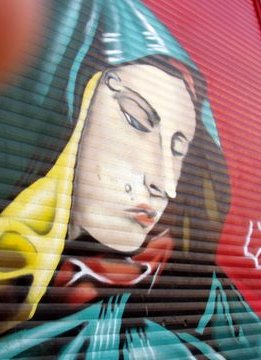
Goddess of Kreuzberg

The Visitor (detail from the side of a parked van)
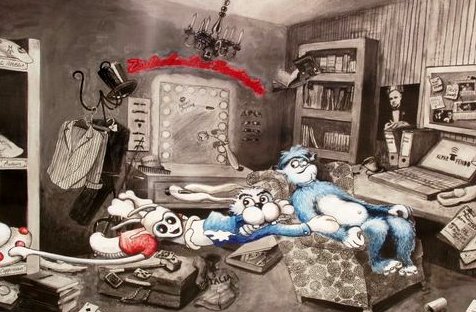
Lounging on Oranienstrasse

We eventually return full circle and ascend the steps back up to Kottbusser Tor station. Our quest to find Turkish markets, and gain enlightenment from Bowie, Iggy and Blixa has failed.  They have all remained spectral and elusive.  Our drift has pulled us into another dimension of Kreuzberg. One of canal paths, white swans, mallards, ants, and détourned red bulls.  Above all, we have discovered and witnessed something mysterious and new. The red and black insects that we now know as The Firebugs of Kreuzberg.

That’s all from the Berlin holiday. It’ll be back to Fife next. Possibly Cowdenbeath!

Now playing: Kluster – Klopfzeichen

♦ ♦

(1) HAU 2 and The Zodiak Free Arts Lab

I was excited to learn that, after a hiatus of twelve years, Keith Rowe, Oren Ambarchi, Christian Fennesz, Peter Rehberg (Pita) and Pimmon were reconvening their curiously named Afternoon Tea project for one night only in Kreuzberg. It was delightful happenstance to discover that this was happening on one of the nights of our holiday.  I headed down to the HAU 2 venue and certainly wasn’t disappointed. One long piece saw this stellar ensemble layer up a set of dark, fractured shards of glitch improv, punctuated with blankets of shimmering serenity. A deep, meditative, all embracing sound. An unfolding. Ambarchi sat almost motionless unleashing his trademark sonic  ‘depth charges’. The aural equivalent of watching and feeling a lava lamp. The bass resonance of the note entering through the feet and traveling up and out of the body.  It was also good to see Keith Rowe having to play in a much louder and busier sound environment than the last couple of times I’ve encountered him. Fennesz couldn’t help but attempt to excavate and instil some melodic fragments into the proceedings whilst Rehberg and Pimmon intervened with pincer movements of laptop noise assault. All in all a fabulous event to witness and experience in the dark, minimal space of HAU 2.

The happenstance of this event was further enhanced when I later discovered that HAU 2 was actually the original site of the Zodiak Free Arts Lab or Zodiac Club, formed by Conrad Schnitzler, Hans-Joachim Roedelius and Boris Schaak in 1968. Whilst only open for a few months, the Zodiak was a melting pot where “freaks and avant-gardists of all stripes could enjoy live psychedelia, free jazz, free performance and freakout”. (A1). It was a space also directly responsible for the emergence of Kluster (Schnitzler/Roedelius/Moebius) and Tangerine Dream, at that time with Schnitzler and Klaus Schulz in the ranks.  This early  incarnation of the Tangs is light years away from the vapid new-age pap that they later embraced in the 1980s.

The first few Kluster albums were engineered by a young Conny Plank who brought his experience of working with Edgar Varese to give some shape and coherence to the brutalist improvised chaos of this embryonic kosmische music. With the subsequent exit of Schnitzler and a later name change to Cluster, the sound took on a softer edge and the recording of classic kosmische albums such as Cluster II, Zuckerzeit, Sowiesoso and Cluster & Eno. The Zodiak also hosted performances by, amongst others, Agitation Free, Ash Ra Tempel, Human Being, Peter Brotzmann and Alexander Von Schlippenbach.

I love it when buildings can reveal their embedded memories like this. From a few months activity, the ripples from the epicentre are still being felt.

(A1) Nikolaos Kotsopoulos (Ed), (2009), Krautrock: Cosmic Rock and It’s Legacy, (London: black dog publishing).

This Land…

Machrie Moor Arran

This land

these      rocks and stones

vessels of deep time

being                 before

being inscribed

in landscape

before      being

named and claimed

as landscape.

This land

a made place

a place             made

to build, dwell

settled.

Gone now

gone.          Only

ghosts and bocans

sounding

the stones      over

peat bog, moss

moor and lichen.

.

Breathe and feel

the chiliastic serenity

of this uncanny land.

I rediscovered this photograph recently which was taken a couple of years ago at Machrie Moor on the Isle of Arran.  We were on holiday and I went out at around 6.00am to go for a walk before the family were up.  It’s about 2.5km to the stones from the closest road, which is long enough to immerse yourself in the feeling of the place.  The photograph is of the main grouping of stones which stand amongst a ritual landscape consisting of seven stone circles, several chambered cairns and hut circles.  A highly evocative liminal landscape to wander alone in the thin morning light wrapped in light drizzle. Whilst written at a different time of the day, I cannot better the feeling described by John McArthur in The Antiquities of Arran (1861):

We have never witnessed a wilder and more grandly solemn scene than these old circles on the Mauchrie Moor, looming in shadowy indistinctiveness of an autumn moonlight…as we wandered amongst the old ruins, the weirdly stirring legends of the past haunted our mind, til the wreaths of mist seemed to float about like shadowy phantoms and the circling monoliths and hoary cromlech appeared to rise from the heath, like ghosts of the heroes of old, bending around the grave of their buried chief.

On my way back to the road, I’m reflecting on  the tales of local folklore and particularly the stories of the bocans (malign spirits) which are said to inhabit the area.  I’m rolling some sheep trintle in my hand  – those soft wisps of wool which get snagged on fences or whin.  It was as quiet as a remote landscape could be. Only the occasional bird call, a tuft of wind, the soft fizz of drizzle. Amongst all the greens and browns, I’m distracted by an impressive growth of witches butter, that bright yellow, almost golden fungus and head over for a closer look.  I’m just about to step over a large tuft of moor grass, when, as is their wont, a pheasant takes wing from almost underneath my foot, squawking like a banshee.   As the bird ascends in that awkward, unbalanced, flapping squall a tail feather whirligigs down from the sky which I manage to catch just before it hits the ground.

A gift from the moor dwellers to soothe my pounding heart.

Pheasant Feather/Sheep Trintle Cloud

Now playing: Eliane Radigue – Koumé, the third part of Trilogie de la Mort.

Levitate the Crags!

One of the most direct ways to immerse yourself in Fife’s liminal energies is to walk the Coastal Path. Out on the edge at the intersection of land and sea is always a receptive  place to be.  However, for the more expedient traveller, or slacker psychogeographer, the short train journey that hugs the coastline from Inverkeithing to Kirkcaldy can be a sensory delight as the train rattles through the villages of Aberdour, Burntisland and Kinghorn.  Position yourself on the right hand side of the train and open up the synapses to the field of vision that floods the senses.

If I have a taste, it’s for scarcely more than earth and stones.
I eat air, rock, earth, iron.

Arthur Rimbaud [1].

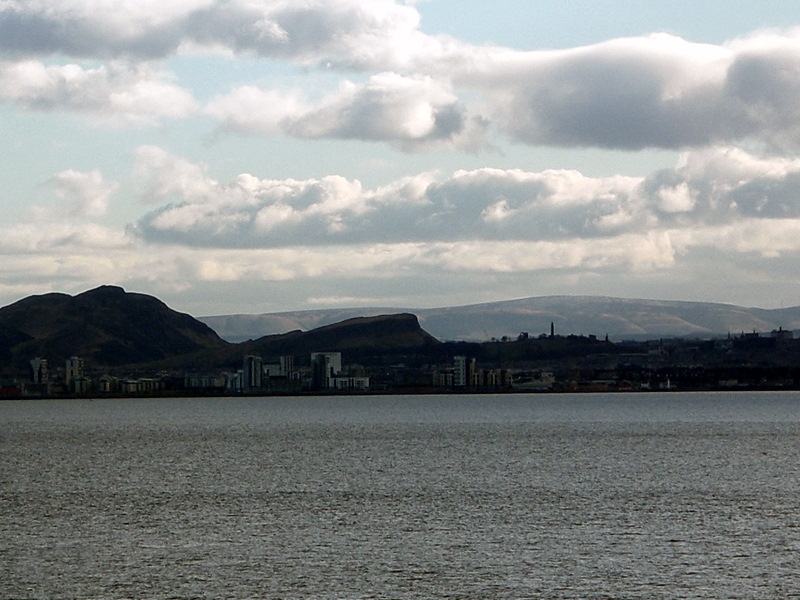
Arthur's Seat and the Salisbury Crags from Fife

Gazing out over the Firth of Forth to Arthur’s Seat and the dolerite and columnar basalt of the Salisbury Crags.  Like some striated, cosmic sombrero, angled and poised ready for take-off over the needle teeth of Edinburgh’s gothic spires. The castle nesting atop its volcanic plug.  In the foreground stands the stillborn Edinburgh Riviera a Ballardian monument to pre-credit crunch architectural and financial hubris.

Deep Time / City Time / Hubris Time

There is a solidity of presence to the Salisbury Crags that radiates over the Forth.  Layered custodian of the longue durée, deep time is encoded in these rocks.  Thoughts turn to James Hutton (1726-1797) amateur geologist whose pioneering discoveries, on these very stones, challenged two prevailing ‘scientific’ shibboleths. Firstly, the  notion of the Genesis creation myth which suggested that the earth was only a few thousand years old and secondly, the Neptunist theory that all rocks had precipitated from a single primordial ocean.

“the mind seemed to grow giddy by looking so far into the abyss of time.” [2]

I like the idea of Hutton’s work being rooted in direct observation of the rock layers that he could walk on, see, pick up, touch and feel. Open to the calling of the rocks and stones:

“The result, therefore, of our present enquiry is, that we find no vestige of a beginning,– no prospect of an end” [3].

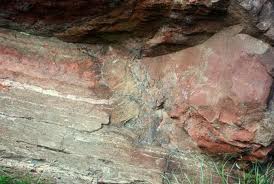
The Hutton Section

By observing what is now known as the Hutton Section, Hutton arrived at a theory that the Salisbury Crags ‘sill’ was formed when a much younger layer of fluid, hot magma intruded into older layers of sedimentary rock and solidified.  It is now known that this sill is at least 25 million years younger.  Hutton’s theory of ‘deep time’ was presented in his revolutionary Theory of the Earth, (1785), which proposed that Planet Earth was the literal bedrock of all history, long predating the appearance of the human and would endure long after they had gone. The age of the Earth is now believed to be 4.54 billion years old.

“Those of us who grew up in the sixties, when we put men on the Moon, now have to watch as every Republican candidate for this year’s presidential election denies the science behind climate change and evolution. That is a staggering state of affairs and it is very worrying,”

Professor Naomi Oreskes, University of California, San Diego. [4]


The train rattles along the coast between Aberdour and Burntisland. Over the shimmering Forth:

The space of the Crags

floods the imagination

singing their presence

of encoded deep time

and time yet to come.

a need to start from the ground

on which we stand.

more magma needed

Levitate the Crags!

Caravans at Pettycur Bay

As the train approaches Kinghorn on a bright morning, the sun reflects off the rows of caravans , draped like rows of emerald jewels on the hill above Pettycur Bay. Look seaward and it’s possible to see basking seals sunning themselves on the rocks.

Perhaps today? Tide is out.

When taking this journey, I am always alert to the possibility of a sighting of the fish “which they could find no name for”.

Daniel Defoe’s visit to Fife is recounted in Letter XIII of his A Tour Through the Whole Islands of Great Britain, published in 1724. At Kinghorn he observes how the men ‘carry’d on an odd kind of trade, or sport, of shooting of porpoises of which very great numbers are seen almost constantly in the Firth’. Defoe explains how the porpoises are brought on shore and their fat boiled off for oil, which they also do with other fish such as ‘grampusses, finn fish, and several species of the small whale kind’.  However, in one particular year, ‘there came several such fish on shore which they could find no name for’. Defoe records seeing eight or nine of these fish lying on the shore from ‘Kinghorn to the Easter Weems, some of which were twenty-foot long and upward’. [5]

It is intriguing to reflect that a well established sea trading community would be unable to name this mysterious fish? A surprise manifestation in a world already mapped, named and territorialized. Perhaps only nine of these creatures ever existed? Perhaps these were the last nine?

The train pulls into Kinghorn,

there they lie on the shore:

cut, boiled and rendered for oil.

the last ones.

Fifteen minutes from Kinghorn there are two petrochemical installations run by global energy giant ExxonMobil. Our train journey has meant we have seen neither. Sometimes the advantages of walking are abundantly clear.  On foot the psychogeographic receptors are more finely attuned.

©2011 Gazetteer for Scotland

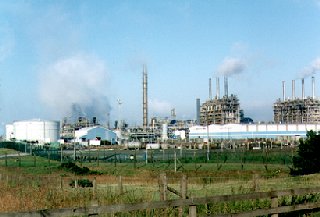
The Fife Ethylene Plant (“FEP”) at Mossmorran, near Cowdenbeath is one of the largest in Europe with an annual output of 830,000 tonnes. Initially, Brent – the largest oil and gas field in the North Sea UK sector – provided the gas feedstock, but with the decline of Brent production, gas from the Norwegian sector is now also used with 50% of feedstock coming from the Stratfjord and Goja-Vega fields. The natural gas is brought ashore at St Fergus, north of Peterhead and then travels to Mossmoran through a 222km underground pipeline. 12 million tonnes litres of water are pumped every day from Glendevon reservoir to generate steam used in the ethylene cracking process. Four miles away on the Firth of Forth, just west of Aberdour, lies the Braefoot Brae marine terminal where the ethylene is shipped to Antwerp and the rest of Europe.

All of these hidden entrails of energies radiate far and wide.

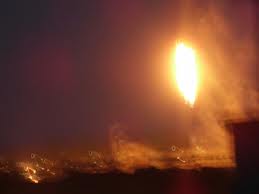
The Mossmorran flare is a well known local phenomenon, which can light up the sky like a surreal, Lynchian, ignited match diffusing its uncanny hue throughout night and day:

The Mossmoran flare

I live at the top end of Lochgelly and the noise keeps me awake most of the night. It sounds like constant thunder or a plane overhead. The roar is ridiculous and the constant light also disturbs my sleep. Through the day I have to keep all the windows shut to cut down on the noise but even with the windows shut you can still hear the constant roar. The flaring and the noise gives me sore heads and I just feel constantly ill with it. It’s ridiculous that we have to put up with this type of noise pollution. If I made that type of noise or a normal industry made that type of a noise I would soon find myself in trouble with complaints against me. How come they are being allowed to get away with this, year in year out. So much for the quality of life for the residents of central Fife”

Margaret. Lochgelly Resident [6]

“FEP is proud of its environmental record in both waste management and emissions”. [7]

ExxonMobil, 2010


Not really knowing where I’m going with all of this, I take a gander at the news headlines on Sunday morning 19th February 2012. I learn two things:

  • It is reported for the first time today that The ExxonMobil oil company has been fined £2.8 million for failing to report 33,000 tonnes of greenhouse gas emissions from the Fife Ethylene Plant at Mossmorran. It is the largest ever fine for an environmental offence in British history.
  • ExxonMobil is an active funder of the Heartland Institute whose mission is to: “discover, develop, and promote free-market solutions to social and economic problems”.  Global warming and climate change is a particular bête noir of Heartland and they make vociferous attacks against the environmental movement and scientists who support the evidence based claims for global warming. Their website features a list of ‘experts’ and  like-minded conservative policy think-tanks, many of whom have also received funding from ExxonMobil. [8]

©Iragerich

The burnt out train

lies mute

at Kinghorn station

the birds are silent.

just over there

 on the shore:

cut, boiled and rendered for oil.

Over the Forth

a faint pulse.

the Crags

are speaking.

more magma

needed

Levitate the Crags!

The local is always global

References:

1. Arthur Rimbaud, ‘Festivals of Hunger’, from Last Poems.

2. John Playfair, (1805), “Hutton’s Unconformity” Transactions of the Royal Society of Edinburgh V (III).

3. James Hutton, (1785), The Theory of the Earth, p. 304.

4. Professor Naomi Oreskes, quoted in ‘Attacks paid for by big business are driving science into a dark era’ The Observer, Sunday 19th February 2012.

5. Daniel Defoe, (1724),  A Tour Through the Whole Islands of Great Britain, (New Haven, Yale University Press, 1991 edition).

6. http://lochgelly.org.uk/2010/06/flaring-at-mossmorran/

7. Your Guide to the Fife Etylene Plant, (2010), brochure produced by ExxonMobil Ltd.

8. ‘Attacks paid for by big business are driving science into a dark era’ The Observer, Sunday 19th February 2012.

Now Playing: William Basinski – Disintegration Loops.

Happenstance – 1 (19.02.12 CE)

Scribbling away this morning and consulting Daniel Defoe’s A Tour Through the Whole Island of Great Britain.

Walking in the afternoon near the beach at Kinghorn, and thinking about Defoe’s visit which he recounts in Letter XIII.  Thoughts also turn to Alexander Selkirk who, not that far up the coast at Lower Largo, gazes out, projecting his own haunting presence into the psychogeographic mindscape.  If Selkirk was the inspiration for Defoe’s Robinson Crusoe, it is the ghost of Robinson who wanders and stalks through many a tract of the psychogeographic imagination. Witness Rimbaud’s supposedly derived verb robinsonner (to travel mentally, or let the mind wander) or the unseen and unheard researcher in Patrick Keiller’s films London and Robinson in Space.

Later on, in the afternoon, cooking the tea.  Stuart Maconie’s Freak Zone on as usual. A haunting over the airwaves:  The Robert Mellin Orchestra playing the soundtrack to The Adventures of Robinson Crusoe.  The particular track: (A) Drift.

Now Playing: Erstlaub – I Am the Line Drawn in the Sand Between the Living and the Dead

The Lundin Links Stones

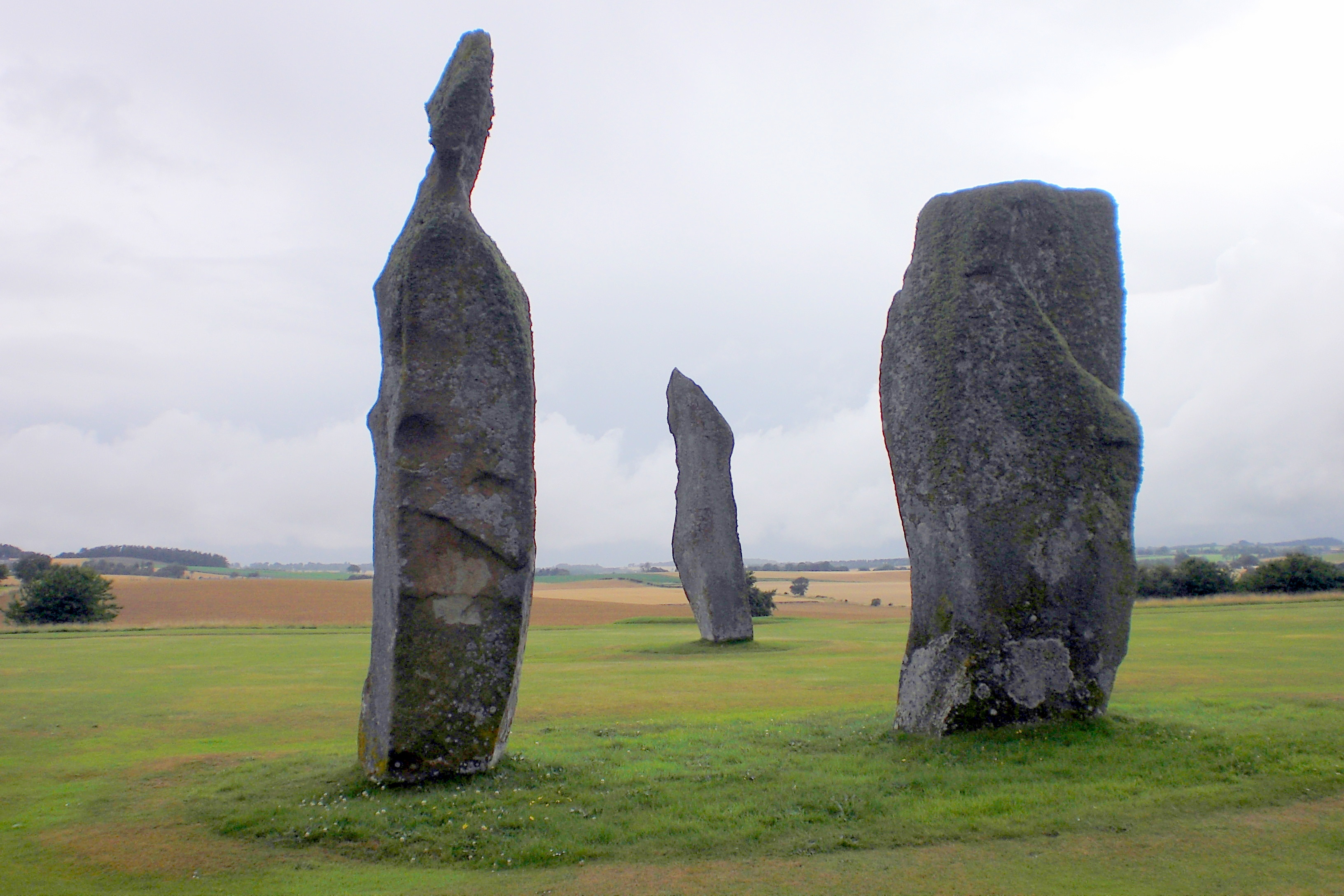
On the cover of Julian Cope’s album Rite is a picture of three colossal megaliths.  The human form giving some indication of the size and scale of this unusual grouping. Whether a function of crafted intent or the ageing process, the three distinctly shaped stones (especially the foregrounded ‘pin head’ or finger?) conjure up a strong sense of the uncanny when you see them up close.  Imagine my delight when I found out that these beauties, the remains of the largest of all the Scottish four-poster stone circles, are located in Lundin Links. Even more surreal is to find out they are presently located on the second fairway of a ladies golf course. It was a mild, drizzly day as I snaked along the A915, into the East Neuk. It was a bit of an opportunistic visit so hadn’t fully determined  the exact location of the stones. All I knew was that they were located on a golf course in Lundin Links.  Of course I hadn’t realised that there are two golf course in Lundin Links so initially stopped off at The Lundin Golf Club, which has the appearance of catering for the affluent, Edinburgh-on-sea weekenders who tend to congregate around this part of the coast at their weekend cottages. By this time it was a pretty dreich day so not a lot of people were around to ask.  I just set off, going on the basis that the size of these monsters should make them fairly easy to track down.  However, the landscape didn’t feel ‘right’. Largo Law was too far away, and the Lundin Club is right on the coast. Nonetheless I had an enjoyable saunter along the seaward side of the links, back towards Leven, watching the white breakers fizz on the shore.  I soon realised that this was not a landscape where sacred stones would be erected.  It was too windswept, open, and there was no relationship to Largo Law. Back I trudged, gazing up the coast and feeling the wind, spray and drizzle on my face. I had to be guided by the Law – what Julian Cope refers to (rather poetically) as a mother mountain – and set off once again in search of the stones. I soon found some signposts to the Lundin Ladies Golf Club and I could tell that this location was going to yield a more fruitful expedition.  I subsequently found out that Lundin Ladies is the oldest ladies golf club in the world (established in 1890) and is run completely independently by the lady members.  In the unreconstructed chauvinism of the typical male golf club, there was something quite radical and subversive about all this.  It was further confirmed when I asked two ladies who were loading their clubs into the car where I may find the stones and whether I need to seek formal permission to go and have a look.  They couldn’t have been more welcoming, and it was pleasant to observe their local accents and nay a set of pearls in sight.  As indicated, I crunched along the stone path to the starters hut and as soon as you turn the corner, you can see the stones way up the fairway in the distance. Once again, the starter was very welcoming and told me that there was no-one on the course so I could go and have a good look without worrying about any balls passing nearby. This time the land did ‘feel right’. A clear relationship is evident with Largo Law, and the stones nestle in the rolling foothills.  Notwithstanding the sand bunkers, tee boxes, and suburban sprawl on the south side, this still feels like a special place, and the light drizzle, absence of people and eerie quietness added to this.  As I walked up the edge of the fairway, the sheer size of the stones soon becomes apparent. These are towering monsters at thirteen, seventeen and eighteen feet high, with the finger/pinhead stone, twisting and pointing to the heavens, radiating a strange, seductive energy.  There used to be four stones, and apparently the fourth stone lay prostrate until around 1792 before it was no doubt removed for more utilitarian purposes. There is a local story that Michael Scot, the Wizard of Balwearie, summoned the demon familiars, Prig, Prim and Pricker to the sacred hill of Largo Law with a view to dismantling it.  As they began to dig, Scott had a change of plan and their single shovelful was thrown to create the nearby cairn of Norrie’s Law at the wonderfully named farm of Baldastard.  There is also a local story that a rich goldmine exists somewhere underneath Largo Law and that sheep have returned from grazing  on the foothills with golden fleeces. I guess that these stones must be one of the best kept secrets in Fife, (Scotland?) and yet as a site for experiencing the uncanny, difficult to surpass. I can understand that the good ladies of Lundin Links do not want hordes of trampling visitors all over their gold course, so perhaps there is something poetic that they remain available to the seeker and yet are well looked after and protected by the Lundin Ladies, drawing energy from their mother mountain. I wonder if it helps their golf? Thanks to Julian Cope’s magisterial The Modern Antiquarian. Now playing: John Barleycorn Reborn: Dark Britannica, V/A.