The opening address by Phil Smith (aka Crab Man, aka Mythogeography), is a fascinating and thought-provoking missive on the state of psychogeography and the walking arts today. You can read, download and share it here:
Also check out Phil’s Mythogeography website – ‘an ambulatory goldmine’ and his books published by Triarchy Press.
≈≈≈
One of the points Phil makes is the need to rethink the drift on a smaller scale. In the gaps, in the smallest fractures, in small disruptions to personal routines; the late running of a train that allows you a few minutes to explore the hinterland around a station.
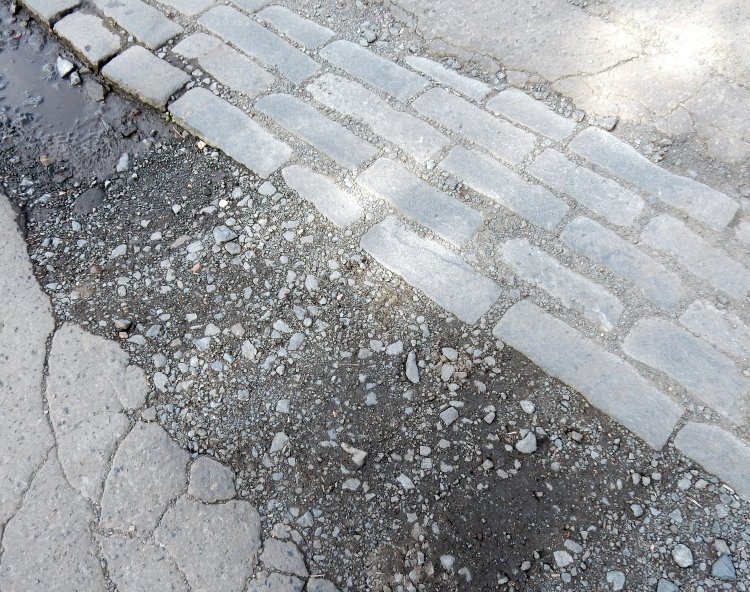
A recent personal example was the unexpected distress visit to a garage when a section of exhaust pipe fell off the car. Whilst the new part was being sourced and fitted, a short walk around the immediate environs:
Crack-
ed slab scree
c o b b l e s
c o b b l e d
in p O O l
-ing light
≈≈≈
Now playing: The Soft Machine – s/t (with a nod to Boyle Family).
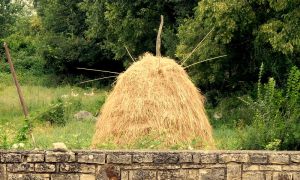
No neatly packaged hay bales in the uncanny rural. Creatures of twilight, sit hunched in the corner of smallholdings, backs turned. In fading light, walking past these halo-skewered field dwellers: was that a lengthening shadow? a sigh? a suggestion of movement?
IV
They would appear in the adjoining field at around 7.00pm each evening. A symphony of bells heralding their arrival. We never did see where they came from. They would feast in the field for around half an hour, a clanking cacophony of movement. Occasionally, one would come over to eye us up, usually the smallest with the highest pitched bell. Curious young eyes stared us out. Yet, these eyes tapped into something much older. Some fundamental rhythm of the land. Jaws rotating in perpetual motion and then, as they do, leaping into the air as if the earth had administered an electric shock to their hooves. A display of exuberance and delight in contrast to the slow, deliberate movements of the herd elders. They kept their heads down, chewing, chewing, chewing. After a cycle of time, which we were not party to, the deepest, most sonorous bell started to sound out a rhythm. The largest goat of the herd was calling time and starting to amble away. Gradually, the other goats began to follow, bells around their necks congealing into a moving mass of sound. A few short explosive trills as the stragglers ran to catch them up. We watched as the herd turned a corner and listened as the bells faded into the distance.
V
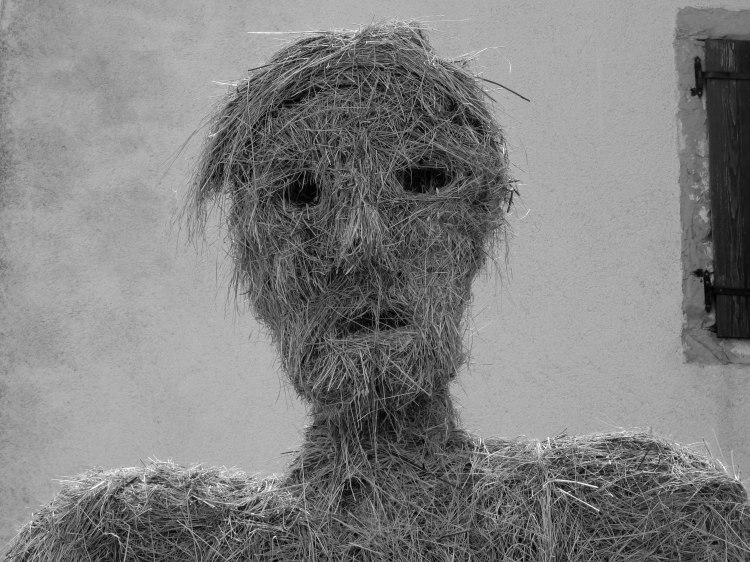
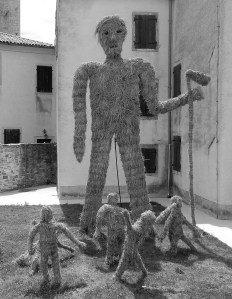
A visit to the small hilltop town of Motovun and very surprised to meet this straw giant and his dancing acolytes. Staring us out with his silent gaze, he must have been over twenty feet tall, At his feet, some folk ritual or dance taking place, arms thrown open to embrace the sun. Something of the Wicker Man about it all.
As far as I could find out, his name is Veli Jože, a giant who lived (lives?) in a local truffle-rich forest. Local stories suggest that he has been known to enter the town and physically shake the church tower to sound the bell.
To reach Motovun, it is a steep walk up the hillside to reach the town perched on top. Whilst not religious, was touched by the care and beauty displayed in the construction of this minimal roadside shrine.
Motovun sits is on a hill in the Mirna valley and evidence of human settlement dates back to prehistoric times when it would have been surrounded by water. The river Mirna is Istria’s longest river and legend has it that Jason and the Argonauts fled down the estuary after having captured the Golden Fleece.
.
VI
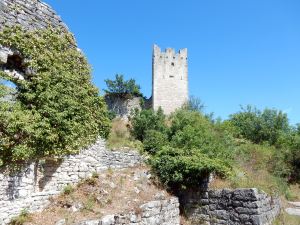
Another hill-top town, this time with a twist. Dvigrad is a relatively well-preserved mediaeval ghost town in the Draga valley. The population was initially decimated by the Black Death in the 16th century and finally abandoned completely in the early 1700s. As the town was unoccupied, it was spared from the destructive ravages of war which were a constant feature on the Istrian peninsula. Today, the town gates still exist, and it is possible to walk around the town walls. The defence tower still rises to cut the blue sky and interior room structures of the 200 odds houses are clearly visible.
.
VII
Aura of the town walls: return of the gaze:
To perceive the aura of an object, we look at, means to invest it with the ability to look at us in return … when this expectation is met … there is an experience of the aura to the fullest extent.
Walter Benjamin
.
VIII
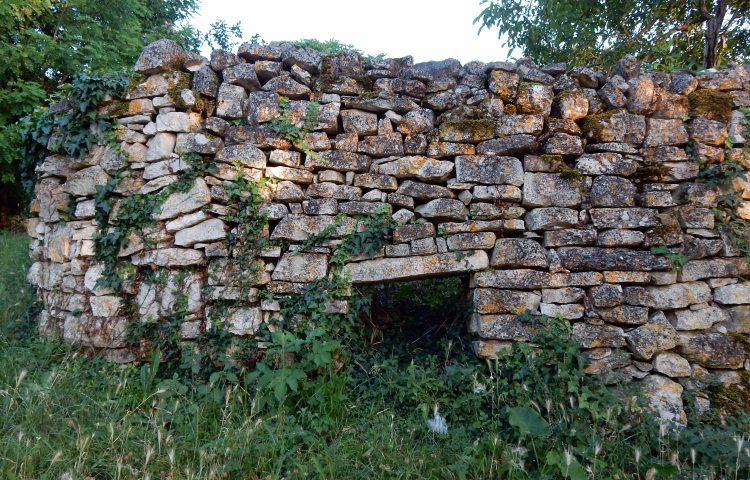
Amongst the networks of rural paths and tracks.
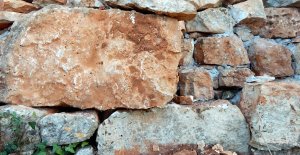
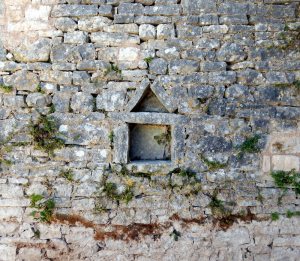
Always the walls:
Stacked
Held
Holding
.
IX
Entropic Futures.
An alien structure in the rural landscape:
the new, never having ever been.
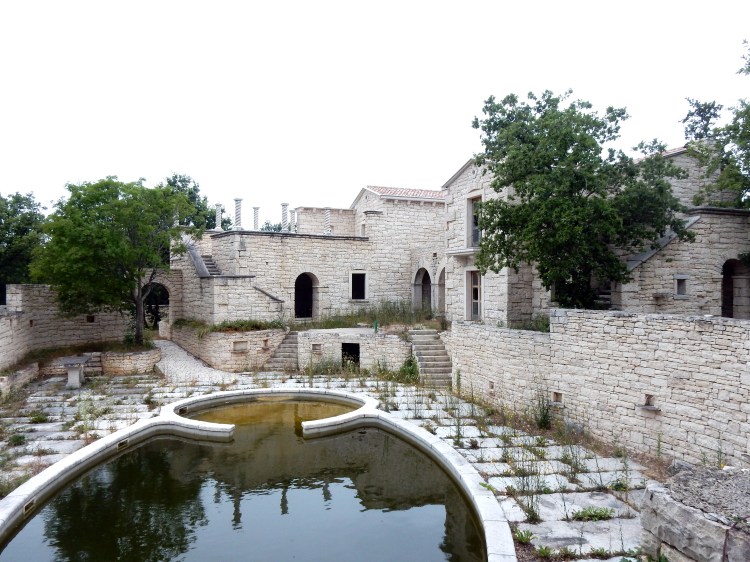
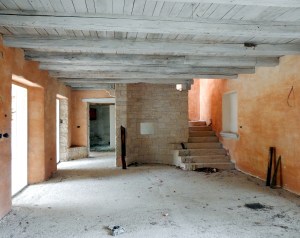
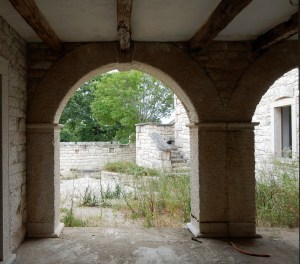
We were staying on the Istrian peninsula in what could best be described as an agricultural hamlet, mostly comprised of smallholdings and cottage style dwellings. These were all constructed in a similar style with what looked like local quarried stone. A network of paths and tracks connected up to other nearby hamlets which were also of a similar architectural style. When we stumbled across the half completed building above, it looked as alien to its surroundings as finding a mountain bothy in the middle of Las Vegas.
The scale of the building was completely out of proportion to anything else locally. The pick and mix collision of architectural styles created a bizarre postmodern mash-up with a tear shaped swimming pool or fish pond, bizarre minaret style columns half-built on the roof and Italian style interiors. What was clear, was that the building was the new that had never been. We wandered around the half completed rooms, bare wires hanging out of walls, yet opulent installed marble bathrooms. Work had clearly stopped some time ago with the extensive grounds already starting to be reclaimed by nature. It was as if we had walked into the film set of a Ballard adaptation, where the crew had disappeared.
Of course we had to construct some sort of narrative as to what had happened here. Ms A came up with the one that we settled on. The remote location, stilted opulence and rather garish tastes indicated that this could have been a low-key hideaway for some gangster or Mafiosi. Work on the property was well underway when they were either rubbed out, banged up, or cleaned out of money, leaving this rural fun palace to slowly begin to merge back into the Croatian countryside. The new that had never been.
.
X
Walking a line
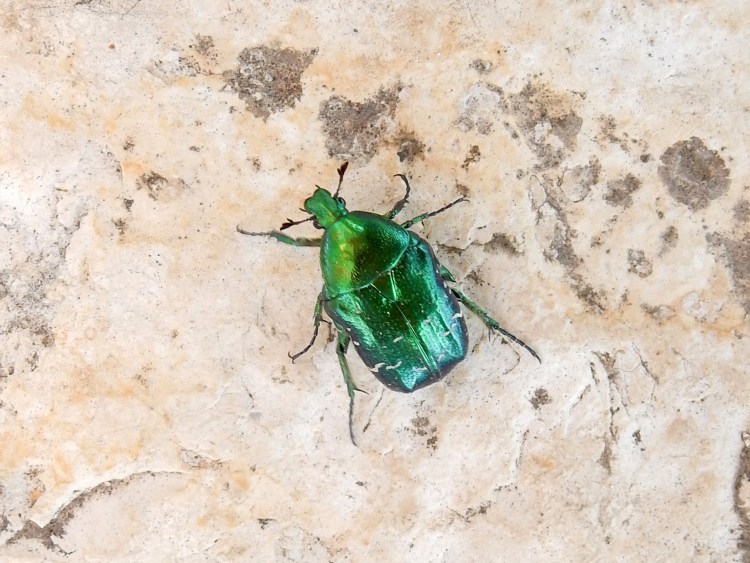
an iridescent alchemist
pulls the sun
across the sky
.
XI
XII
That night, an absence of city light and gravity. We fell from earth, lost our breath, immersed in that plunge pool of dark sky. We learned to gather stars, eat planets for sustenance, grab comet tails to move. The dawn light made us heavy again. We fell back.
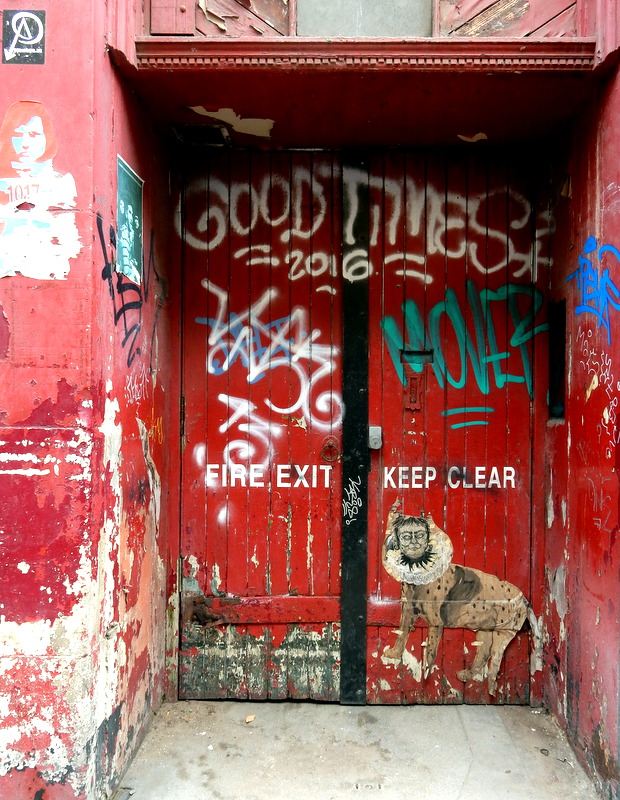
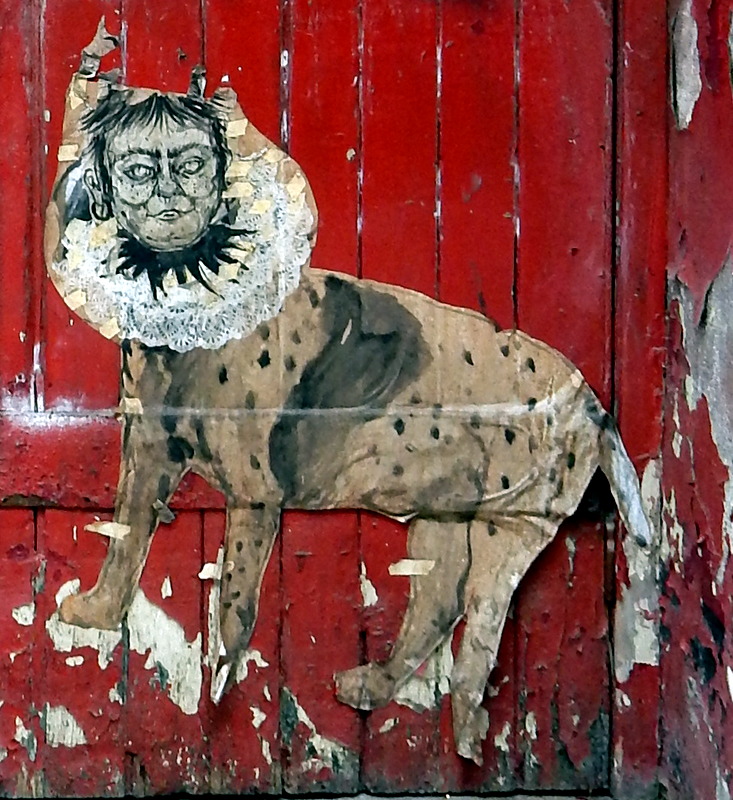
Perhaps just another graffiti strewn doorway but the phrase “Good Times = 2016 =” called out. I doubt that there are many people I know who would readily conflate 2016 and ‘good times’. So just a throwaway action with a spray can? irony? a small act of resistance?
Possibly it was just a coincidence but passed this doorway during the Edinburgh Festival. A time when the city opens its arms to the world in a celebration of all the performing arts, bringing together audiences and artists. Just walking the streets, soaking up the creative energy can bring sustenance. Good Times indeed.
And what about that figure on the bottom right?
Now playing: King Champion Sounds – To Awake in That Heaven of Freedom (Thanks to Teesside Psychogeography for altering me to this. Check out their excellent blog Smell of Water).
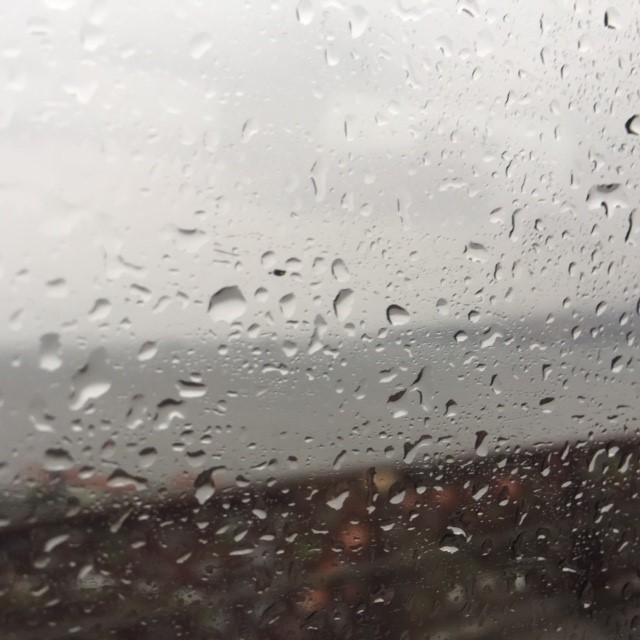
Passing, at speed, on a train through the three red diamonds of the Forth Rail Bridge. The eye drawn to the foreground. Shards of red-painted steel, morph and distort, through shifting prisms of wind-scattered raindrops. The Firth of Forth, a grey blanket folded at the horizon beneath a brightening sky.
The commuters scurrying down the stairs at Rosyth Halt railway station, are unlikely to give much thought, if any, to the field on their left as they descend to the platform below. Some may notice subtle changes in colour throughout the year. The recent appearance of yellow broom blossom; the overhead sun creating a dappled patchwork of greens, sandy browns and heathery purple. In a few weeks, the hawthorn blossom will sit like scented snow on the ancient hedge.
Standing at a certain part of the station platform, it is possible to hear the gentle purr of the Whinny Burn tracing its route through the field on its way to the River Forth at Inverkeithing Bay. Magpies, rooks and collared doves appear to take a curious interest in the arrivals and departures of station commuters whilst overhead, the sun splinters around the extended wings of a buzzard soaring like Icarus ever higher into the blue.
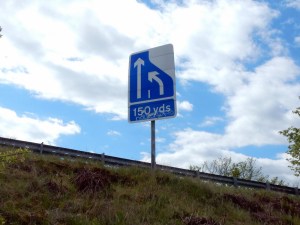
The field is now bounded on all sides by motorway, dual carriageway and the railway line. A severed island of abandoned agricultural land cast adrift with no easy public access. At the top of the halt steps, there are no particularly distinguishing visual features as we look over the land which we are going to walk through. As a train arrives at the platform below, a late flurry of commuters hurl themselves past us and down the stairs to squeeze into the carriages before the doors close. Most are unlikely to be aware that there may be as many as 2,000 bodies buried somewhere in the vicinity.
The fields between the railway and the A823 (were) where the last and bloodiest part of the battle took place … it is likely to be where the majority of the killing took place. (Historic Scotland).
it is said that the burn ran red with blood for three days.
The casualties on the Scots side were certainly heavy. Most sources agree that about 2,000 were killed and around 1,500 taken prisoner, although various figures are reported for the casualties of the Highland regiments. Cromwell in his letter immediately after the battle reported at least two thousand dead.
July 1651
It was during the night or early morning of 16th /17th July 1651 that the troops of Oliver Cromwell’s New Model Army landed on the north shore of the Forth in the vicinity of Inverkeithing Bay. Whilst they had inflicted a heavy defeat on the Scottish army at Dunbar on 3rd September 1650, they had been thwarted by attempts to advance further into Scotland. Cromwell came to the conclusion that Fife was the key and by 20th July, 4,500 of Cromwell’s Parliamentarian force were dug in on Ferry Hills, whilst a Scottish force of a similar size had grouped at Castland Hill. The threat of Scottish reinforcements coming from Stirling provoked Cromwell’s Parliamentarians to attack and force the Scottish infantry to retreat north towards Pitreavie Castle. On land close to Pitreavie Castle, the Scottish infantry made a final stand but were soon overwhelmed by the more experienced Parliamentarians who had the additional advantage of cavalry. The Scots suffered heavy losses. This became known as The Battle of Inverkeithing (sometimes The Battle of Pitreavie) and was the last major battle of the Wars of the Three Kingdoms in Scotland. From 1652, Scotland was wholly under control of Cromwell’s Protectorate.
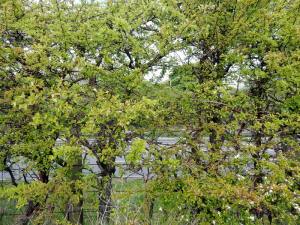
Entering the field is not too difficult. Not far from the station steps there is a locked gate but a little further along we find a gap in the hedgerow. If you are prepared to navigate or slide down a steep slope, this will deposit you amongst the discarded plastic bottles and assorted rubbish tossed from the stairs above. At ground level, the topography of the field is much more apparent. Pronounced undulations ahead of us, sloping off to the right towards marshy ground around the Whinny Burn. Ground cover is a mix of meadow type grasses, whin bushes, dandelions and what look like dock leaf plants gone to seed.
You only have to look towards the perimeter of the field to be aware that you are surrounded by human presence. The rooftops of Rosyth to the right and the hum of motorway traffic a constant low-level signal. Yet on the actual land we are walking, it is rare to find an almost complete lack of evidence that humans have recently passed. No litter, no discarded cans or bottles or burnt out barbecues. There are hints of desire lines traversing the space, perhaps made by committed dog walkers or something else. It is only as we move further into the field, that there is a clear sense that we are being watched.
At first, we wonder if it is a dog but it soon becomes apparent that it is the eyes of a tiny roe deer that are fixed on our movements. We are both probably equally surprised to encounter each other. This is not an area where you would typically expect to see deer. Where on earth has it come from? We lock into that non-time state of reciprocal, motionless, staring. Eventually the deer decides to break for it. Great elongated leaps for something so small; as if bouncing off the air itself, not really touching the ground. I manage to retrieve the camera and fire off some random shots in the hope that we obtain some record of this actually having happened.
as if bouncing off the air itself
We notice our presence is also alarming a number of skylarks which appear to have made the field their own. Their nervous, vertical flight and fluted song a mix of terror and beauty as we try to avoid what must be their nesting areas.
The field separates in two at a ridge of hawthorn bushes. On the other side:
From a distance
criss-cross
to new horizons
A field of time
history layered
on geography.
Transparent globes
of wind held tension
time scattered
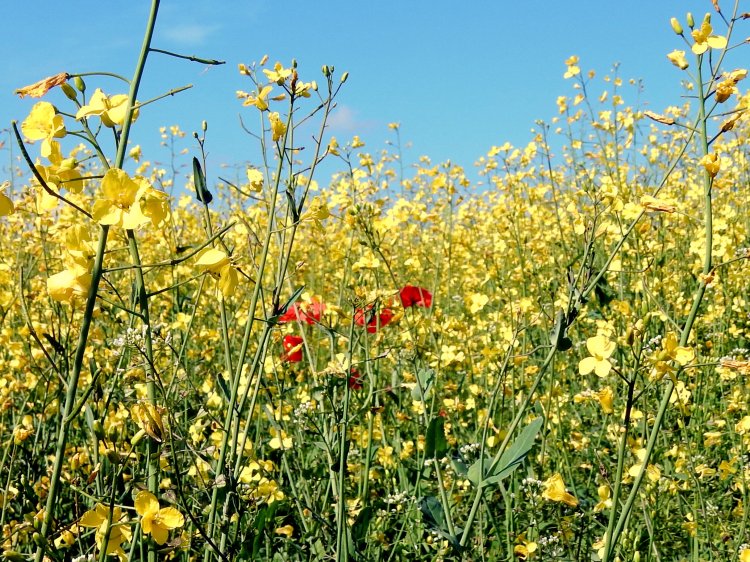
yellow flowerings
of the eternal return
The field eventually tapers to a point where we can go no further, blocked off by the railway and the smooth, solid concrete structure carrying the A823 motorway spur.
We know that beyond the A823 another field will take us to a concrete flyover of the M90 motorway. We work out a way to access the field and head off on a detour. Our serendipitous findings are recorded in a separate blog: Cartographies of Chance – Underneath the M90 (II).
Returning to the field, we walk close to the northern perimeter with only a thin hedgerow between us and the A823. Such a slight threshold separating us from our field of time, skylarks and deer. On the other side, the surveillance cameras, crash barriers, lay-bys and signs – all the material apparatus of the modern motorway.
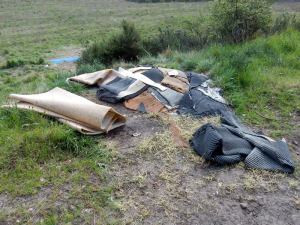
We are quite surprised to come across a footbridge over the motorway that enters the field only to stop at a complete dead-end. The proximity of this easier access results in the usual heaps of fly tipping, something that is hard to understand. It must be much more difficult to dump this stuff here than take it to the municipal waste recycling.
Place and non-place are rather like opposed polarities: the first is never completely erased, the second never totally completed . . . But non-places are the real measure of our time.
Marc Augé
The footbridge takes us over the A823, (Why does an empty motorway always evoke a Ballardian descriptor?) and into the relatively new ‘non-place’ of Carnegie Campus. We know from the old maps and records that this land was also once part of ‘the field’. Being a Sunday, the ‘campus’ is completely deserted as we wander amongst the new build office blocks, many of which still look unoccupied. Roundabouts appear to have been built in hope of a time still to come as roads come to an abrupt end. Rab’s Little Kitchen snack van is closed.
Where the manicured non-space runs out, an explosive wild bouquet of whin sits amongst a covering of red campion:
And yet amongst all the shiny new sheen of this place, older voices intrude. A hexagonal brick structure whose original purpose is unclear:
time stacked textures
brick and concrete
.
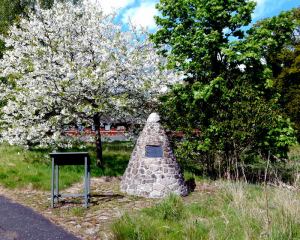
Nestled in at the side of the main road into the campus we come across the cairn. As far as we are aware it is the only explicit acknowledgement of what happened on this land.
the Scots were driven back to the level ground between Hillfield and Pitreavie. Here, in one of the most famous episodes of the Battle of Inverkeithing, the Clan Maclean of Mull regiment, commanded by their chief, Sir Hector, found themselves surrounded by superior enemy forces. The clansmen fought fiercely in defence of their chief, calling out, “Fear eile airson Eachainn!” (Another for Hector!), as they sacrificed themselves.
The battle involved musketry, cavalry, pikes, swords and even archery on the Scottish side, with considerable hand to hand fighting
Near here, Sir Hector MacLean of Duart was killed
at the Battle of Inverkeithing
along with some 760 of his men
20th July 1651
“Another for Hector”
Nearby to the cairn, stands another material presence in the layered history of the field. Peering over a substantial stone wall allows us a view of the Dovecot in the grounds of Pitreavie Castle.
Pitreavie Castle was originally built in the early 17th century by Henry Wardlaw of Balmule, later Sir Henry Wardlaw, 1st Baronet of Pitreavie. Wardlaw was Chamberlain to Queen Anne, wife of James VI of Scotland.
The Battle of Inverkeithing/Pitreavie was fought nearby on 20 July 1651, between an English force commanded by Colonel Robert Overton and a Scottish force, including some 800 Highlanders from the Clan Maclean. After the battle, which was a decisive victory for the Cromwellian forces (contemporary reports speak of 2,000 Scots killed and 1,600 captured, all for the loss of 8 of Overton’s troops), a group of Macleans sought refuge in Pitreavie Castle. The Wardlaw family refused them sanctuary and the Macleans were likely to have been captured or killed.
The Maclean dead … are more likely to have been buried in a mass grave.
We pass the old dovecot of the castle, turn left and past the front door where the initials of Henry Beveridge are recorded. Beveridge purchased the Castle in 1883 and extensively remodelled it in 1885.
Henry Beveridge was a wealthy mill-owner, philanthropist and educator from Dunfermline. He was an associate of Patrick Geddes having attended Geddes’s summer meetings in Edinburgh. He subsequently became one of the Directors of Geddes’s Edinburgh Town and Gown Association in 1896. As a member of the Carnegie Dunfermline Trust, Beveridge was also partly responsible for arguably Geddes’s greatest work – City Development: a study of parks, gardens and culture institutes. A report to the Carnegie Dunfermline Trust. Geddes also introduced Beveridge to the artists John Duncan and Charles Mackie who painted murals in the castle illustrating the legend of Orpheus and Sir Patrick Spens.
International Studio, 1897
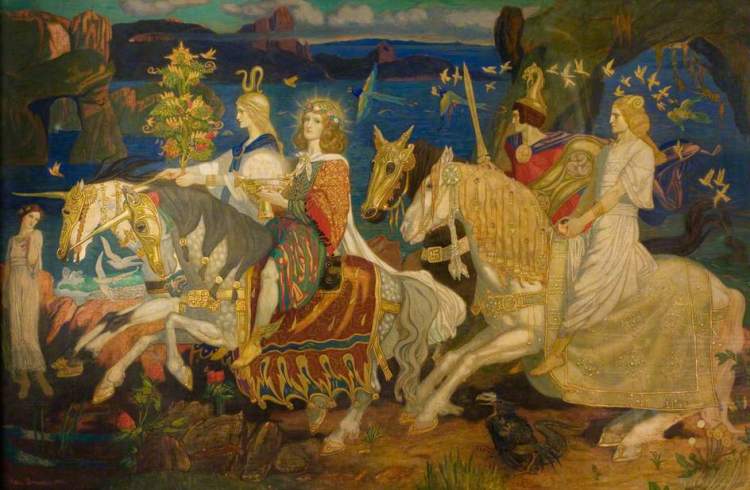
It is believed that these murals may now be at best over-painted and at worst destroyed. A good example of John Duncan’s Symbolist style can be seen in his famous work, The Riders of the Sidhe:
As noted above, Henry Wardlaw’s granddaughter-in-law, Elizabeth Wardlaw, is claimed to be the author of Sir Patrick Spens. (Although the evidence appears somewhat tenuous).
“The king sits in Dunfermline toune drinking the blude reid wine, “O whar will I get a guid sailor, To sail this schip of mine?”
…
Walking past Pitreavie Castle today, it has now been converted into flats and apartments and offers no clue as to another more recent past life. It was bought by the Ministry of Defence in 1938 and after the second world war, deep in a basement bunker became the headquarters of NATO’s Northern Maritime Region. During the Cold War, all Soviet ships and submarines on exercise in the North Sea were monitored from here. The base closed in 1996 and operations moved to RAF Kinloss. There is little or no outward trace of this today, although some photographs of its past life exist:
Access to the underground bunker
(c) Subterranea Britannica
The teleprinter room 1944
(c) Subterranea Britannica
As we head along Castle Drive, we notice that a small housing estate has a story hidden in the street names:
Covenanters Rise: The Scottish army was a Covenanter army, acting under allegiance to Charles II.
MacLean Walk: the aforementioned Sir Hector Maclean of Duart, commander of the Scottish Highland infantry.
Sir John Brown Place: Sir John Brown, commander of the Scottish lowland infantry.
Overton Crescent: – Colonel Robert Overton led the assault party of New Model Army troops that landed in Fife on the night of 16th/17th July.
Our final part of the walk will take us along Castle Drive where we will loop around to bring us back to where we entered the field. Despite the changes over the centuries, we have walked the area of the field as it was in 1657. We continue to ponder our mysterious encounter with the roe deer. Perhaps a manifestation of “only shadows here”?
Four days after the Battle, Cromwell crossed to Fife in person. For him the victory was “an unspeakable mercy”.
As we walk down Castle Drive we pass another new addition to the landscape on the left. A customer contact centre for Rupert Murdoch’s Sky empire.
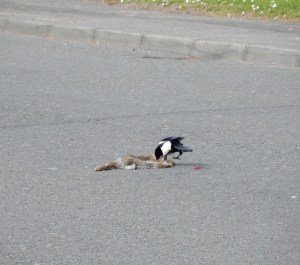
On the other side of the road, a magpie picks at the carcass of a dead squirrel.
≈≈≈
Appendix
Present day map showing the boundary lines and key sites of the Battle of Inverkeithing. (Historic Scotland/Ordnance Survey).
Now playing: June Tabor – ‘Sir Patrick Spens’ from An Echo of Hooves.
or a more jaunty version: Fairport Convention – ‘Sir Patrick Spens’ from Full House.
References:
Marc Augé, Non-places: Introduction to an Anthropology of Supermodernity (London and New York: Verso, 1995).
Charles Holme (ed), The International Style, Vol. 1 No. 1 (New York: The Bodley Head, March 1897).
Helen Meller, Patrick Geddes: Social Evolutionist and City Planner (London and New York: Routledge, 1993).
Wisława Szymborska, Map: Collected Poems and Last Poems (Boston and New York: Mariner Books, Houghton Mifflin Harcourt, 2016).
Ben Wheatley Dir. A Field in England (Film4, 2013). Film.
Area Combined HQ Rosyth – Pitreavie Castle (Flag Officer, Rosyth, RN & AOC No 18 Group, RAF Coastal Command) on Subterranea Britannica
The Inventory of Historic Battlefields – Battle of Inverkeithing, Historic Scotland, 14th December, 2012.


































 Murdo Eason - From Hill to Sea