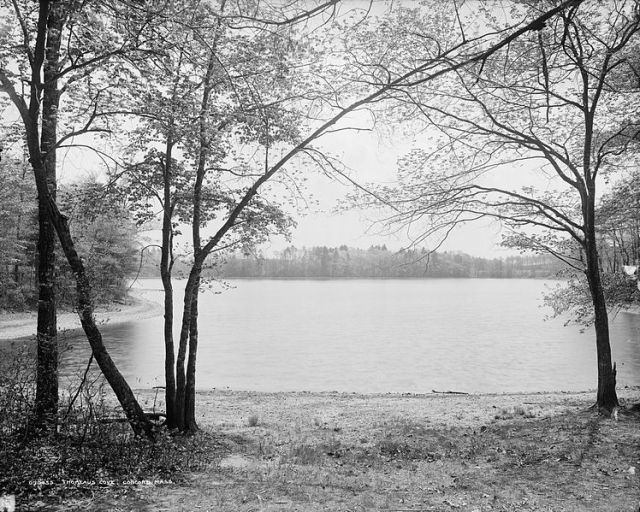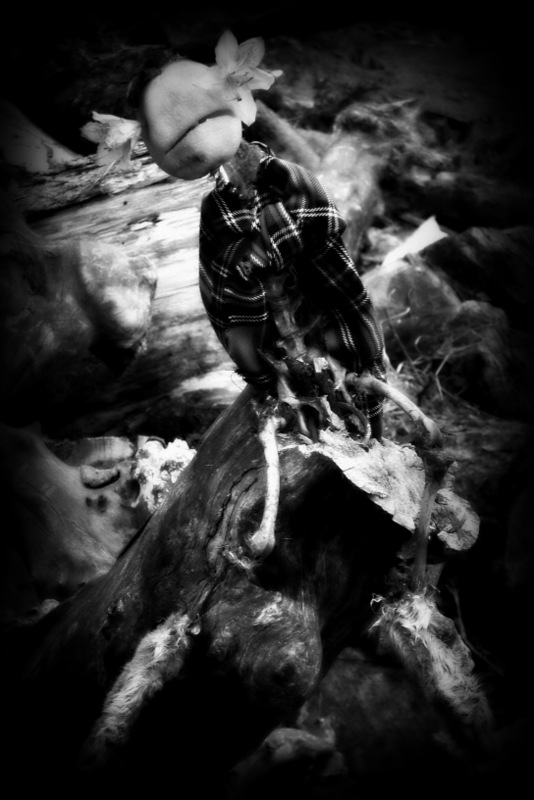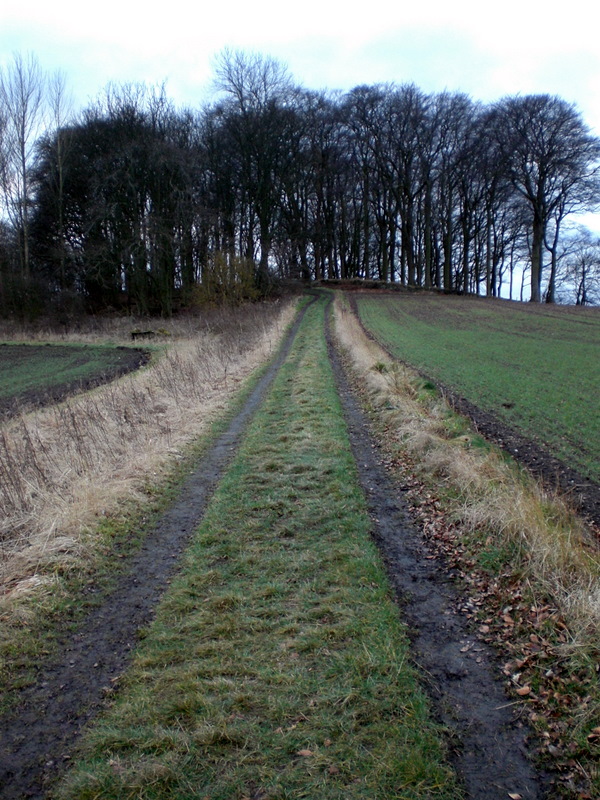
Through fence and over field, to beyond the hem of trees.

through fence

and over field – to

beyond the hem

of trees.

Thanks to all who have taken time to read any of the postings this year. It has been much appreciated and a delight to interact with so many creative and interesting folk. Whether you chose to celebrate, or not, best wishes to all for a peaceful and enjoyable week and onwards to new openings and possibilities for Year 2013.

And just having a look at what Henry David Thoreau was writing in his journal on 24th December 1841:

I want to go soon and live away by the pond, where I shall hear only the wind whispering among the reeds. It will be success if I shall have left myself behind. But my friends ask what I will do when I get there. Will it not be employment enough to watch the progress of the seasons?

http://commons.wikimedia.org/wiki/File:Walden_Pond.jpg
Walden Pond

Now playing: Jan Bang, Erik Honoré – Uncommon Deities. (With David Sylvian, Sidsel Endresen, Arve Henriksen, John Tilbury & Philip Jeck).

Reference:

The Journal, 1837-1861 by Henry David Thoreau; preface by John R. Stilgoe, edited by Damion Searls (New York: New York Review Books classics, 2009).

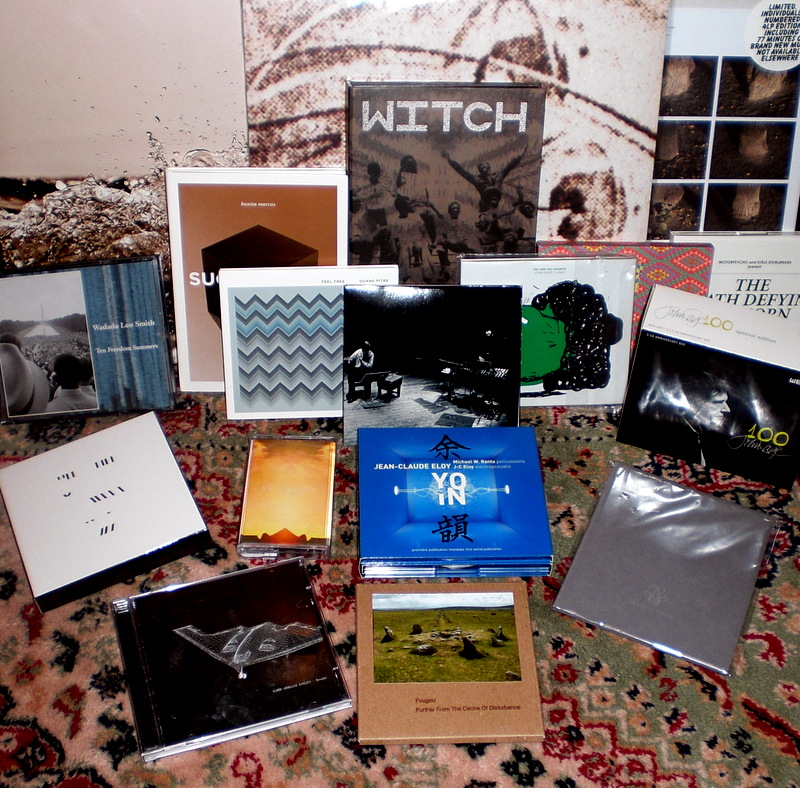
Selected Soundtracks 2012

Our soundtracks of 2012 have been characterised by works of substance:

– the long take and the inner journey

– sounds captured at the threshold of perception

– sounds that affect the body

– sounds to dwell in

– sounds to travel in.

♦♦♦

Our top 30 in alphabetical order:

AlogUnemployed (Rune Grammofon) (Full 4xLP version)

Oren AmbarchiAudience of One (Touch)

Oren AmbarchiSagittarian Domain (Editions Mego)

Oren Ambarchi and Thomas BrinkmannThe Mortimer Trap (Black Truffle)

John CageJohn Cage 100 Box (Wergo)

Don CherryOrganic Music Society (Caprice) (Reissue)

Sidsel Endresen & Stian WesterhusDidymoi Dreams (Rune Grammofon)

Jean-Claude EloyYo-In (Hors Territoires)

ErstlaubMarconi’s Shipwreck (Broken20)

Morton FeldmanCrippled Symmetry: At June in Buffalo (Frozen Reeds)

FougouFurther From the Centre of Disturbance (Greengage Sounds)

Hallock HillThe Union | A Hem Of Evening (MIE)

Thomas KönerNovaya Zemlya (Touch)

Gregg Kowalsky and Jozef Van WissemMovements in Marble and Stone (Amish)

Brian LavelleThe Night Ocean (Dust, Unsettled)

Locrian and MamifferBless Them That Curse You (Profound Lore)

Bunita MarcusSugarcubes (TESTKLANG)

Now Wakes the SeaHot Cygnet Tape (The Geography Trip)

Duane PitreFeel Free (Important Records)

Porter RicksBiokinetics (Type) (Reissue)

Eliane RadigueFeedback Works 1969-1970 (Alga Marghen)

Akos Rozmann12 Stationer VI (Ideologic Organ)

Richard SkeltonVerse of Birds (Corbel Stone Press)

Sleep Research FacilityStealth (Cold Spring)

Wadada Leo SmithTen Freedom Summers (Cuneiform Records)

Jakob UllmannFremde Zeit – Addendum (Edition RZ)

Mika Vainio / Kevin Drumm / Axel Dörner / Lucio CapeceVenexia (PAN)

Stian WesterhusThe Matriarch And The Wrong Kind Of Flowers (Rune Grammofon)

WITCHWe Intend to Cause Havoc (Now Again) (Reissue)

Nate WooleyThe Almond (Pogus)

♦♦♦

And a further fiery five of fun:

Elephant9 With Reine FiskeAtlantis (Rune Grammofon)

GoatWorld Music (Rocket Recordings)

Motorpsycho and Ståle Storløkken – The Death Defying Unicorn (Rune Grammofon)

Oren Ambarchi / Fire!In the Mouth – A Hand (Rune Grammofon)

Neil Young with Crazy HorsePsychedelic Pill (Reprise)

♦♦♦

Live Highlights:

Afternoon Tea (Ambarchi/Fennesz/Rowe/Rehberg/Pimmon) – HAU2, Berlin

Be a Hobo, The Music of Moondog – Carnegie Hall, Dunfermline

John Cage @ 100 Concert – John Tilbury, RSNO, Ivan Volkov, City Halls, Glasgow

The Fall – The Arches, Glasgow. (On the basis that any Fall gig that is not a complete car crash these days is a highlight)

Morton Feldman, Coptic Light and Charles Ives, The Unanswered QuestionRSNO, David Robertson, Usher Hall, Edinburgh

Morton Feldman, SQ2 – The Smith Quartet, City Halls, Glasgow

Tim Hecker – Pilrig St Paul’s Church, Edinburgh

Archie Shepp – Summerhall, Edinburgh

Patti Smith – ABC, Glasgow

Supersonic Festival – The Custard Factory, Birmingham

Now Playing: Bee Mask – Vaporware/Scanops

On Samhain

The moon gazed on my midnight labours, while, with unrelaxed and breathless eagerness, I pursued nature to her hiding-places.

Mary Shelley

at the cusp of light and darkness

through veil of in-world and out-world

they arrive.

~~~

And if in Edinburgh look to the skies:

Witches over Edinburgh
Witches over Edinburgh (1923).

Endpiece from Dramatisations of History: The Masque of Ancient Learning and Its Many Meanings by Patrick Geddes, Edinburgh: Patrick Geddes and Colleagues, (1923).

Now Playing:  Rhys Chatham – A Rite for Samhain (From The Bern Project).

Of Walking in Ice – Werner Herzog, Kenneth White and Liminal Pilgrimage

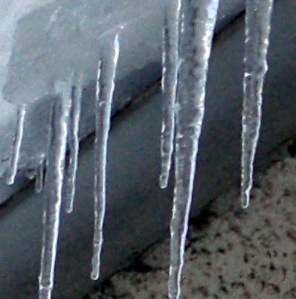
Ice

If I actually make it, no one will know what this journey means.

I’m following a direct imaginary line.

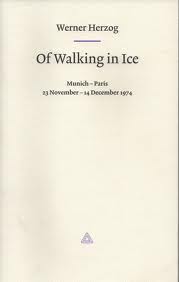
Werner Herzog’s Of Walking in Ice is arguably one of the great texts of existential walking and pilgrimage.  A short diary, never intended for publication, all is reduced to the (a)lone figure of Herzog moving through a landscape, trying to cope with a litany of physical discomforts and atrocious weather conditions which write themselves on his body.  If psychogeography is an increasingly used, abused, and slippery signifier, it is clearly absent from Herzog’s practice. There are no dérives here. This is walking as an act of resistance against the ultimate inevitability of death and as a process to absorb and internalise the landscape rather than make any attempt to open up and engage with it. This is an immersion into the mind and soul of the “I” pitted against malevolent nature that cares little for humankind.

I set off on the most direct route to Paris, in full faith, believing that she would stay alive if I came on foot. Besides I wanted to be alone with myself.

In November 1974, Herzog received a telephone call from a friend advising him that the Of Walking in IceGerman film critic Lotte Eisner was seriously ill and would ‘probably die’.  She was 78 years old.  Herzog responds: “I said that this must not be, not at this time, German cinema could not do without her now, we would not permit her death”. As an act of secular faith, he decides to walk from Munich to Paris and strides out on what turns out to be a three-week odyssey. Armed only with a jacket, compass, duffel bag, new boots (!) and some survival money, Herzog sets out from Munich on 23rd November and eventually arrives in Paris on 14th December. Along the way, he endures increasingly intense levels of physical discomfort, shelters from the hostile weather in chapels and farm buildings, breaks into unoccupied houses to sleep and gradually withdraws and tries to avoid any prospect of human contact:
Then snow, snow, rainy snow, snowy rain; I curse Creation. What for? I’m so utterly soaked that I avoid people by crossing sodden meadows, in order to save myself from facing them.

Rain, rain, rain, rain, rain, only rain, I can’t recall anything more. It’s become a steady, even drizzle and the roads become endless.

The soles burn from the red-hot core in the earths interior.

In spite of all the physical ailments that Herzog endures, I find the book strangely uplifting as it is clear that the process of walking is an almost shamanic ritual that allows access to what he has described, in other interviews, as ‘ecstatic truth’.  It is as if the repeated act of placing one foot after another gradually opens up the mind to a transcendent dream state where fact and fiction merge and new ideas are born:

Traveling on foot has nothing to do with exercise. I spoke earlier about daydreaming and that I do not dream at nights. Yet when I am walking I fall deep into dreams. I float through fantasies and find myself inside unbelievable stories. I literally walk through whole novels and films, and football matches. I do not even look at where I am stepping, but I never lose my direction.

It is not difficult to imagine how Herzog’s obsessive, driven characters may have been dreamt into being during this process of walking pilgrimage.

In Wanderlust, Rebecca Solnit makes the point that by going on a pilgrimage, one has left behind the complications of one’s place in the world – family, hierarchy, and duty and the pilgrim enters a truly liminal state. A state of being-in-the-world on the cusp of past and future personal identity – a state of possibility.  Solnit also reminds us that liminality is derived from the Latin limin, a threshold. As the pilgrim steps over the line, symbolically and physically, s/he is stripped of status and authority, removed from a social structure, maintained and sanctioned by power and force, and levelled to a homogenous state of being with fellow pilgrims through discipline and ordeal. However, if the sacred pilgrim is bound by a sense of comradeship and communion with fellow travellers, there is no such comfort for Herzog and nor is any sought.

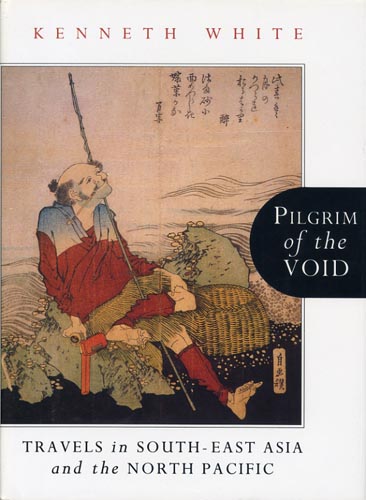
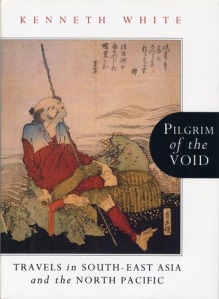
Herzog’s existential, shamanic, pilgrimage also reminds me of the great Franco-Scottish poet, White Pilgrim of the Voidessayist and geopoetician Kenneth White whose work is also centred on walking as a means of ‘opening a world’ and, in particular, establishing a fundamental relationship with planet Earth.  White was involved with Alexander Trocchi’s Project Sigma in the 1960s and took part in the Paris évenements of 1968. This lost him his university teaching post which led to him going ‘on a long walk in the Basque Country’.   White is inspired by what he calls ‘intellectual nomads’ such as Friedrich Nietzsche, Arthur Rimbaud, Henry Thoreau and Patrick Geddes (all keen walkers) who he views as having wandered from the ‘motorway of Western civilisation’ in order to find new ways of thinking and living.  (As an aside Giles Deleuze was one of the panel who judged White’s doctoral thesis on intellectual nomadism).  White has undertaken  numerous long walks and geopoetic pilgrimages such as his travels in Asia which are  collected in the volume Pilgrim of the Void. (the title says it all!)  This includes an account of White walking in the footsteps of Basho from Tokyo to Hokkaido:
All alone
with an old crow
in unfamiliar country

which reminds me of one of the rare occasions in Herzog’s book where he achieves some form of solace and communion with the natural world:

A nuthatch was tapping on a tree and I stood there a while, listening to him, as it soothed me.

Off course, as Herzog arrives in Paris, the question has to be asked. What happened to Lotte Eisner?  She is tired and weak, but still alive and given that she manages to push a chair over to Herzog, is possibly in better shape than he is:

Someone must have told her on the phone that I had come on foot – I didn’t want to mention it. I was embarrassed and placed my smarting legs up on a second armchair which she pushed over to me. In the embarrassment a thought passed through my head and, since the situation was strange anyway, I told it to her. Together, I said, we shall boil fire and stop fish. Then she looked at me and smiled very delicately, and since she knew that I was someone on foot and therefore unprotected, she understood me. For one splendid, fleeting moment, something mellow flowed through my deadly tired body. I said to her, “Open the window. From these last days onward, I can fly.”

Lotte Eisner lived for another nine years and died in 1983.

Now Playing:  Thomas Köner – Permafrost

References:

Paul Cronin, ed, (2003),  Herzog on Herzog, (London, Faber & Faber).

Werner Herzog, (1978), Of Walking in Ice, (Delf, Free Association, English translation 2008).

Michael Gardiner, (2006),  From Trocchi to Trainspotting, Scottish Critical Theory since 1960 (Edinburgh, Edinburgh University Press).

Rebecca Solnit, (2001) Wanderlust: A History of Walking (London, Verso).

Kenneth White, (1992),  Pilgrim of the Void (Edinburgh, Mainstream).

Observation

Slightly incongruous to be re-reading Werner Herzog’s Of Walking in Ice whilst we all wallow in the sunshine this week.  A bit like walking around with an ice-cube in my pocket as Edinburgh metamorphoses into an outdoor theatre and city life explodes on to the streets.  It’s interesting to think about how a hot snap of unseasonal weather can challenge the notion of city design, public space, and it’s usage.  Groups and individuals start to congregate freely in the most unlikeliest of spaces under ‘normal weather conditions’. The usual wet and windy expanse of the Usher Hall steps are transformed into a natural amphitheatre, for meeting, eating, drinking, thinking and reading. Any available sun-facing surface is colonised by the intrepid light worshiper including window sills and ledges. People appear to embrace drifting and flaneuring in lunch hours, glad to be moving though the city with no particular purpose.   I haven’t really given too much  thought about the relationship between weather and city space but when you see such an instant and radical transformation it is hard to ignore.

Now playing:  Untitled – Birchville Cat Motel . Bruce Russell.

Rosyth Edgelands Dérive

Rosyth Edgelands Derive

We are in dangerous territory, walking westward out of the town of Rosyth, along the A985, one of ‘Britain’s killer roads’.  This arterial incision into the connective tissue of the Rosyth edgelands is to fully engage with the disruptive polarities emanating from two monolithic structures, which have recently appeared on either side of the road. There is a real sense that the landscape, skyscape and mindscape have all been irretrievably altered.  Whether this is benign or malevolent who can say?  It is this that we must investigate  and address head-on with our dérive. Establish relations, resist, remap, and reclaim as necessary.

As we set off, along the ridgeline of the A985, there is an undercurrent of fear that a vortex of radiant, colliding energies may threaten to rip us, stalking walkers, apart or even lure us into the path of oncoming traffic on the killer road. This is a risk that we are prepared for and must take.

The first stretch of road between two roundabouts is almost classic edgeland topography. On the right hand side, the small favela of allotments, with waves of canes, poles, pallet fencing and water butts; shanty sheds and corrugated iron knitted together with plastic pipework. There is a disordered/orderliness about the place; a charivari of utility and resourceful exchange, which resists the carefully manicured garden porn displayed in garden centres and lifestyle magazines.  You can tell that this is land that is worked, loved and loves back.

On the other side of the road, past the football pitch, stands the ‘old Lexmark building’, supposedly  the location of ‘the factory’ in Gregory Burke’s play Gagarin Way. We  have investigated this building before and continue to monitor its energy levels , but no sign of the smoked salmon fishes as yet.

As we traverse over the second roundabout, there are clear intimations that the interzone between the town and edgelands has been breached.  For the car driver, flooring it off the roundabout and opening up to the straight road ahead  it’s as if the gravitational pull of the town loses its grip, supplanted by a carnivalesque impulse to wind down the window and toss the debris of consumer society into the hedgecomb of trees and shrubs edging the road.  Here lies a graveyard of inert excess, an inventory of impulse purchases; eating and drinking on the hoof and a veritable time capsule of the non-biodegradable floatsam of consumer culture.  Like true twitchers, we must record our spoils:

Diet Coke, Fosters, Tennant’s, McCoys, Irn Bru, Sprite, Muller, McDonalds, Pepsi, Corona, Red Rooster, Lucozade, KP, Dr Pepper, Costa, Coke, Yorkie, Milky Bar, Pampers, Cadbury’s Buttons, Starbucks, Walkers, Carling, Graham’s Dairies, Tesco, Diet Pepsi, Asda, Smoking Kills, Ginsters, Pizza Hut, Golden Wonder, Red Bull, Powerade, Wild Bean Cafe, Huggies, Greggs,  Snickers…

Fired up on caffeine,

the sugar rush floods

the synapses,

foot to the floor,

screech, toss

and off.

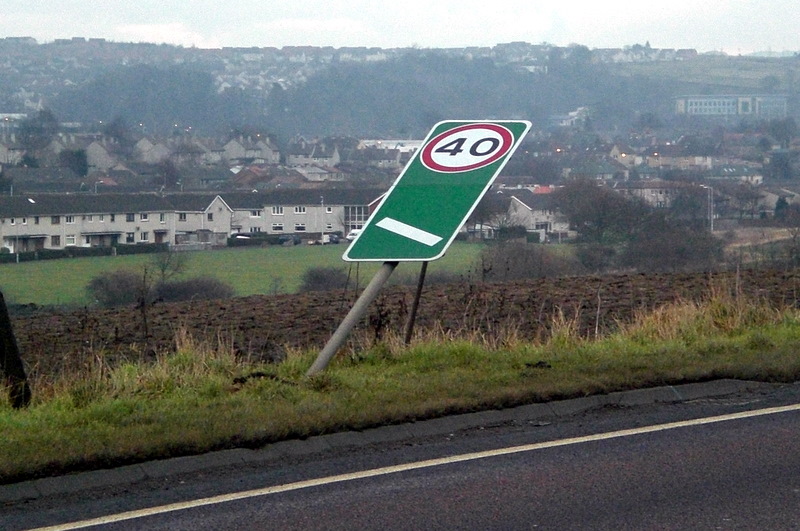
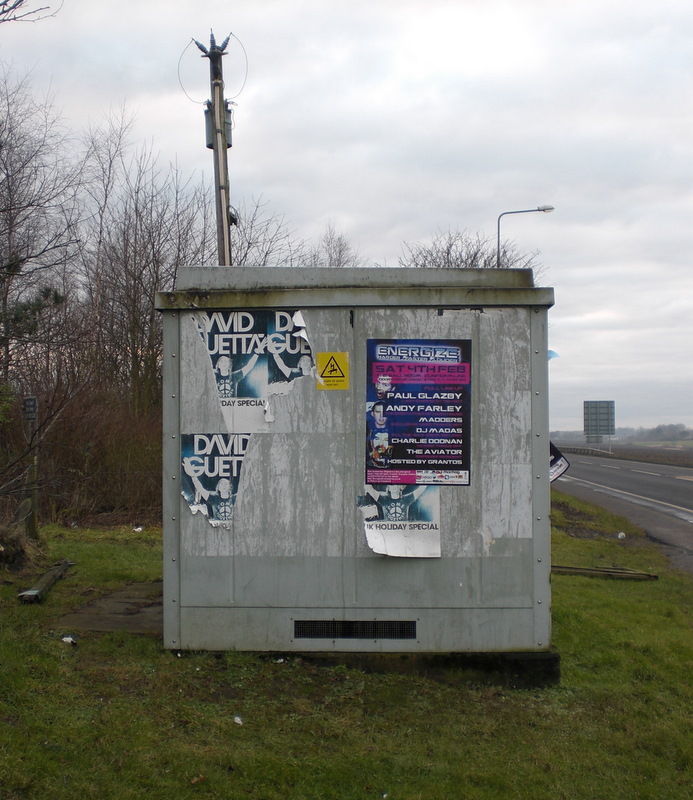
We are also struck by how thIndustrial Units for Sale or Leasee edgelands are places where things are simply forgotten about. Advertising signs from a more benign economic environment offering ‘Industrial Units for Sale or Lease’ are falling down and are never replaced; road signs tilt at 45 degrees; posters on substations intimate long forgotten concerts and  doors on the mysterious roadside bunkers have all disappeared.

We are now out in the true edgelands, hugging the ribbon of verge by the side of the road as  every vehicle utterly tanks it past us. We are pebbledashed by huge swathes of road spray and the draught, from the huge artic lorries that pass, threatens to pull us foot-powered perambulators into the middle of road.  However, the objects of our effort and attention can now be clearly seen on either side of the road. We can feel their energies drilling into us and can only marvel at the scale of their transforming presence on this stretch of the edgelands.  As long as we can stay vigilant and remain on the ribbon verge, we can resist the siren call urging us into the killer road.

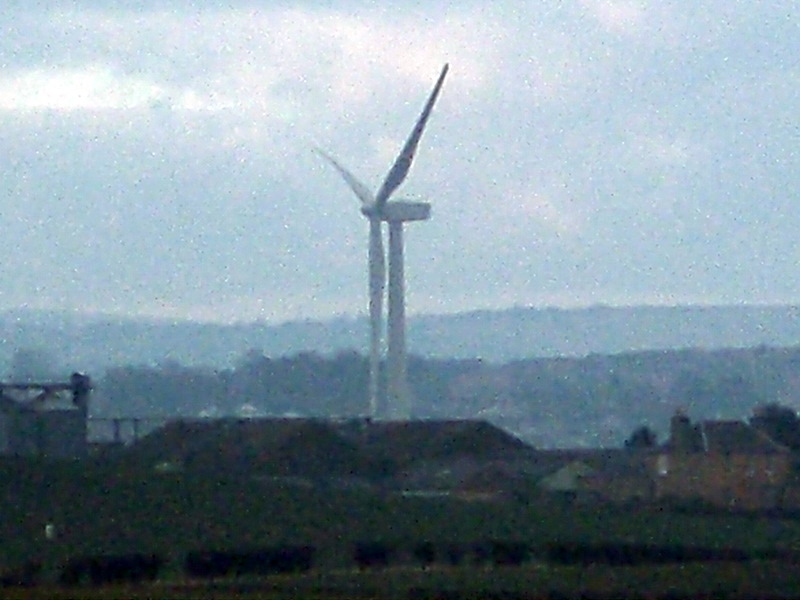
Over to the right, in the middle distance, is a 100 metre column, on top of which sits a rotating turbine with three, colossal, scythe -like blades. This somehow reminds us of the free gifts of plastic spinners that you used to get sellotaped to the front cover of children’s comics like The Beano and The Dandy.  Thus  we have a name for our monster – Spinner – a vital part of the engagement and neutralisation process.   Spinner is of such a scale that it doesn’t look quite real. It’s as if it is projecting some perspective morphing force field which shrinks or obliterates the elements within the landscape which offer any indication of human scale.

Spinner belongs to FMC Technologies, a Houston, Texas headquartered business, which manufactures subsea systems for the oil and gas and renewables industry.  The 1.5MW turbine is projected to supply up to 40% of their energy needs at their Dunfermline facility and was financed by Triodos, the ethical bank.   We stand and watch the strange poetry of the rotating blades dancing with the wind, quite hypnotic and completely silent from our vantage point. There is some some sense of good energy radiating from this structure and there is a fluidity and engagement with the elements.  Spinner could probably only be a product of the edgelands. A place where a turbine of this size can be erected then lost and forgotten, despite it’s landscape transforming qualities.

GoliathIf Spinner has a slightly ethereal, alchemical quality, transforming wind into electricity, over to our left is a structure that looks as if it is marauding up towards the ridge, like a mechanised robotic toy about to attack.  This is the aptly named Goliath crane recently transported from China’s Shanghai Zhenhua Port Machinery Co Ltd, where it was manufactured.  Goliath is the largest crane installed in the UK and across its 120m beam is the clearly visible signage:

aircraft carrier alliance

Goliath sits in Rosyth Dockyard which lies over the hill down on the Forth.  In effect, we are only seeing the top of the crane which at 90m high almost rivals Spinner in height.  Goliath is part of the most expensive project in British naval history with two aircraft carriers presently being constructed at £3 billion a pop. We have already been told that once constructed, one will be mothballed immediately and the other will have no planes  to fly from it.  Try explaining this logic to a five year old. The carriers are to be named HMS Queen Elizabeth and HMS Prince of Wales.  The sheer folly, financial carnage and symbolism of this whole escapade is such that it almost fries our collective brain into meltdown.  However, very soon we are all whistling and singing Elvis Costello’s Shipbuilding – the Robert Wyatt version naturally – so we can hum the piano solo with our kazoos.  This has the desired effect, tames the beast and calm descends. As we walk further along the road, we can gain a better vantage point to look down Rosyth Dockyardover the dockyard and see the true scale of Goliath.  Our fear turns to pity as we realise  that all we are looking at is simply a dumb, beast of burden, a heavy lifter, on which has been foisted the indignity of jingoistic colours, the White Ensign flag and the reek of failed empire. Also lurking down there, somewhere in the bowels are seven decommissioned nuclear submarines, still radioactive and we are reminded of some possibly apocryphal tales of technicians metal-capped boots glowing green in the dark. Isn’t it amazing what can be buried in the edgelands.

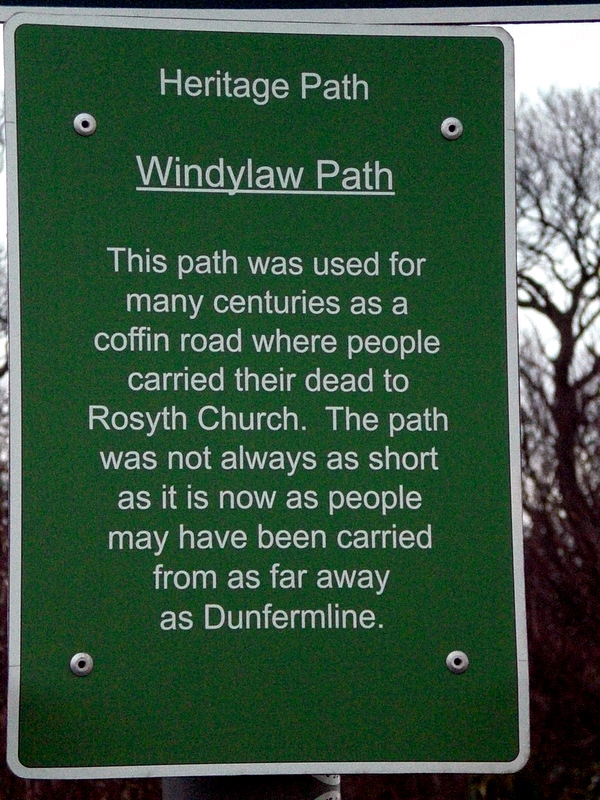
Back on the A985 and another juggernaut threatens to drag us into the road as we alight on Windylaw Path which leads down to the villages of Limekilns and Charlestown.  We’ve had enough of the road but happy to have got the measure of Spinner and Goliath. Our dérive receptors are once again activated when we read that Windylaw Path is a coffin road.

Who could resist that and was Limekilns not mentioned in Stevenson’s Kidnapped?

Windylaw, The Coffin Road

As we head up the coffin road, a buzzard soars overhead…


Now playing: Brian Lavelle – Lambent

Sounds of Spaces and Places Week ending 26th February 2012 CE

I

hint of filigree,

a thread of presence folds

into darkness.

Like draped silk,

a whisper of air

folds into silence.

there…/…not there.

II

Sounds like

Ed Blackwell, and Max Roach

are gi’en it laldy in the park’s municipal bin.

Ane of thae big green wheely numbers

pitchin’ and pulsatin’

wi polyrhythmic paradiddles.

Then oot! vertical!

two squirrel’s explode

through the brushes,

an aff wi the spoils.

III

A night sky of

deep darkness

soaking in the light

as stars sigh.

A crescent of moon

resists and smiles

as Venus breathes.

IV

Magical, Moondog moonbeams of metre. Celestial songs and canons.

(After the Art Ensemble of Fife, Duglas T Stewart and Davie Scott’s wonderful Moondog evening at The Fife Jazz Festival).

Soundtracks (Past few weeks)
Nate Wooley – The Almond
Oren Ambarchi – Audience of One
Jean Claude Eloy – Yo-In
Alog – Unemployed (4xLP version)
Jah Wobble/Keith Levene – EP
Stephen O’Malley/Steve Noble – St Francis Duo
Erstlaub – The Last Few Seconds Before Sleep
Erstlaub – I Am The Line Drawn In The Sand Between The Living And The Dead
Erstlaub – Unfolding Inwards
Julian Cope – Psychedelic Revolution
William Basinki – Disintegration Loops I & II
Lambchop – Mr.M
The Pop Group – ‘Y’
The Caretaker – Patience (After Sebald)
The Caretaker – Extra Patience (After Sebald)
Motorpsycho and Ståle Storløkken – The Death Defying Unicorn
Supersilent – Supersilent 9
Valerio Tricoli – Did They, Did I
Django Django – s/t
The Coral – Butterfly House, Acoustic version
Errors – Have Some Faith in Magic
Mogwai – Hardcore Will Never Die But You Will
Robbie Basho – The Seal of the Blue Lotus
John Coltrane – Kulu Se Mama
Kraftwerk – The Man Machine
Miles Davis – Dark Magus
Arthur Russell – Calling Out of Context
Jonathan Harvey – Mythic Figures
Jonathan Harvey – Imaginings
Jonathan Harvey – Complete String Quartets
The Thirteenth Assembly (Mary Halvorson/Jessica Pavone etc) Jazz on Three session
The Red Krayola – The Parable of Arable Land
John Surman – Where Fortune Smiles
Scorch Trio – s/t
Scorch Trio – Brolt!
Max Roach – Members Don’t Git Weary
Moondog – In Europe
Frederic Rzewski – The People United Will Never Be Defeated
and in celebration of 35 years of Marquee Moon, a bunch of Television boots.

Sounds of Spaces and Places – Week ending 29th January 2012 CE

I

Piercing cry
high in the sky…

                                    Gone

Flecks of crimson,
cloud smears.

Chill air
cups the face.

II

Low growl of wind
worries the bins
Lids yapping
like pack dogs.

III

Over there,
fingers,
da dah dah dat dat
dat dah dah DA
earphone fizz, foaming
through the carriage,
Billy Idol’s White Wedding.

Soundtracks:
The Caretaker – Patience (After Sebald)
Bill Ryder Jones – If
The Fall – The Unutterable
Mick Karn – Dreams of Reason Produce Monsters
Ben Frost and Daniel Bjarnason – Solaris
Jean-Claude Eloy – Shanti
King Creosote and Jon Hopkins – Diamond Mine
Kevin Drumm – Don’t Ask
Alog – Miniatures
Julian Cope – 20 Mothers
El Doom and the Born Electric – s/t
Kayo Dot – Gamma Knife
Jah Wobble and Julie Campbell – Psychic Life
Matana Roberts – COIN COIN Chapter One: Gens de couleur libres
Pete Swanson – Man With Potential
Hallock Hill – The Union