A Huddersfield Bestiary – with Kingfisher


DSCN0549

the handsomest by far of all the factory towns in Yorkshire and Lancashire

Friedrich Engels

In hindsight, it was perhaps inevitable. Brought to this town by a Wolf(f) and a Cow, (1) the animistic world was transmitting subtle messages within seconds of walking out of the station.

Directly opposite the grandiose railway building, that could easily masquerade as a town hall, a lion prowls the rooftops, frozen in time since 1853.  Those Victorians loved their symbols of Empire and the earthbound relative of our rooftop dweller, gazes out imperiously from the entrance to Lion Chambers.  A small winged dragon sits above on the keystone. Possibly a symbol of Victorian industriousness or, as Ruskin would have it, a more sinister, ‘satanic’ motif of rampant industrialisation. Or perhaps the dragon is simply hiding from St George.  I have just walked across a square that bears his name.

DSCN0553

I find out later that the present rooftop lion is a fibreglass copy of the original which was made in Coade stone, a ceramic stoneware popular with Victorian and Edwardian architectural sculptors. Other Coade stone lions and decorative statues can be found at Kew Gardens, Buckingham Palace and Westminster Bridge, the present home to London’s Red Lion a.k.a The South Bank Lion.

.

WP_000772Minutes later I turn a corner to come face to face with the Emporium Dog. All eager eyes and panting tongue. I half expect him to bound up on hind legs to his full height – “Buy Me, Buy Me, Buy Me”.

I pass him a few times over the weekend. Always looking happy, as dogs invariably are, when outside in the fresh air. Locked up for the night, he takes on a melancholy countenance, looking out wistfully from his glass cage under the red neon.
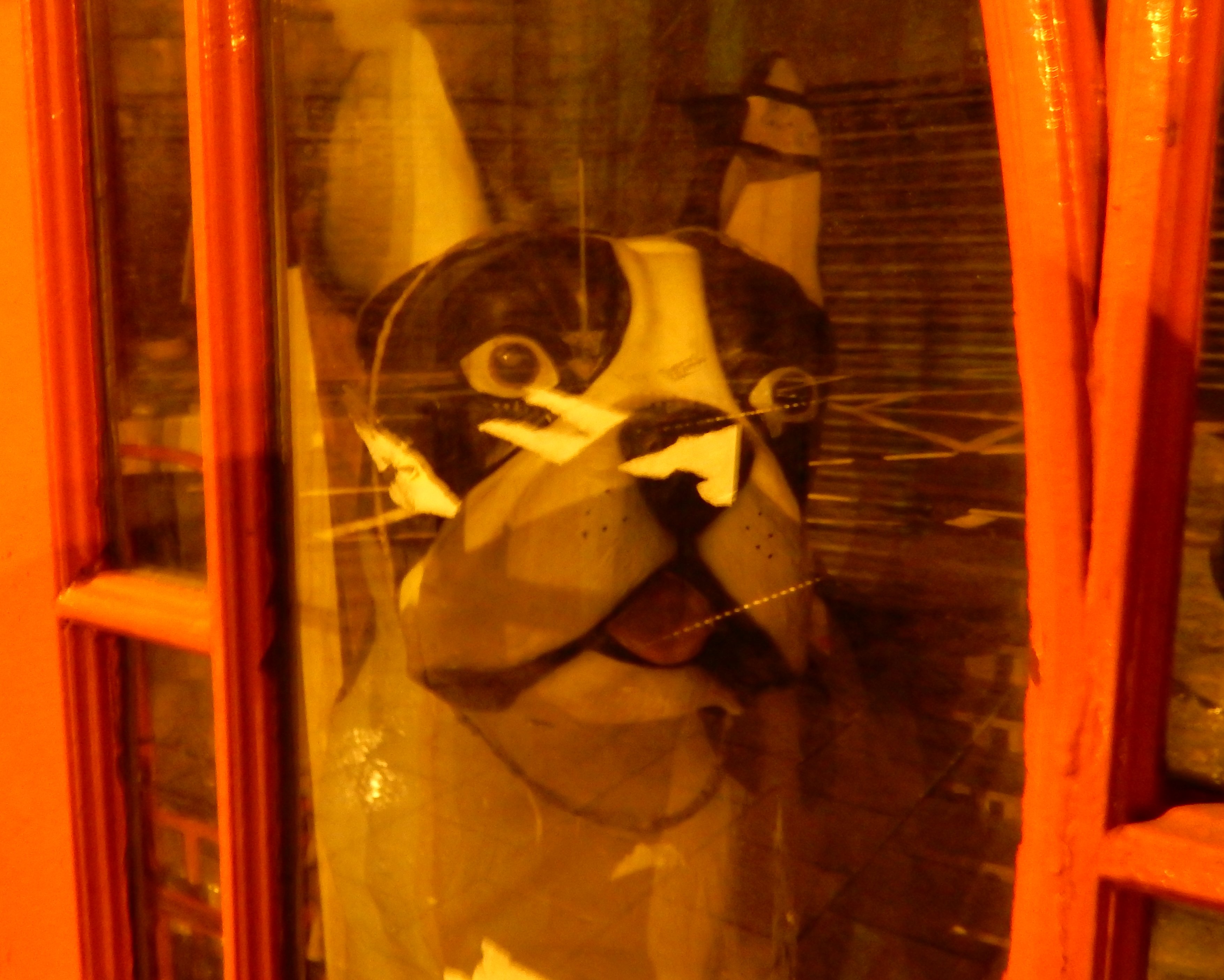
Caged

.

I imagine taking him out for the day, navigating on and off trains and buses. A window seat obviously, top deck right at the front. Squeezed into the passenger seat of a car, head out of the window, licking the breeze.


These transmissions from the non-human world became a feature as I wander through Huddersfield over the next few days. I walk up a street named Beast Market and regularly see magpies and crows flitting around the small grid of Victorian streets, perfectly at home in their urban environment.

Above what is now a nightclub bar called Sin, two fine horses catch the eye. Even with the stone weathering you can see that one is elegant, poised and groomed with a manicured mane.

DSCN0520

 .

The other is wild and untamed. Encased in its stone alcove since the 1840s, you can sense its desire to break free and run.

.
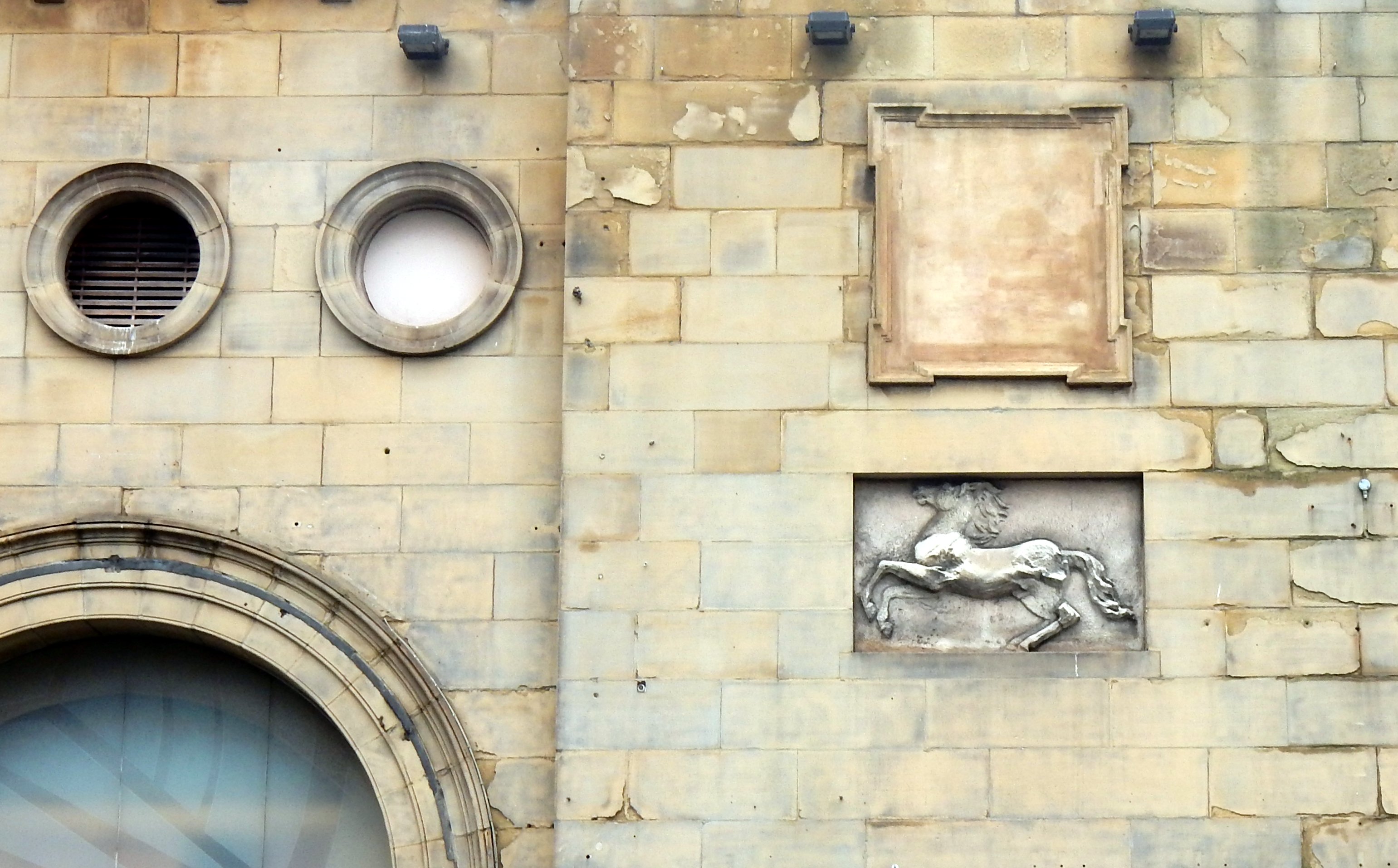
Encased Horse Huddersfield
I find out that the building was originally built as a military riding school in the late 1840s and was the headquarters of the 2nd West Yorkshire Yeomanry Cavalry.  DSCN0519It subsequently became a music hall in 1905, aptly named the Hippodrome which must have made our wild horse dream of running around the racing stadiums of ancient Greece.  Perhaps our groomed stallion was more suited for hippodrome chariot racing. I wonder what our horses make of the carnivalesque ambiance of the nightclub bar. Passing outside at night, the dull, techno thud-thud conjuring up the Taraxippus – or ‘horse disturber’ – a ghostly presence blamed for frightening horses at the hippodromes throughout ancient Greece. The current ‘To Let’ sign on the building must create future uncertainty for our equine friends and in a town bristling with the fading lions of Empire, the horses must always remain vigilant.

.

DSCN0579

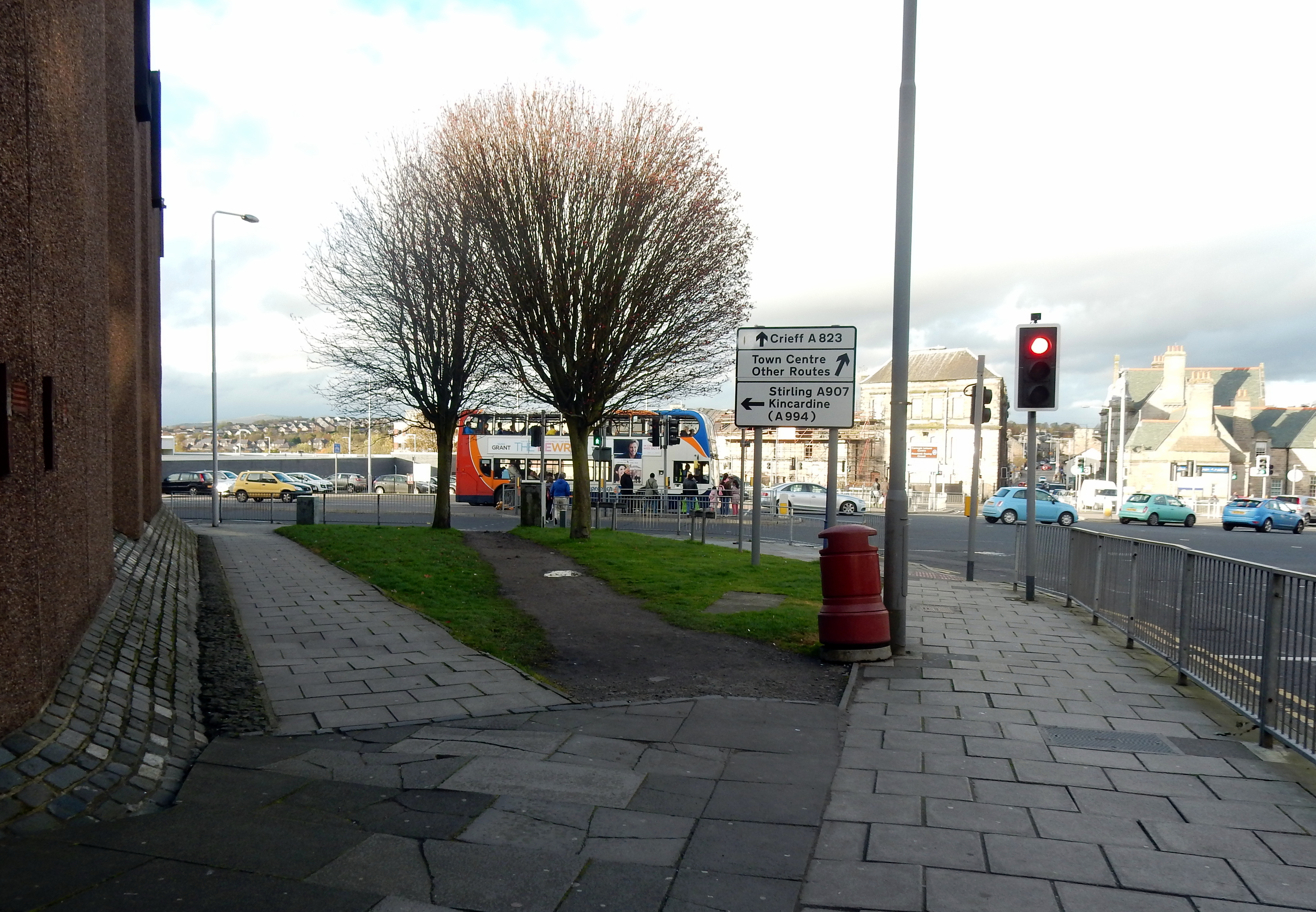
One thing quickly becomes apparent about Huddersfield. Walk in any direction from the centre of the town and you will soon find that it is completely encased in a ring of traffic.

On a Saturday afternoon and with a bit of time until the next concert, I manage to break through the A62 ring road and head down towards the old industrial mill district, passing the winged lioness and griffins of the Gothic Milton Congregational Church on the way:
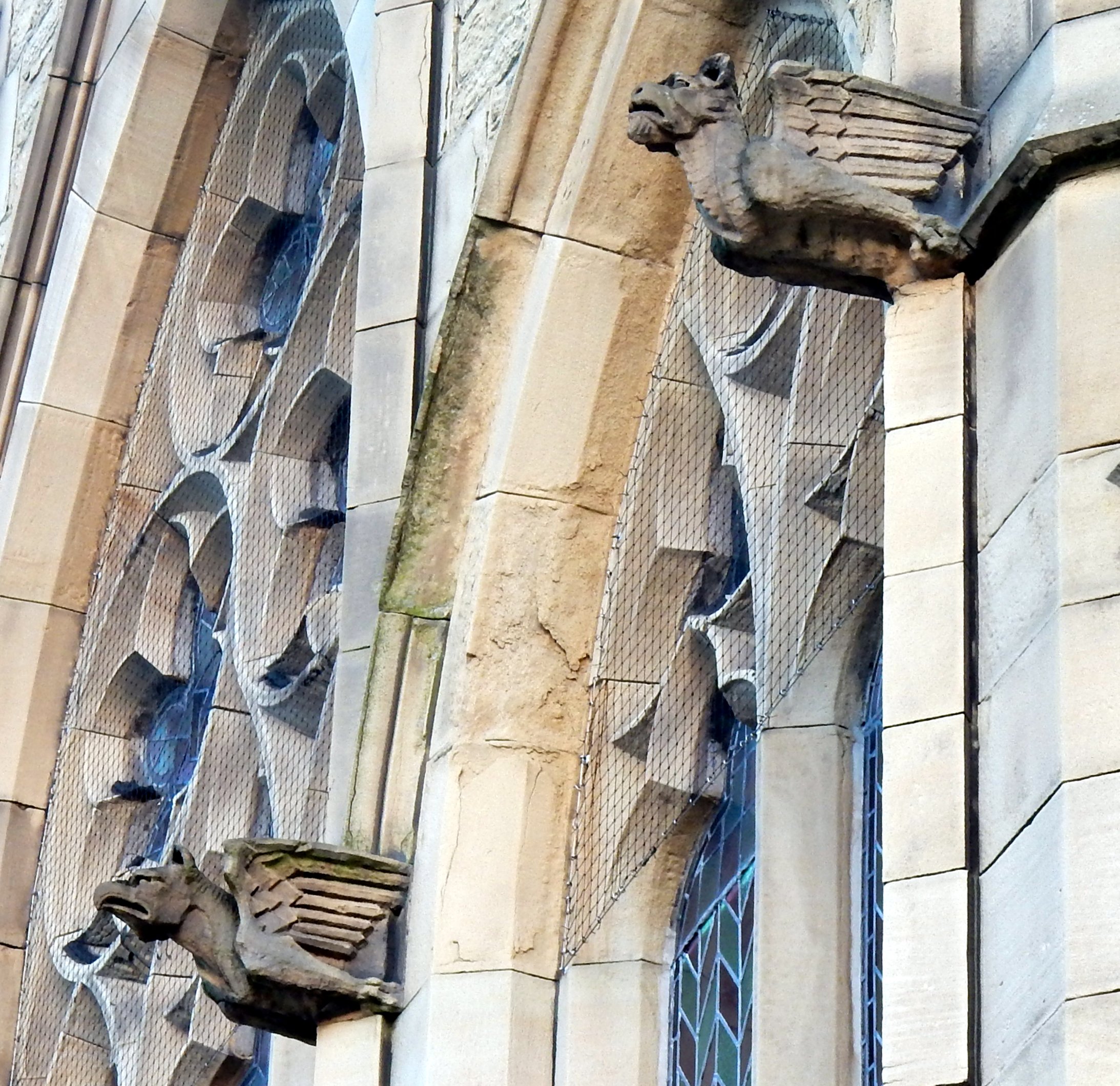
DSCN0523

.

I’m drawn to a fairly nondescript, light industrial building. Shuttered and silent it’s a colour which has a kind of luminosity, casting light on the road. A premonition of blue?
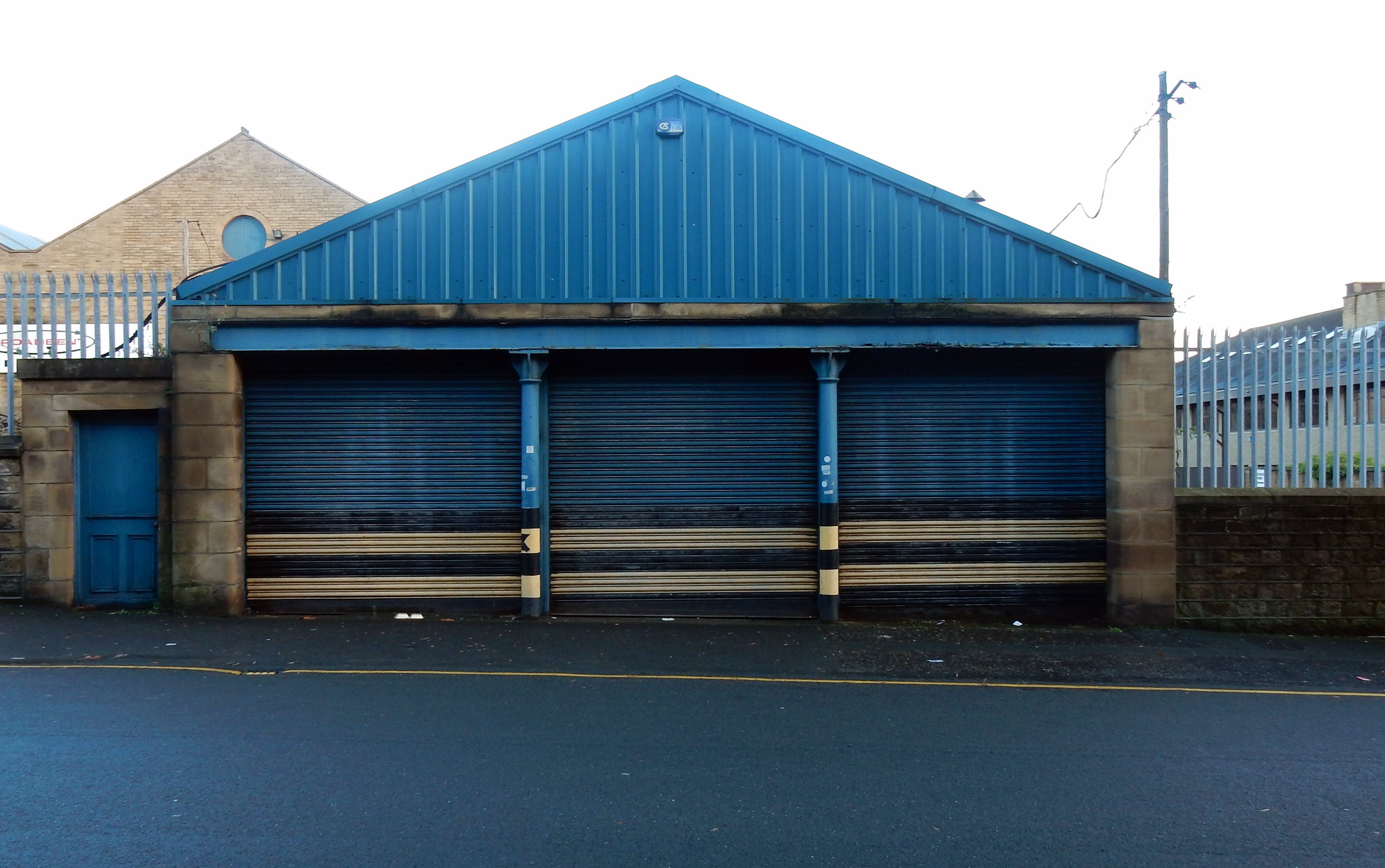
Premonition of a kingfisher

I’m heading to Bates Mill to see Carlos Casas‘ audio-visual installation Avalanche:

Exploring the interrelation of landscape, soundscape, music and ethnography, Avalanche is an audiovisual meditation about a village and its traditions on the way to disappearance. One of the world’s highest inhabited villages, Hichigh is located in Tajikistan’s mysterious and fascinating Pamir mountains, home to many archaic and well-kept traditions. The film depicts Hichigh at a time of literal and figurative dusk: on the cusp of becoming a ghost village, just before its stones and mud houses are eaten by the mountain again.

It is a powerful and poignant piece, with the multi-screen environment enhanced by a Phill Niblock score. Depicting a culture barely surviving at subsistence level, they are clinging on to existence on the side of this high mountain landscape and yet, life goes on.

Standing in this space, you cannot help but reflect on the building where this is being exhibited. This old textile mill where the skills, traditions and culture of the yarn spinners was slowly eroded by globalisation, lower cost labour and the flight of international capital. Yet, life goes on. It is good to see Bates Mill now being reinvented as an arts venue, incubator space and photographic studio.

It is late afternoon, drizzly and overcast when I exit Bates Mill. I can hear the River Colne nearby and head off for a quick look. Walking through a deserted car park, a corner of graffiti and greenery, topped off by the pedestrian bridge, punches some colour into the monochrome light. Bizarrely, it looks like the wall has been partly rebuilt, with new bricks erasing part of the original graffiti.

DSCN0525

I need to get back to the University where the next event will take place and notice a sign for the Narrow Canal Towpath. How can this be resisted? It feels as if it will take me in the general direction of the University so I enter the narrow opening, casting off the distant traffic sounds with each step as I descend on to the towpath. Looking underneath the arch of the road, which runs overhead, it’s no surprise to see the place has been tagged. The water, a still pool of black ink.

DSCN0531

I’m heading in the opposite direction. It is so quiet and there is barely any movement on the water as the grey blanket of dusk descends. The phone in my pocket starts to ring and I have barely answered when I’m hit by a jolt of blue at the periphery of vision. Surely not. For I second, I wonder if I’ve imagined this, when it happens again, like a razor, scything through the twilight which descends to alight barely 10 feet away on the canal bank. A twitching ball of nervous energy, curious. It appears to pull in all the surrounding light and radiate it back. The illuminated blues of lapis lazuli, golden orange, red flecks. A shape-shifting intensity of colours.

“I’ve just seen a kingfisher, will phone you back”

Of course, it disappeared again as quickly as it had appeared and I was once again left wondering whether I had just imagined this. Up until this day, I had never seen a live kingfisher. I had certainly tried. I had gone to spots along The Water of Leith, in Edinburgh, where there had been sightings and yet they remained elusive. One day I sat on the banks of the Lyne Burn in Fife for hours like a fisherman without a rod, waiting for a glimpse. Anything … Nothing … Funny thing is, I doubt if I would have done this for any other bird. I’m not a birder and have little real knowledge of birds, yet they always captivate and fascinate when I stop to look at them. However, the kingfisher has always exerted a strange magic. The name itself – king – fisher – flitting between land and water with a display of colour that shouldn’t really belong in this world. As if it this small bird has escaped from a cartoon or wandered in from some exotic climate by accident.

Yet here, today, alongside an old industrial canal I had finally seen one. Of course the bird was long gone but this is where it happened:

DSCN0534-001

Any lingering doubts of having imagined all of this were dispelled when it reappeared one final time. Flying low down the middle of the canal, barely above the water. It almost seemed to be a gesture to confirm its existence. A life enhancing presence in the most unlikely of settings.

Those animistic spirits had clearly been working in my favour.

.

Now playing: Lyndsay Cooper – Rags

Reference:

Huddersfield Heritage – Leaflet produced by Huddersfield Local History Society, Huddersfield Civic Society and Kirklees Council.

(1) In town for the fantastic Huddersfield Contemporary Music Festival. On this particular weekend two of the major events were concerts featuring Christian Wolff and Henry Cow. Christian Wolff is the last surviving member of the composers who came to be called The New York School alongside John Cage, Morton Feldman and Earle Brown. Wolff is also the person who gave John Cage his first copy of the I-Ching.  Henry Cow and associated musicians reformed to celebrate the music of composer and multi-instrumentalist Lindsay Cooper (1951 – 2013).

Crows, Crowns and a Curious Landscape

DSCN0254

Like animated clods of black earth suspended in the branches. A murder of crows.

We can feel their collective beady gaze following us as we walk down the single-track road that leads into the hamlet of Pattiesmuir.  A fluttering of wings and more descend. It is hard not to think of the gathering flocks in Hitchcock’s The Birds. 

For no apparent reason, they suddenly take flight. A spiralling vortex of wing, beak and claw, ascending, then wind-blown towards the white crosses in Douglas Bank Cemetery. Only four return to the upper branches, no longer interested in us. One looks west whilst three gaze towards the east indicating our direction of travel.

Three craws …

The old car at the entrance to Pattiesmuir evokes a sense of time travel asDSCN0256 we walk through an agricultural hamlet whose physical fabric has changed very little over the past 150 years.  A collection of low-level whitewashed cottages line a single street that provides both entrance and exit with no through road.

Pattiesmuir has been recorded on maps as Patiemuir, Peattie Muir, Pettymuir and a number of other variants. An early map from 1654 records it as Pettimuir, although the origin of the name remains obscure.  Local folklore suggests that the area was once a focus of Romany activity and even that The King of the Gypsies once had a ‘palace’ nearby. The 1896 Ordnance Survey map does refer to an area of trees to the west of the settlement as “Egyptian Clump”, and a neighbouring field is also noted as “Egypt Field”.

In the early 18th Century a small community of hand-loom weavers formed in Pattiesmuir to help supply the Dunfermline linen industry.  By 1841,there was a population of 130 which supported a school – attended by 34 pupils – an Inn, a blacksmith and three public wells. By 1857 the population was 190. However, the introduction of the power-loom meant a slow decline in the fortunes of hand-loom weavers and by 1870 almost all weaving activity had ceased.

There are no schools or Inns in Pattiesmuir these days but a building called The College remains. It’s origins lie in a fraternity of radical weavers who set up the ‘college’ so that weavers and agricultural workers could meet for self-improvement classes in politics, philosophy, economics and theology. They subscribed to the Edinburgh Political and Literary Journal and pooled funds to buy the works of Burns and the new Waverley novels of Walter Scott. One notable member and self-proclaimed ‘professor’ of the College was Andrew Carnegie, grandfather to a Dunfermline born grandson of the same name. Young ‘Andra’ would travel to America in 1848 and eventually consolidate the US steel industry to become the ‘richest man in the world’.

You cannot drive through Pattiesmuir, but if you walk you can take a left where the road stops and walk into a curious area of landscape. Neither edgeland nor particularly rural it is bounded by Dunfermline, only a few miles away, to the north and Rosyth to the East. A rarely walked mix of hedgerows, old woodland, farm tracks and tenanted agricultural land. On Google maps it is an area that is deemed ‘featureless’. However, we already know that it hosts a coffin road and the wild wood. Today’s walk will reveal a few more surprises …

DSCN0261

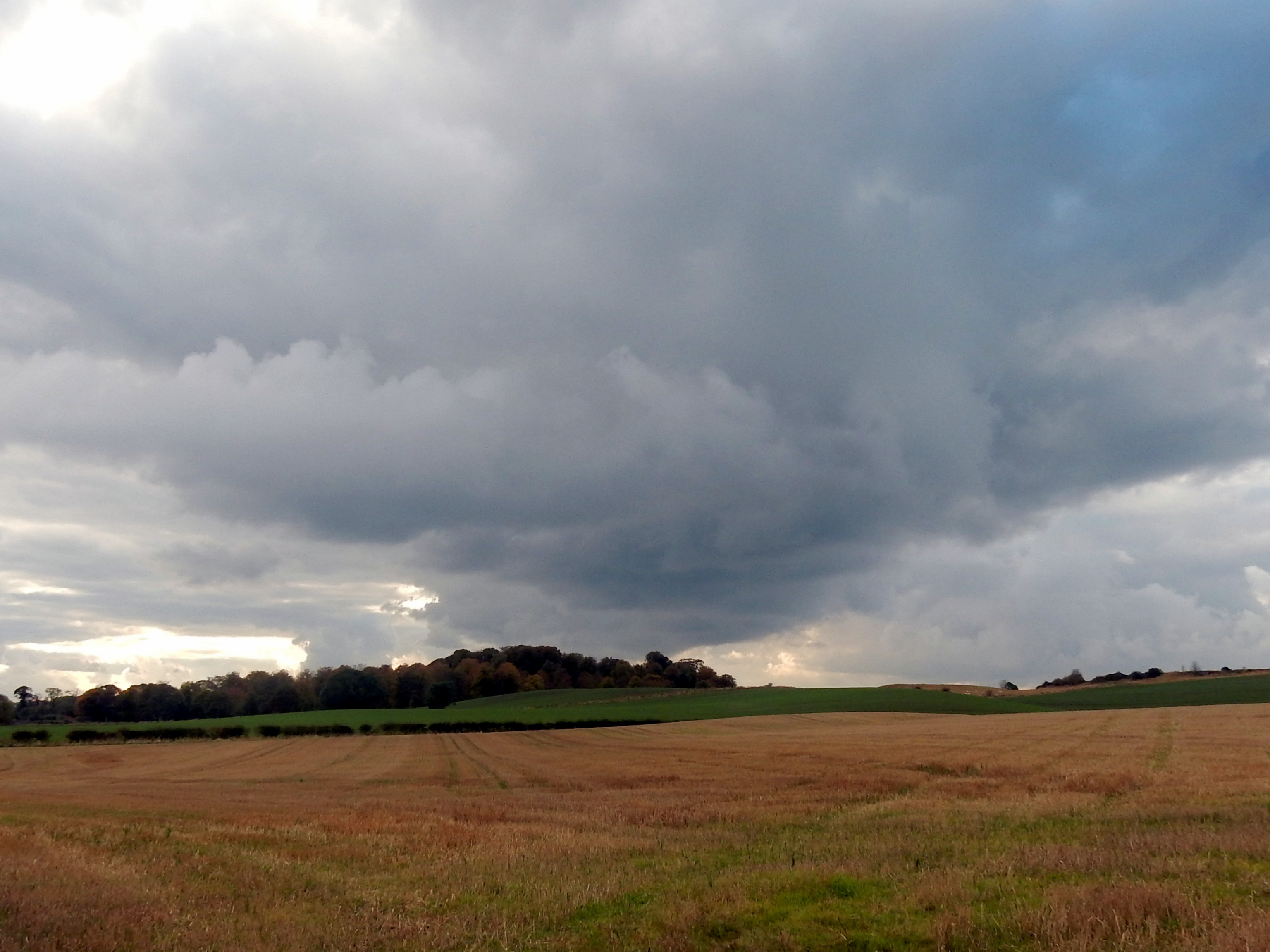
We stand and watch the weather arrive. A huge palm of grey sky that threatens to smother us with rain but growls quickly past. Underfoot, attention is diverted to the heroic efforts of a slug traversing the rough stone path. The intensity of existence revealed in this waltzing fuselage of seal-smooth skin and striated hand-painted detail. Eventually it reaches more hospitable looking terrain and we can walk on.

DSCN0264

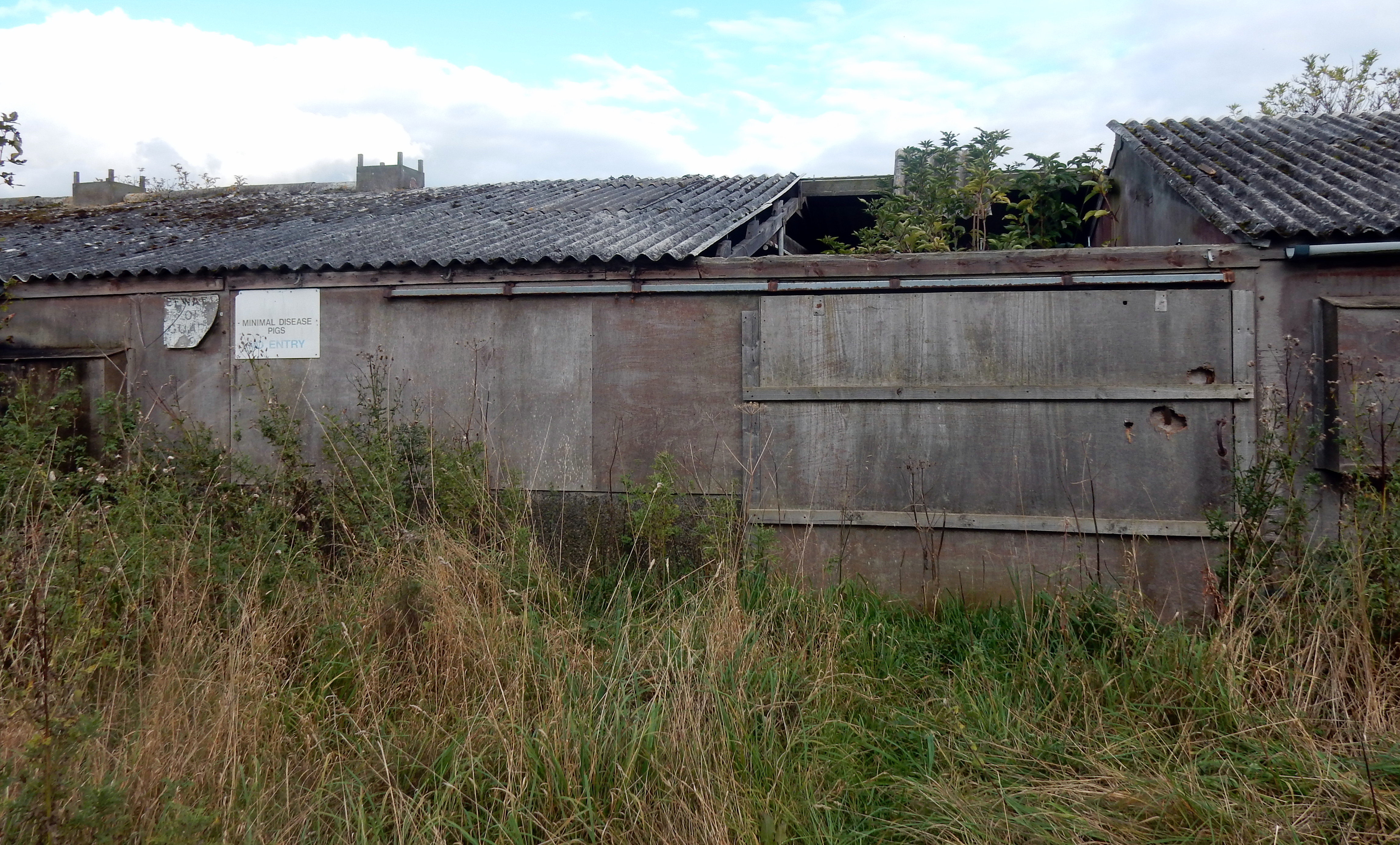
Minimum Disease Pigs II

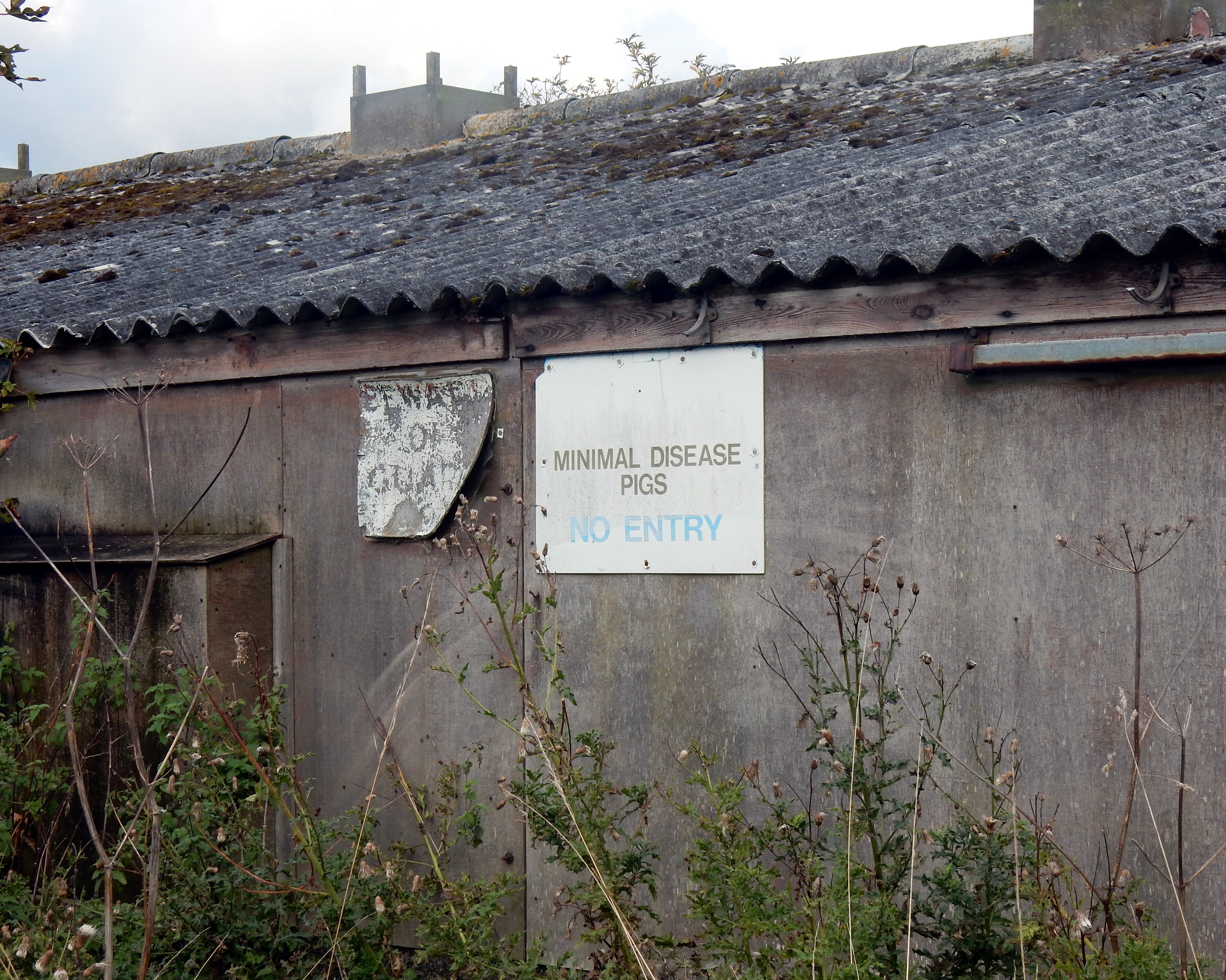
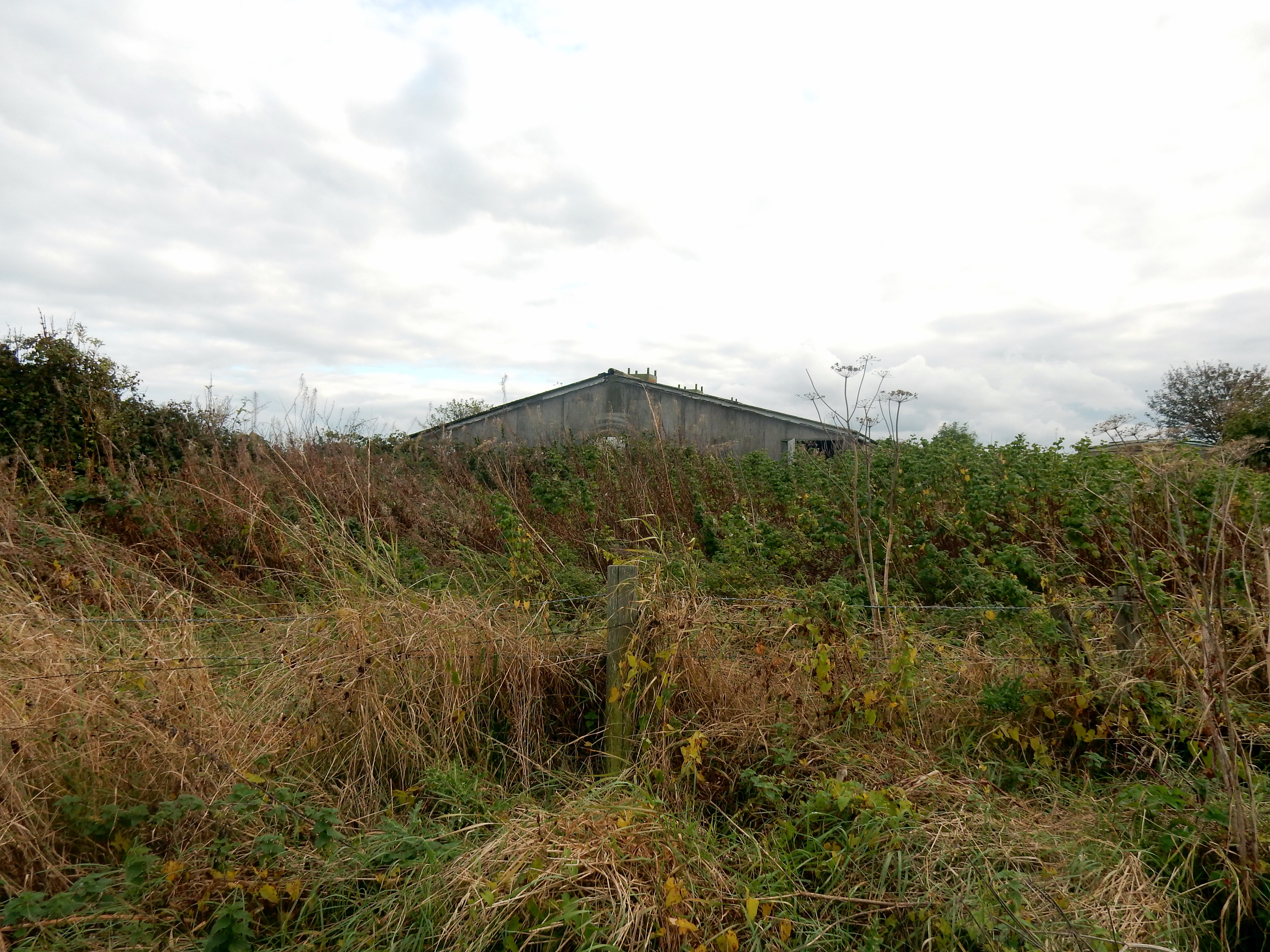
We are intrigued by the sign on a set of ruined agricultural buildings. Clearly, it has been a long time since they were operational. Part of the roof is missing and internal vegetation is now stretching for the sun.

Minimal Disease Pigs No EntryMinimal Disease Pigs – it could either be the name of an undiscovered hardcore punk band or a fragment from a Mark E. Smith lyric:

Beware of Guard – uh

Minimal Disease Pigs

No Entry

No Entry – uh

Of course, after the walk we had to find out what minimal disease pigs were:

Many infectious diseases are transferred from the sow to her offspring after birth and breaking this cycle of transference is the basis of the minimal disease concept. If piglets are reared in total isolation from their mother and all other pigs that are not minimal disease pigs (that is they never come in contact with or even breathe the same air as other pigs), they will not become infected with certain disease-causing organisms (pathogens) that are normally present in pigs. Thus the cycle of transfer of many organisms from one generation (the sow) to the next (her offspring) is broken.

There is an almost chilling bio-technocratic language behind this concept. A section on ‘Breaking the Cycle‘ becomes even more so with descriptions of ‘snatch farrowing’, ‘hysterectomy procurement techniques’, ‘euthanased sows’ and ‘total isolation rearing’. It would appear that the minimal disease nomenclature died out, in the UK, in the 1970s to be replaced by ‘High Health Status‘.

DSCN0260It is unclear what happened to the fortunes of this particular pig farm that is now being slowly reclaimed back into the landscape. An agricultural ruin that has given us a partial glimpse into the bio-technic world of the animal husbandry practices that deliver up packets of bacon and pork on to the supermarket shelves. Another connection that illustrates that the urban and rural, local and global  can never be viewed in isolation when we consider such basic questions as to how and where do we get our food.


DSCN0266

As we head northwards towards the distant spires of Dunfermline, we encounter another relic of the agricultural past.

DSCN0268

Crowned by thorns

an elegy

from the future?

An old petrol pump, presumably used at one time for filling up farm vehicles.  Crowned by thorns, nature’s brittle fingers have enveloped the head and spiraled down the structure. Any message that was once conveyed by the sign on the wall is completely effaced. At one level the image perhaps conveys a narrative of decline of the tenant farmer or small farmer in general. As food production becomes increasingly industrialised, the small farmer finds it uneconomic to compete. Like the pig-farm, the infrastructure is slowly being reclaimed by the natural world.

Rural Elegy II

However, is there another narrative? The petrol pump as a potent symbol of the global petrochemical and energy industries that exploit non-renewable resources that will one day inevitably run out. What will the cost be to planet Earth and its lifeforms? Is a crown of thorns awaiting the petrochemical plants, power stations, cars, aeroplanes …?

All questions to ponder as we head over the fields, nodding to the strange, silent wind poetry of Spinner. Just another story layered upon this ‘featureless’ curious landscape.


CIMG3699-002


 ≈≈≈

Now playing: Hacker Farm – UHF

References:

Department of Agriculture, Fisheries and Forestry, Queensland Government, Minimal Disease Pigs

Fife Council Enterprise Planning and Protective Services Pattiesmuir Conservation Area Appraisal and Conservation Area Management Plan, October 2011.

Raymond Lamont-Brown,  Carnegie: The Richest Man in the World (Stroud: The History Press, 2006).

Addendum: Into the Void – A Field Trip

We have previously entered the Zone-like territory of The Void which was documented in a previous post here:

.

We have just been sent this wonderful photo by Stray Seal which captures the uncanny, submerged world of The Void.  It also confirms that the pike rumoured to patrol the waters is clearly swimming in the depths:

Underwater Chair and Pike ©strayseal
©strayseal

Stray Seal is Lindsay Brown, a cinematographer specialising in underwater film and photography for both drama and documentary, including natural history.  There are some more of her quarry pictures here and check out her website and facebook albums.

Now playing: Mothlite – ‘The One in the Water’ from Flax of Reverie

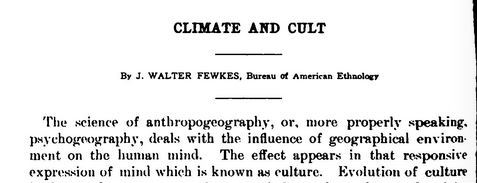
Is this the first published use of the term ‘psychogeography’?

“The science of anthropogeography, or more properly speaking, psychogeography, deals with the influence of geographical environment on the human mind.”

J. Walter Fewkes, Bureau of American Ethnology, (1905)

.

≈≈≈

.

First definition?

Presented in  a paper ‘Climate and Cult’ published in the Report of the Eighth International Geographic Congress. 1904, pp.664-670, (Washington: Washington Government Printing Office, 1905).

.

reporteighthint00unkngoog_0006

Jesse Walter Fewkes (1850 – 1930) was born in Newton, Massachusetts and initially pursued a career as a marine zoologist at Harvard. From 1887, he turned his attention to anthropology and ethnological studies, particularly the culture and history of the Pueblo Native Americans. Fewkes made some of the first recordings of their music. In 1895 he embarked on various archaeological explorations of the American Southwest for the Smithsonian’s Bureau of American Ethnology. In 1918 he was appointed chief of the Bureau and retired in 1928, dying two years later.

The paper Fewkes presented to the Congress examines the relationship between climate, food supply and ritual ceremony, (what Fewkes calls ‘cult’). One example  given is the rain ceremonies of the Hopi people. Fewkes argues that the Hopi’s strong connection with their arid landscape led them to develop a set of beliefs, practices and rituals to appeal to the sky gods to deliver rain. In these ceremonies, the gods are represented through masks, idols and other symbols and in order to influence the “magic powers of these personages” the worshipper employs signs or gestures, songs, verbal incantations or rituals of imitation. For example, water is poured into a medicine bowl from its four sides to show that water is desired from all world quarters; a cloud of smoke represents a rain cloud. Sacred kivas (rooms used for rituals) are painted with symbols of falling rain and lightning to remind the gods of the Hopi people’s need for water.

As a conference paper, it is very much of its time but interesting in that it specifically mentions ‘psychogeography’ and clearly relates this to a linkage between the effect of the environment on the human mind. We have never seen it referenced before in any of the psychogeographic literature.

References to the origin of the term ‘psychogeography’ often refer to Guy Debord’s Introduction to a Critique of Urban Geography, (1955) and his definition:

Psychogeography sets for itself the study of the precise laws and specific effects of the geographical environment, whether consciously organised or not, on the emotions and behavior of individuals.

Whilst the Letterists and Situationists clearly developed their psychogeographic activities, during the 1950s, in an urban environment, it is interesting to learn that the  relationship between the environment and the human mind was being considered as ‘psychogeography’ in a non-urban context at the turn of the century.

Now playing: Éliane Radigue – Elemental II.

Plants, potters, webs: On forms, usefulness and emptiness

With the clocks about to go back this weekend, autumnal hues cloak the body and seep into the skin. The piercing light of summer is almost emptied out. Weak threads of sunlight dissolve amongst russet, ochre and blanket skies of grey.

Here then, some small cups of blue:

CIMG3757-001

.

inked

……………upon the sky

blue

……………cupped

time

……………held

in a breath

≈≈≈

The potter makes the earthen pitcher out of earth selected and prepared specifically for it.  The potter … shapes the clay.  No – he shapes the emptiness.

Martin Heidegger

When posting the above image on twitter, I received, by return, a digital echo from Andrew Male, (@AndrewMaleMojo). A fragile image, of the same unknown plant, etched in glaze and fire; ‘cupped’ and bleeding into blue.

BtfTt6YIUAAmhb0
(c) Andrew Male

The bowl  was made by the potter Beresford Pealing who ran a studio-pottery at Harnham Mill, West Harnham, Salisbury, Wiltshire from 1966-1972. Pealing created hand-thrown domestic stoneware оf а type pioneered by Bernard Leach working іn аn Arts & Crafts tradition.

Beresford Pealing
Beresford Pealing’s studio-pottery at Harnham Mill. (c) Wiltshire Museums

The image of Pealing’s bowl resonated with the image of that flower cupping light, sky and time and somehow reminded me of Martin Heidegger’s late thought, particularly his Bremen Lecture of 1949, Insight into That Which Is:  

When we fill the pitcher, the liquid flows into the empty pitcher … The thingness of the container in no way rests in the material that it is made of, but in the emptiness that [it?] contains. 

I’m not sure if Heidegger ever acknowledged it, but it seems too much of a coincidence if this passage was not influenced by the arguably more poetic rendering in the Tao Te Ching:

Shape clay into a vessel;
It is the space within that makes it useful.

(Tao Te Ching: Chapter 11, translated by Stephen Mitchell, 1988)

or in an alternative translation:

Hollowed out,
clay makes a pot.
Where the pot’s not
is where it’s useful.

(Tao Te Ching: Chapter 11, translated by Ursula K. Le Guin, 1998)

A random moment this week threaded together that plant inked against the sky and Beresford Pealing’s bowl. Opening the front door, an empty form cupping the autumn light:

DSCN0291

Overnight, a dweller on the threshold had constructed possibly the perfect form of useful emptiness. A filigree construction allowing the world to pass through and bring whatever bounty may stick on the way…

And of the unknown plant?

When the photograph was taken, I had no idea what it was, although A, who is the gardener, told me that it would soon ‘explode’. She didn’t know the name either.

Fraser MacDonald @JAFMacDonald kindly identified it as Agapanthus and sent a link to this stunning time-lapse film. Enjoy the white stars exploding in all their glory. All within fifteen seconds:

.

But there is one final act of synchronicity. Re-watching the film clip today and revisiting Heidegger’s lecture, I come across his thinking on the emerging technologies of 1949 (for example film) and specifically, their ability to collapse time and space. An example that he gives is:

the sprouting and flourishing of plants which remained hidden throughout the seasons is now openly displayed on film within a minute…

We can only imagine what his response may have been to the webs spun by modern technologies. Lots of un-useful emptiness? Perhaps we can learn from the spider. Spin the web, shape the emptiness and see what sticks.

Many thanks go to Andrew Male and Fraser MacDonald for their invaluable contributions to this post.

Now playing: Brian Lavelle – Empty Transmissions.

References:

Martin Heidegger, Insight into That Which Is, Bremen Lecture, 1949 (Indiana: Indiana University Press, 2012)

Lao Tzu. The Tao Te Ching, various translations.