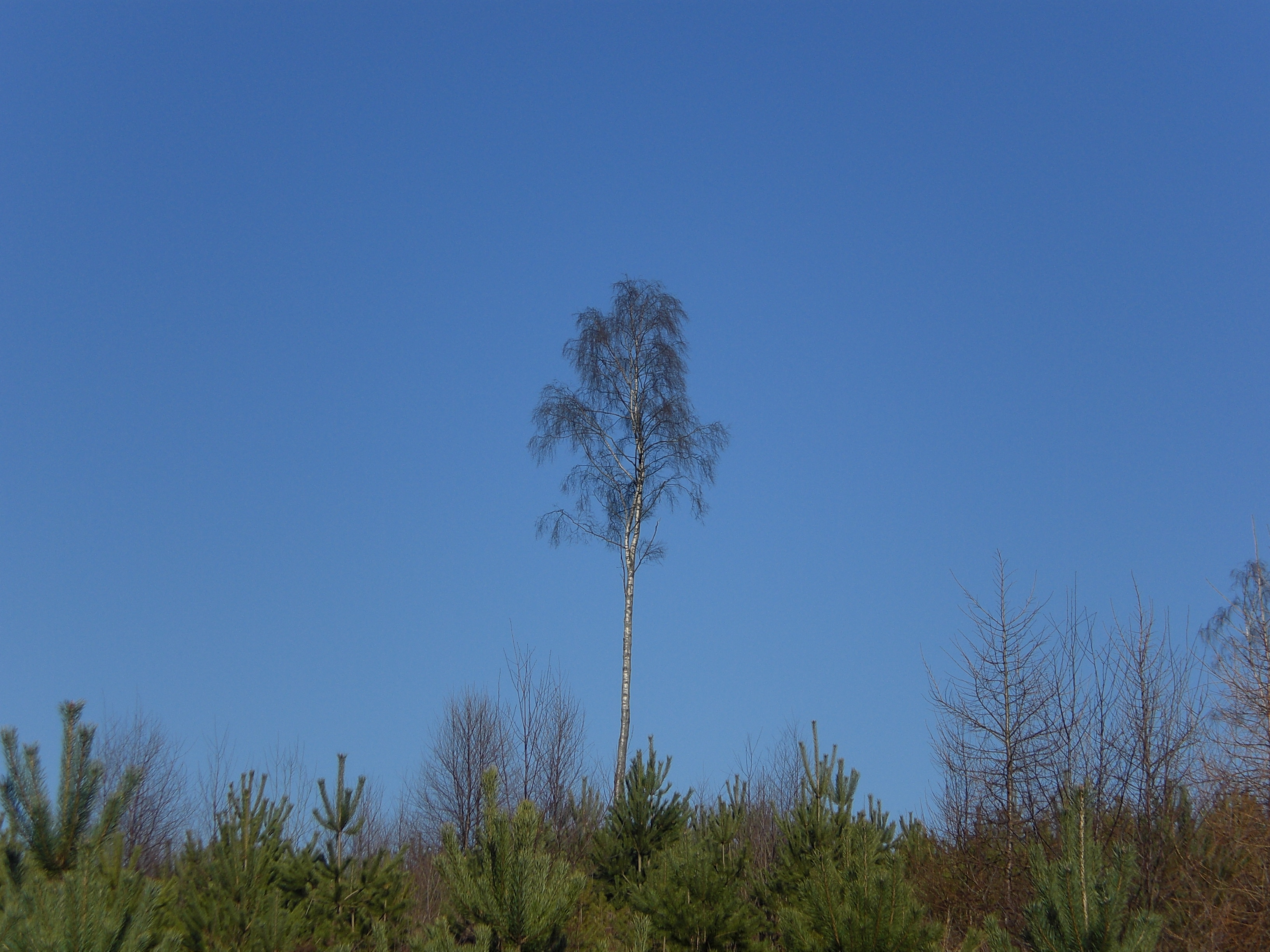
Looking up to the ridge, over the evergreen crowns, two spectral trees hang mid-air in the limpid heat. A smoke spiral, all coiled movement, settles to stillness as a Rorschach blot of charcoal smudge bleeds into sun saturated blue. The universe melts into my hands. A sublime stasis cupped and held close.
For how long is not the right question – linear time is of no help to us here.
The “caw caw” of a black craw – pierces the membrane of this no-time. The moment trickles away, dissolves on the ground, scattering the seeds of its eternal recurrence as memory…
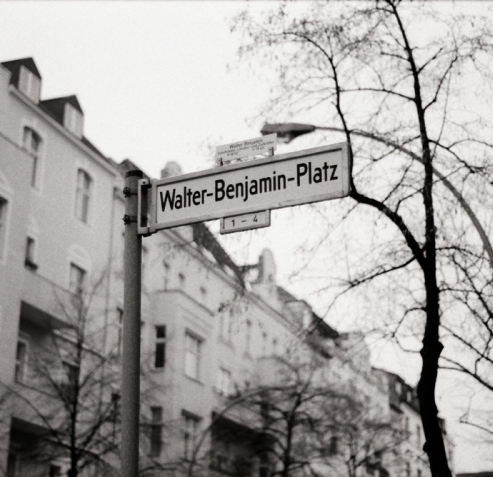
Memory is not an instrument for exploring the past but its theatre. It is the medium of past experience, as the ground is the medium in which dead cities lie interred.
Walter Benjamin
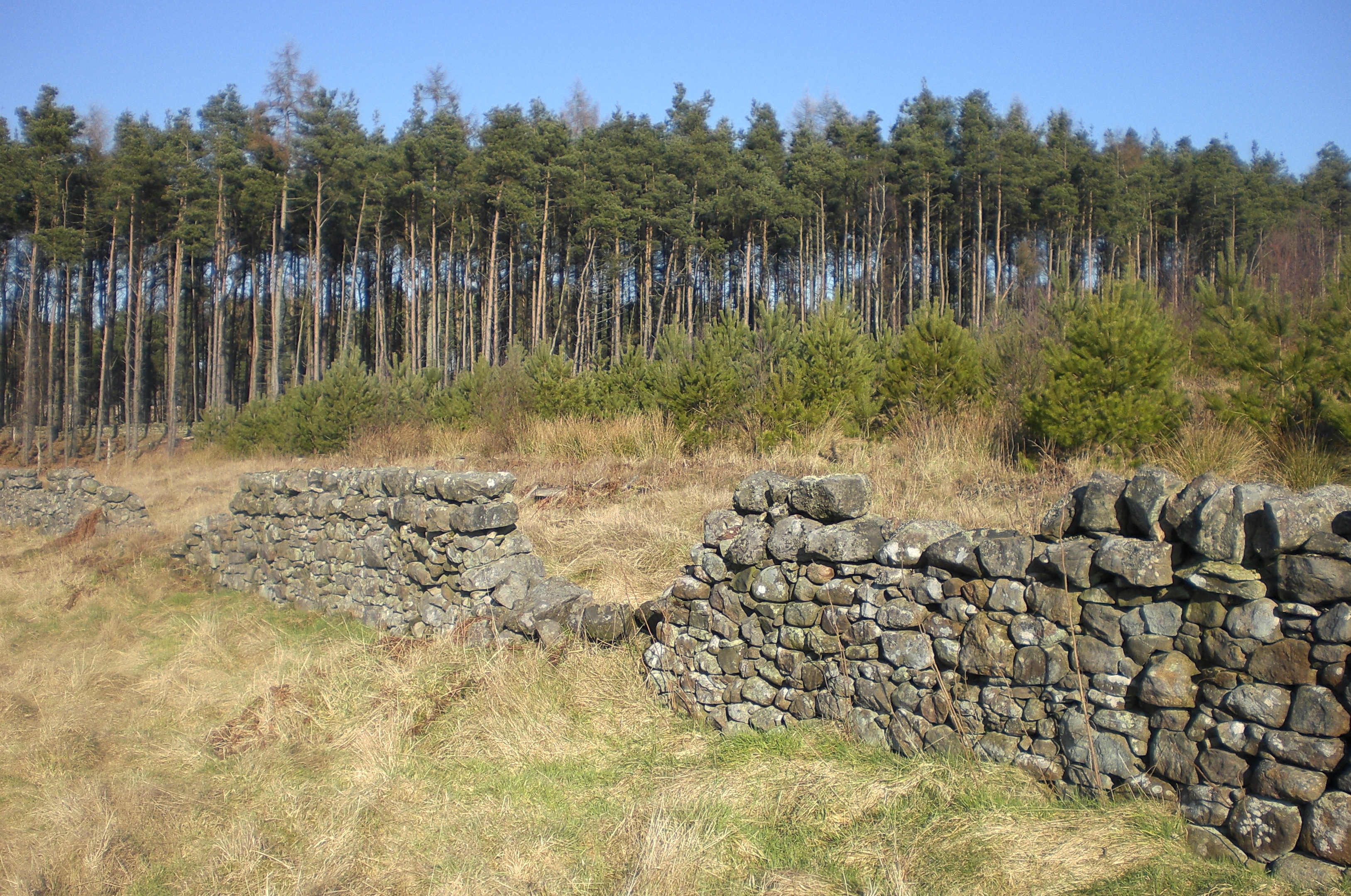
Just a brief extract from what will eventually develop into a longer piece or a series of shorter pieces. We have made a couple of visits to Devilla Forest, near Kincardine, recently and it is clear that it will take us a good few more trips to really get the measure of this place. Our foray into the heart of the forest last week was an exercise in getting hopelessly lost which coupled with the first intimation of Spring was no bad result. The overhead sky, was a cloudless colour field of bleached blue and once the sun was up it felt like the last of the winter murk was being cleansed away. We eventually ended up North of the forest climbing up to a ridge above the tree tops. Here we found the spectral trees and a curious weather mast amongst crumbling drystane dykes.
Devilla Forest is located just North East of Kincardine and the name is said to come from the Gaelic “dubh” and “eilean” meaning “black island”. The forest is now run as a commercial tree plantation by the Forestry Commission and consists mainly of Scots Pine, Norway Spruce and Larch. However, the area has a long history of land use with Prehistoric coffins, stone circles and Roman urns all found in different parts of the forest.
There are also plague graves, a stone which a local legend says is marked by the grooves from a witches apron string and the remains of a World War II explosives research establishment within the forest area. Combine all of that with four lochs/ponds, burns, meadowland and rich wildlife – including red squirrels – and it’s easy to see why this site should we worthy of further investigation.
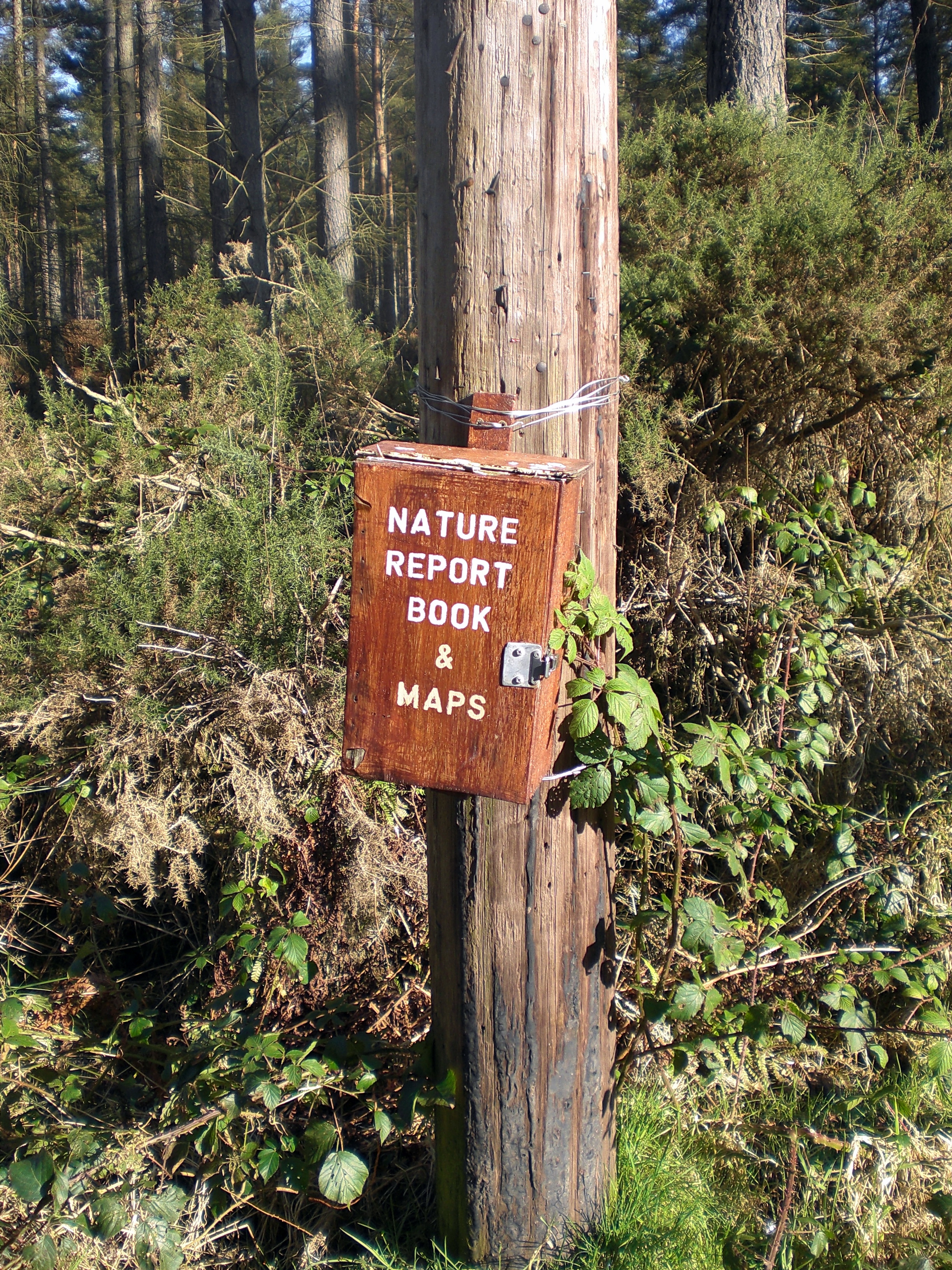
Oh and there is also a history of Big Black Cat sightings. We may have the chance to record one ourselves in The Nature Report Book.
Unfortunately there were no maps:
“I hunt among stones” – Charles Olson.
Prior to last week, we had made one previous brief visit to the forest on 23rd February. This date coincided with Terminalia, the ancient Roman Festival in honour of the god Terminus who presided over boundaries. Often his statue was merely a post or stone stuck in the ground to mark the boundaries between land. Aware that some psychogeographers throughout the country were commemorating Terminalia in some fashion, it was perhaps a serendipitous discovery to find some wonderful local examples in the forest:
This is a Meith Stone which has the St Andrews Cross carved in the top. The stones were used to mark land boundaries and sometimes initials were inscribed on each side of the stone denoting land ownership. Apparently five stones have been found along what would have been the old drove road between Kincardine and Culross.
This enigmatic looking stone is known locally as The Standard Stone, which according to local legend marks the spot where a Danish Army defeated Duncan and his generals Macbeth and Banquo in The Battle of Bordie Moor. (1038). The stone could also have been where the Scots army placed their battle standards, but is more likely to be the base of a medieval stone cross on a parish boundary or a wooden gallows.
From our initial couple of visits, we can feel that Devilla is going to yield up some interesting discoveries if we can manage to avoid getting lost next time. Then again that may be no bad thing.
The Owl is awaiting our return.
Now Playing: Boards of Canada – ‘You Could Feel the Sky’ from Geogaddi.
How could we not be intrigued?
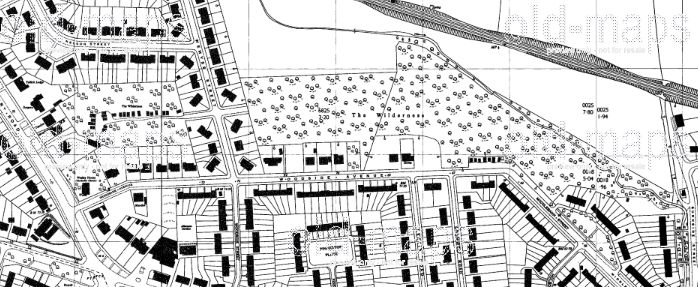
Casting an eye over some local maps from the late 1800s. Stumble and trip.
The Wilderness.
An actual place on the map.
The delineated form resembles a long-front-legged cartoon fox. We resist the urge to draw on ears, eyes, nose and a brush. Somewhat ironically, The Wilderness is represented by dotted clumps of trees contrasting with the surrounding patchwork of largely undefined white space.
A field trip beckons. Is it possible to visit The Wilderness as an actual place, rather than just as an idea? Is The Wilderness always just an idea, conjuring up clichéd images of distant rain forests, shifting desert sands or a featureless frozen tundra pulled towards a distant white edge of land and sky. What would this Wilderness look like in 2012?
On a sunny December Sunday of 2012 we set off to see what we can find and mentally attempt to visualise the area of the cartoon fox, as it is today. Our best guess is that if anything is left it may now be in the middle of a housing estate in Rosyth, Fife. There could also be a Tesco store and pub planted firmly in its hind quarters…
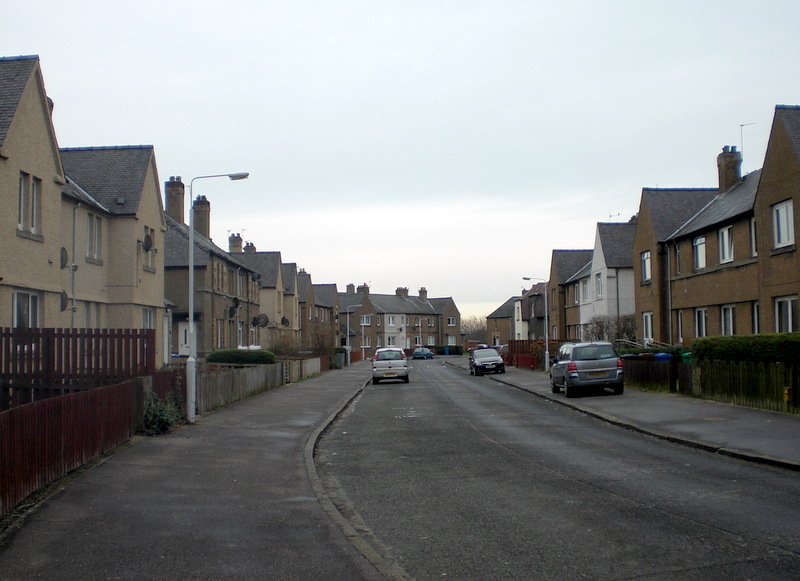
The above map dates from 1896 which predates the building of Rosyth, Scotland’s only Garden City. The town was built to service the Royal Naval Dockyard which began construction in 1909. The original houses were first occupied in 1915 and still stand, exuding a solidity and displaying attractive design features that would be alien to the mass, wooden boxbuilders of today. (Who would bet against the big bad wolf confronting a timber-framed flat pack?). The original tree-lined street plan also remains largely intact although you will have to search harder to find a front garden. Many are now paved over into parking spaces for the ubiquitous car.
Arriving in Rosyth, we orientate ourselves from the railway station and set off. As suspected, it is clear that the rear end of our fox, on the 1896 map, now houses a Tesco store with Cleos pub alongside. The main road through the town – Queensferry Road – dissects a later phase of house building on the other side. As we walk down Queensferry Road, there is certainly no obvious sign or hint of any wilderness. We can see some mature trees lining the side of the road but it is difficult to say whether these could be original Wilderness trees or part of the town landscaping plan. Following our noses we turn left into Wemyss Street and ponder on the name. “Wemyss” is derived from the Gaelic word ‘uaimh’, meaning ‘cave’. There are strong landscape resonances in Fife to the Wemyss caves up the coast, beyond Dysart but we guess that the linkage is more likely to be associated with the landowning Wemyss family. Descended from the MacDuff Earls of Fife, (Macbeth!) the Wemyss built their castle between what is now known as East and West Wemyss. There are certainly no obvious caves around, that we can see, but in appellation terms, the connotation of landed gentry hobnobbing with royalty sits well with the nearby Kings Road and Queensferry Road.
Walking along Wemyss Street, it does occur to us that this may be a short trip. We are surrounded by residential houses and yet looking at the map we must be walking over part of the fox’s torso mapped as The Wilderness in 1896. Maybe this is actually a walk of mourning. A wake for an idea that, for whatever reason, resulted in an area of land being named The Wilderness. We can also extrapolate from the local to the global and the sense of the Earth’s Wilderness footprint being appropriated, exploited, diminished and perhaps lost forever.
Wemyss Street, Rosyth
We continue to follow the sweep of Wemyss Street and start heading south when we come across a little cul-de-sac named The Woodlands. This feels better. The signs are singing. We can see trees to the East. This looks more promising – and it is.
Across the world, people have perceived forest wildernesses to be full of spirit, as if the real and visible world had an equally real but invisible world folded within it.
Jay Griffiths (Wild: An Elemental Journey, p. 53).
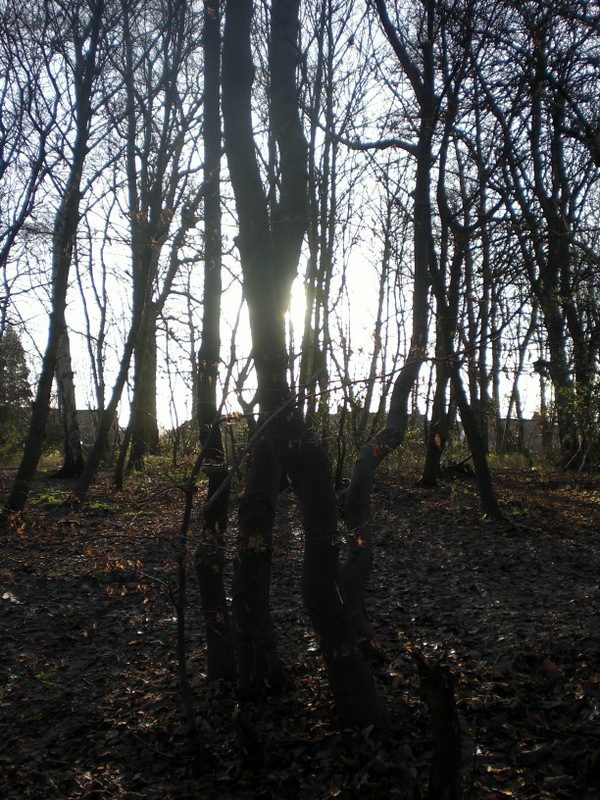
It never ceases to amaze how, within a few short steps, the feeling of our surroundings can change completely. Guy Debord talks of moving between zones of distinct psychic atmospheres in the city. We believe that this can also happen outwith an urban setting as described in our post on the Fife Coastal Path. This happens here. One minute we are unmistakably in a quiet residential area of a small Fife town. Our most noticeable observation is a black cat dozing contentedly on top of a blue plastic dustbin. She jumps down to greet us and walks a few paces alongside glad of the company. A few steps later and we are through that transition zone and enter The Wilderness. It really does exist.
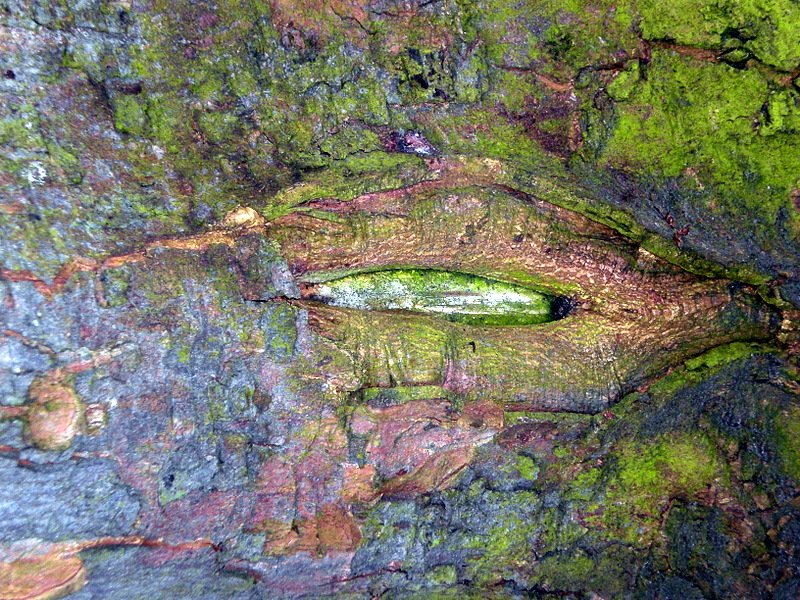
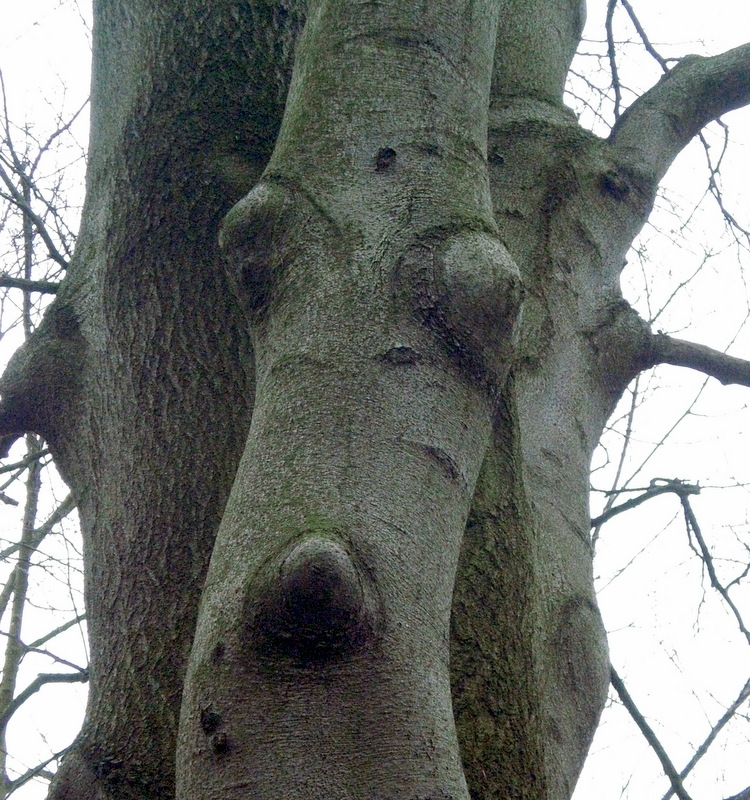
Tree mouth
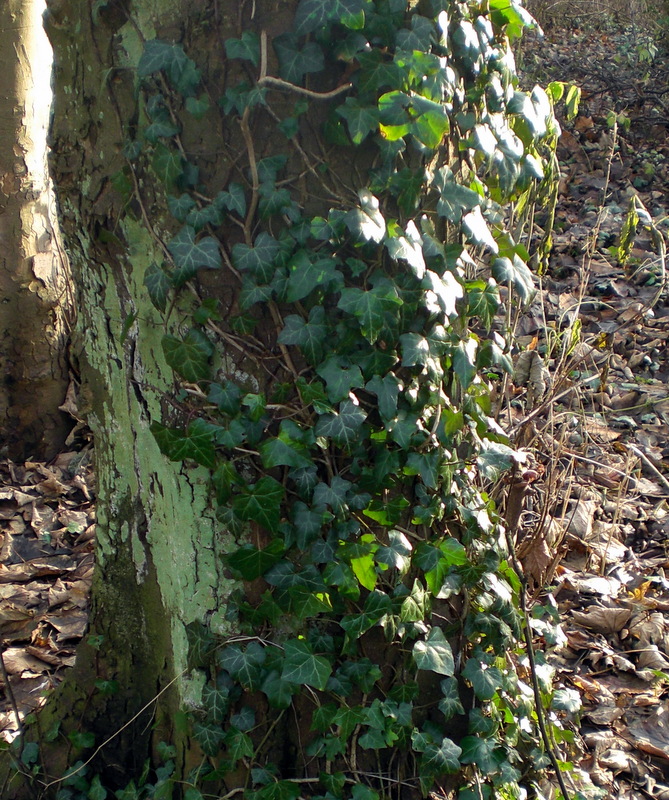
It’s good to feel the sun today. Fingers of warmth entwine and clasp hands amongst us. The lichens on my skin dissolve into light and the ivy loosens slightly. Stretching up towards the blue, a moment held in these short, chill days. Drinking from the earth, heavy with water. Sustained.
There are movers on the path. Coming.
Fingers of warmth entwine and clasp hands amongst uslichens on my skin dissolve into lightthe ivy loosens slightly
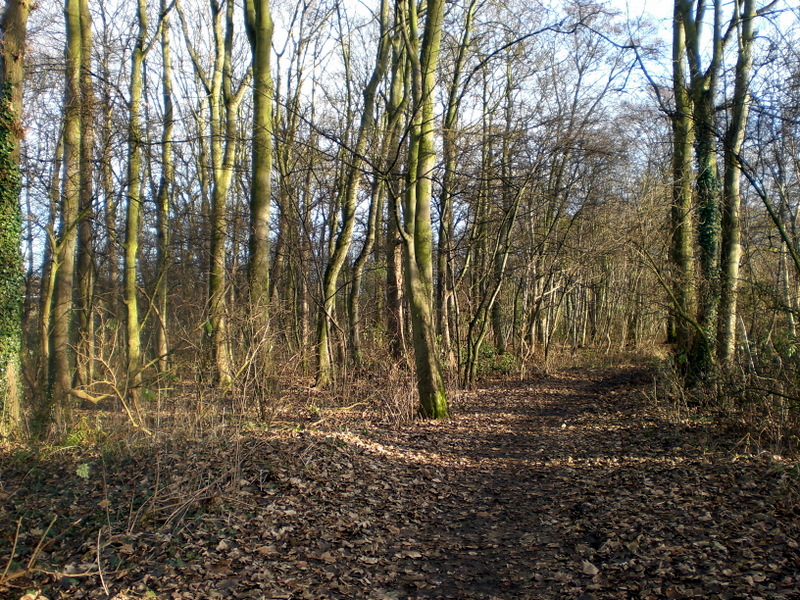
We enter the invisible, folded, other world of the wood. Old trees, bark encrusted with mottled green. Root formations resemble clawed, long-toed dinosaur feet. We expect them to lift free from the ground at any time.
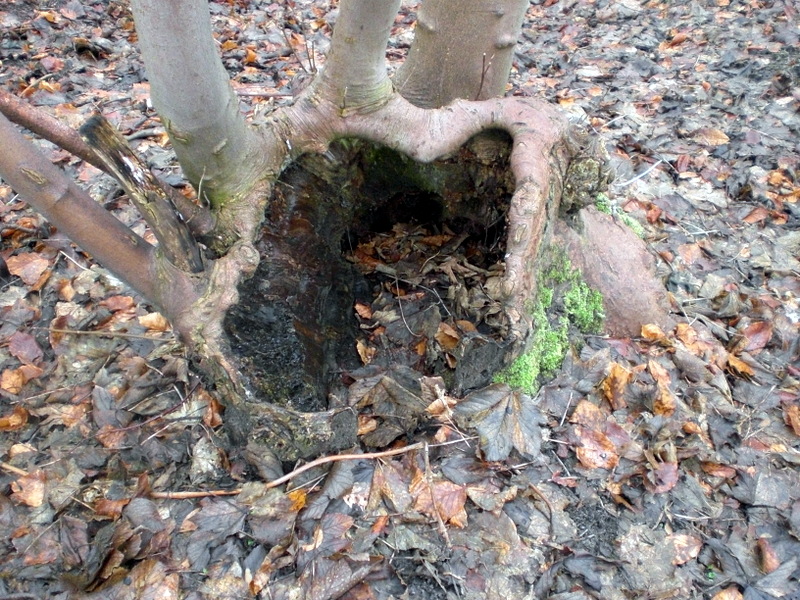
Hollowed out stumps of wooden teeth sup on leaves and sunlight.
There is a sense of a trail through the woods but little evidence of human visitation. During our visit no one arrives. No one goes. Just us. The trees and the sound and sense of birds. We find out later that there is no through-route. You have to climb a fence at the other end to get out so The Wilderness is effectively a bounded area. No doubt this discourages the use of the woods as path of transit, but perhaps helps to retain a little sliver of embedded wilderness.
We have often found that bounded, hidden areas become covert fly tipping sites but there is remarkably little evidence of this practice. A stray carrier bag probably relates to the two empty cans of Foster’s lager tossed aside.
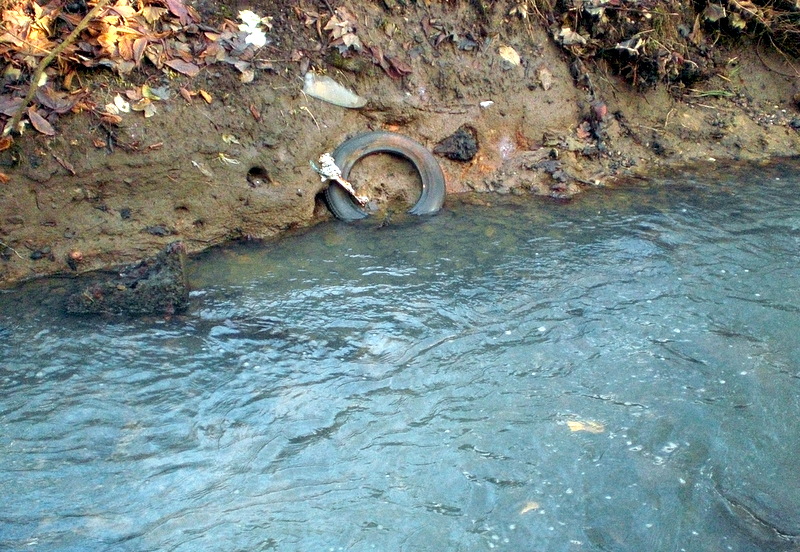
You can almost visualise the youngsters chipping in to scrape up enough money for their couple of cans before heading to the woods in anticipation of some bacchanalian wildness. We later find one car tyre and a bicycle frame. No white goods!
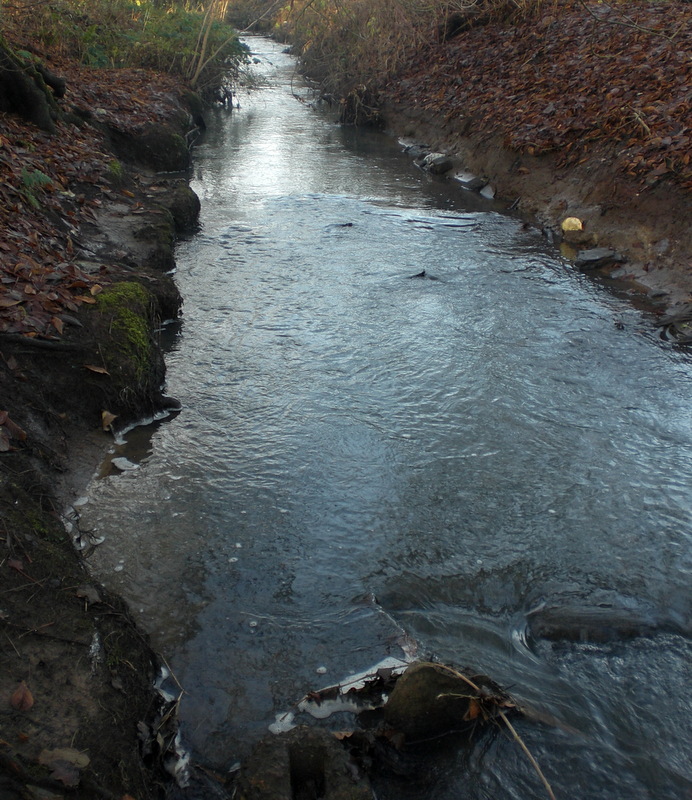
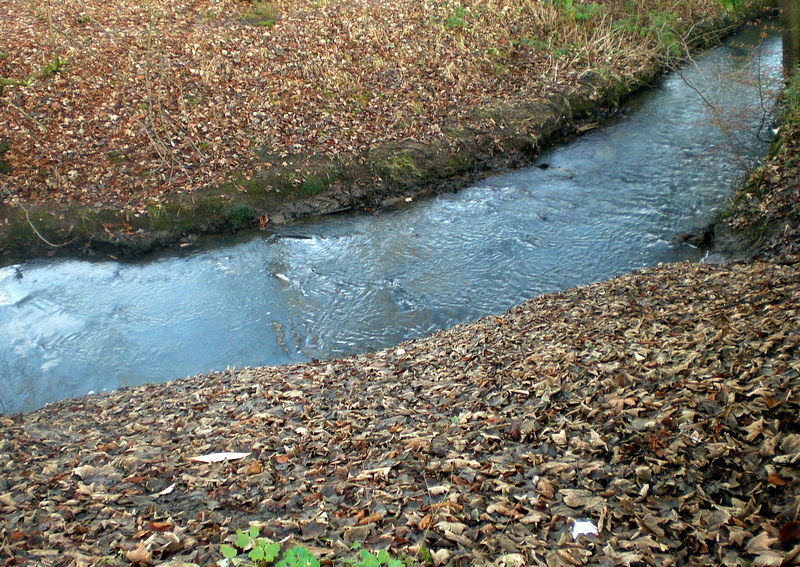
The purring murmur of running water soon entices and we follow the slope of the land down towards a wee burn.
Flowing here for many a year that’s what us wee burns do. The flow and the flux of the present moment, always existing in the eternal now. No history, no future, no time. Old Heraclitus was right you never step in the same burn twice.
Burn, stream, river, estuary. It’s all just a matter of scale.
A balloon lies trapped on the water underneath a branch. A human breath captured in time and space.
Imagine a situation where the last trace of human life on earth was the breath captured in a balloon? The most ephemeral of traces. Perhaps this is the breath of the Earth. The life-force slowly puckering, deflating, evaporating. If The Wilderness can exist in Rosyth, then why not the breath of Planet Earth?
We follow the burn through to the end of the wood, watched by the bug-eyed tree spirit. Chameleon eyes surveying, observing. Oblivious to time or circumstance.
Listening and watching the wildness of the fungi, spilling from the tree stump.
[L o s t t i m e i n t h e m o m e n t]
Over the fence at the other end and we are back in a residential street. We know that we are walking down the front leg of the cartoon fox. Appropriately, the road is called Burnside.
The paws of the fox mark the transition zone and we exit The Wilderness and track back through Rosyth past the Carnegie Institute.
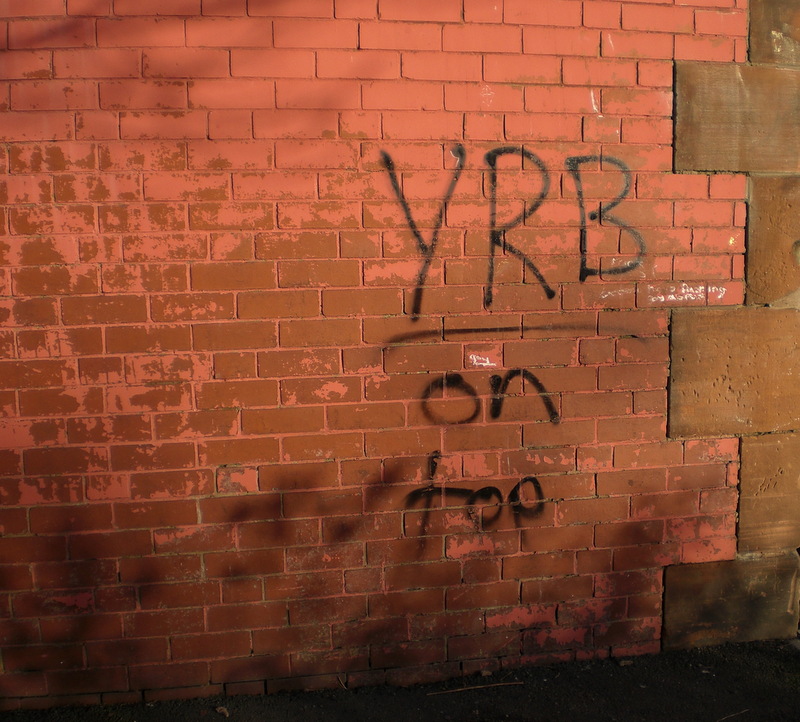
Back to civilisation, the chimneys, the birds and the tags.
Rosyth Institute – the chimneys, the birds
Appendix: The Wilderness over time
The Wilderness 1915
1915 – The Wilderness and our Fox are fully formed.
The Wilderness 1926-27
1926 -1927: The Garden City of Rosyth is now built. We can still see our fox although the rump has been annexed. A trail through The Wilderness is indicated on the map. Wilderness Cottage sits at the South West corner. Our best guess is that this was demolished and replaced by a new build church.
Wilderness 1952-66
1952-1966: New residential building has dissected our Fox’s torso almost right through the middle.
The Wilderness – 2013
2013: This is how The Wilderness is represented on Google Maps. Only a sliver of green remains – the head of our fox. The name has also disappeared but we know that however diminished it may be, The Wilderness most certainly does exist.
Now Playing: Andrew Chalk – The River that Flows into the Sands
References:
Jay Griffiths, Wild: An Elemental Journey (London: Penguin Books, 2006).
It is often the shortest journey, undertaken with least expectation, that offers up an excess of possibility beyond what we expect to see.
It’s always worth exploring the other side of the barbed wire fence.
Never keep to the path.
(Extracts from FPC Field Guide).
Time constrained by commitments later on in the day and yet compelled by the need to go for a walk, we settle on a local part of the Fife Coastal Path. The very short stretch between Inverkeithing and Dalgety Bay is a narrow tarmacadam / cinder ribbon of a mile, or so, that meanders around the coastline. Whilst offering fine views of the Forth Rail Bridge and over to Edinburgh and Arthur’s Seat it is unlikely to trouble any tourist brochure. Indeed, the walking guide for the Fife Coastal Path devotes one short paragraph to it. There is a clear implication that this is a space that you can simply pass through. It is also a functional path, popular with dog walkers, leisurely strollers and is even lined with street lighting. However, as the sign above indicates, the traveller is asked to keep within the marked path. We cannot help thinking of Little Red Riding Hood but can only read the sign as an invitation to stray …
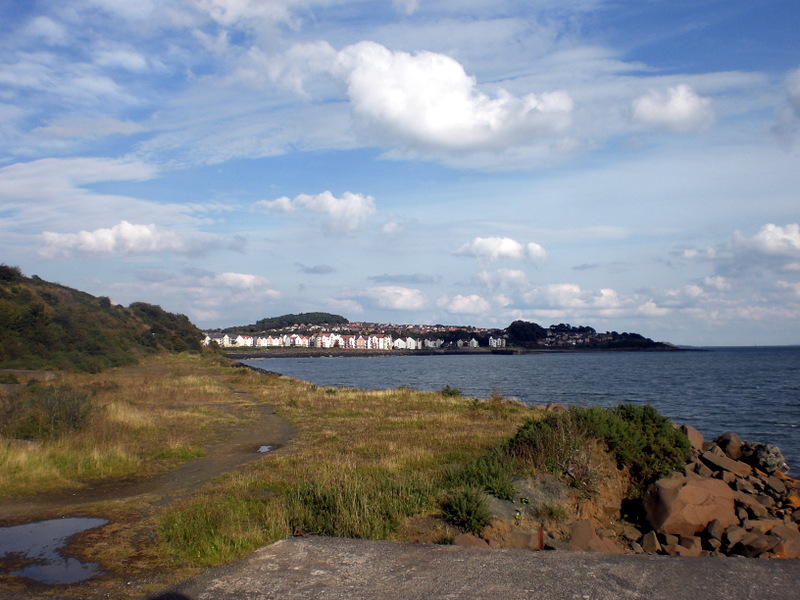
There is a distinctive topography to the land along this stretch of the path which edges around Inverkeithing Bay with sloping scrub and wooded elevations up to Preston Hill and Letham Hill behind. These factors and lack of road access, has prevented any urban coalescence between the nodal points of the old industrial harbour of Inverkeithing and the 1960s new town of Dalgety Bay.
Looking towards Dalgety Bay from Inverkeithing
However, there is also a distinct feeling of crossing a threshold, as you escape the gravity and material ephemera of the human settlement, and move into this zone from either end. A feeling of the wildness encroaching, long forgotten histories written into the land, whispered stories at the periphery of perception. A freeing up of the rules.
~~~
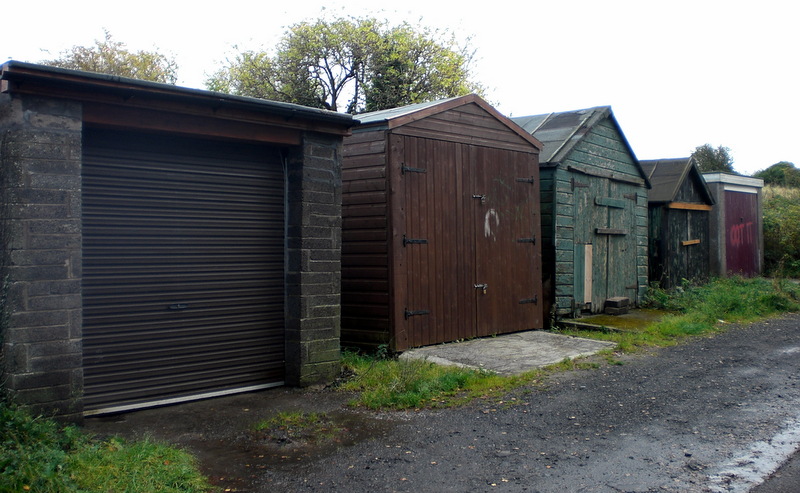
Lock-ups – Leaving Inverkeithing
Leaving from Inverkeithing, we walk past a row of lock-ups, that are not without some semblance of aesthetic beauty in their irregular order and contrasting colours. You wonder what is behind these out-of-the-way closed doors? Some have obviously not been accessed for some time given the overgrown vegetation in front. We also notice that as soon as you pass the last lock-up, the wild space is already there, encroaching green fingers, edging into the human space and into the photo frame. There is also a rather cryptic graffiti announcement:
Oot ItEntering / Leaving The Zone – Dalgety Bay
We are not sure whether to read this utterance as a comment on some existentialist predicament (“Out of it”) or a marker post to signify a transition point of moving out of the urban setting. (Moving oot it). Later on, when we reach the Dalgety Bay end of the path we find more graffiti on the first inhabited house. There is a clear sense that both of these graffiti bookend an entry – or exit. We read these signs as an intimation that what lies between these threshold markers is a different place – a zone. Not urban, yet not rural. Not even ‘classic’ edgeland. Instead, an indication that what lies within is an escape from the ostensible order of the settlements. Possibly a play area, a hidden place, an out of sight place, a gathering place, a wildness.
Follow the Desire Path
We are not far out of Inverkeithing when our advice to keep to the marked path is quickly discounted. We are drawn to the barbed wire topped, chain wire fence that we can see across a flat area of post industrial wasteland off to the left. It’s a pretty feeble attempt at preventing access as a whole section has been removed and most of the barbed wire has been snipped off.
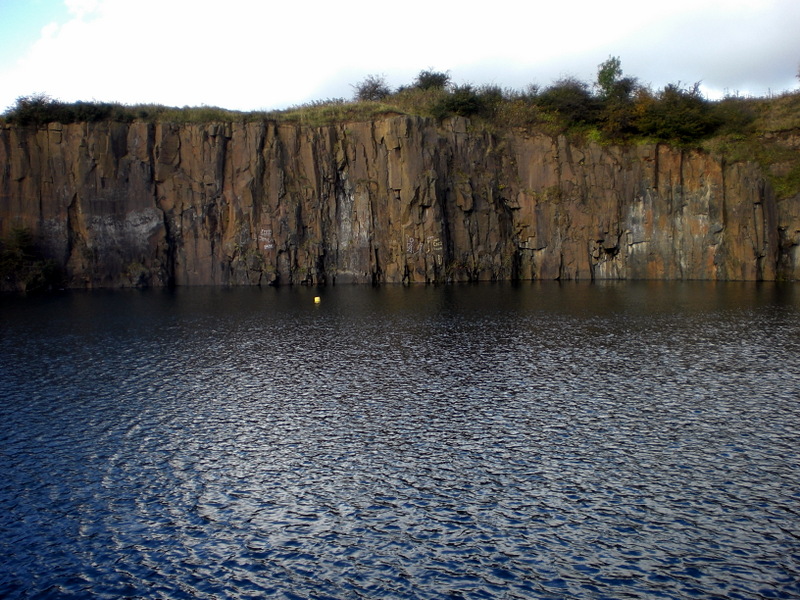
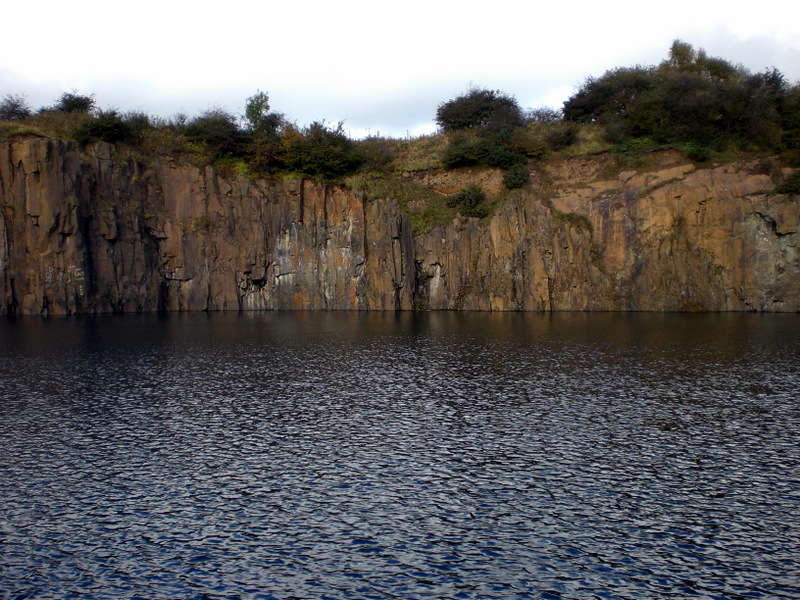
We follow the well trodden desire path through the fence to find ourselves in the heart of the abandoned Prestonhill Quarry, now filled up with water. There is a compelling, uncanny beauty to this place. A void gouged and hewn out of the Earth, with the remaining dolerite walls reflecting weak sunlight like a cubist canvas. The acoustic ambience has also noticeably changed. We are in a huge reverberating chamber so that the slightest noise pings around the walls. A distant ice cream van sounds as if it should be coming from somewhere within the quarry, possibly submerged underneath the water. At the same time swallows dart and zig-zag above our heads, whilst magpies hop and skip around the top rocks, observing us with curiosity. A couple of buzzards circle in the distance . There is no one else around.
Prestonhill Quarry – Cubist Walls ICubist Walls II
What is noticeable is that even in these most barren of conditions, non-human nature is restaking a claim with outcrops of growing vegetation, clinging to the quarry walls, thriving in the most hostile of conditions and the thinnest scrapings of soil.
Cubist Walls III
We soon find the ubiquitous discarded fridge. Lying face down, its broken body surrounded by other accumulated fly tipped debris. The human stain of the dumping ground. It is always a puzzle to consider the time and energy it must take to fly tip a fridge in an ‘out of the way’ area, such as this, compared with taking it to the recycling point. Perhaps it’s for the sheer visceral thrill of throwing a fridge into a quarry. We assume that it has been pushed over the top and has been there for some time.
~~~
There is perhaps another attraction of the quarry. It is an unseen place with very deep water. Every surface has another side. What else lurks underneath the skin of calm blue water? What is submerged down there in the green depths with the little fishes?
~~~~~
g
o
i
n
g
~~~~~
b
e
l
o
w
~~~~~
t
h
e
~~~~~
s
u
r
f
a
c
e
~~~~~~~~~~~~~~~
(c) Zibi(c) Zibi(c) ZibiFish in Prestonhill Quarry (c) Zibi
All underwater photographs of the quarry are by ‘Zibi’ and can be accessed here along with many others. Whilst we have attempted to seek permission from Zibi to use these images, we have not received any reply to our request. Clearly if our request is subsequently refused we will remove the photographs from the blog but in the meantime were are grateful to Zibi for their inclusion.
It would appear that the quarry is also a favored disposal spot for stolen cars, making for an ideal symbiotic relationship with the diving community who find the quarry an attractive destination for underwater exploration. There is plenty to see and investigate below the surface. We are also told later that local fishermen stock the quarry with fish which they then try to catch again, fostering a fledgling underwater eco-system. There are rumours that someone may have introduced a pike.
~~~
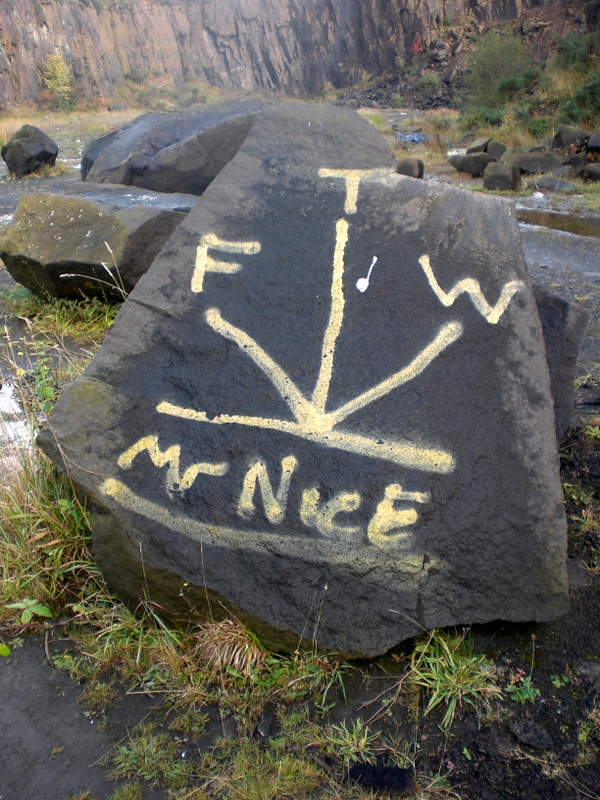
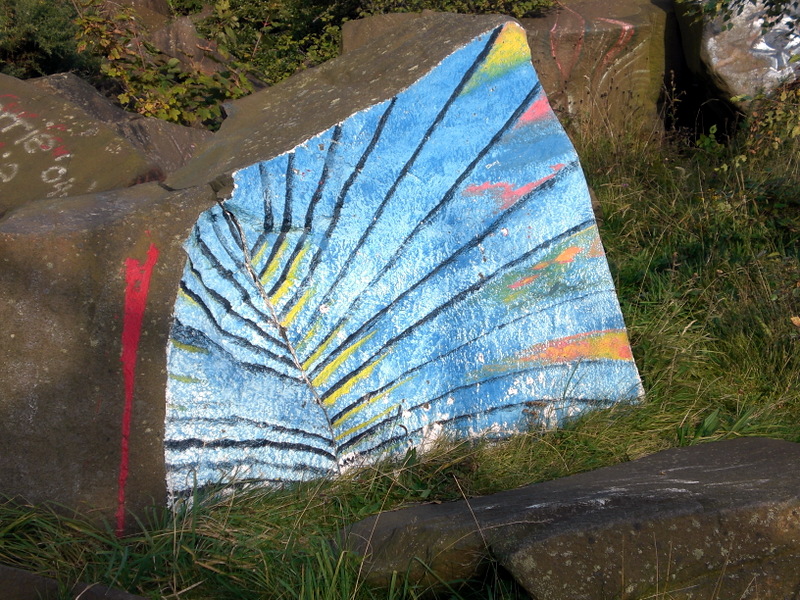
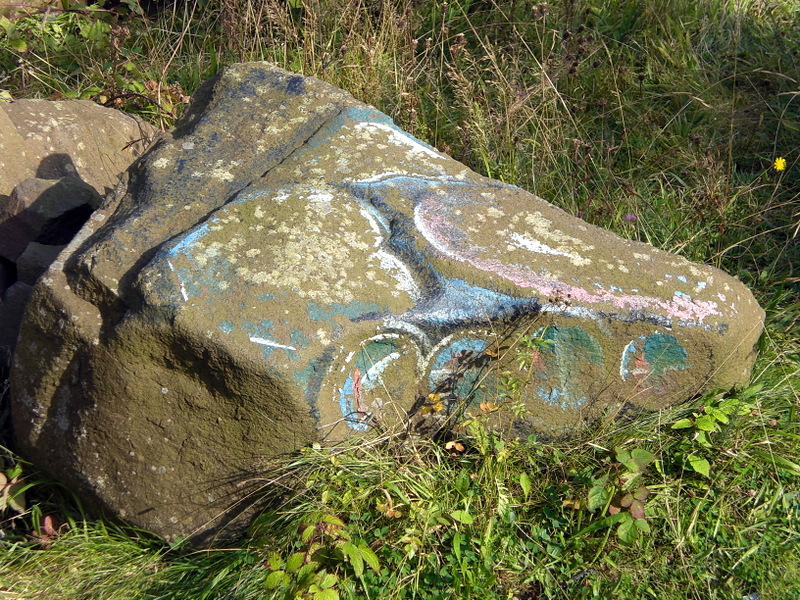
The quarry is also clearly a gathering place. A hidden place of escape and unregulated recreation. We walk around the void, recording some of the many tags that have been written on to the rocks.
Staring up at the quarry wall and contemplating the material passage of time ossified in these rocks. The play of light on the angular shapes conjures up dynamic planes of movement and appear to imbue the rocks with an almost animistic quality. We can eventually see a cubist rock giant, emerging from time with right arm raised:
Emerging Cubist Rock Giant
~~~
Back on the path, we head off to the right hand side this time.
Stretching out over the water is a fretwork pier of rusting metal which we find out later was the old industrial conveyor system used to load the quarried stone on to tethered ships.
We stand for a while to listen out for the lost sounds of this place. The kling klang ghosts of the industrial machinery, the heft of monolithic slabs of dolerite rattling down towards the waiting ships.
almost silent now
now almost silent
only the ack-ack-ack
of a solitary gull
riding the wind currents
overhead.
A large steel plate has been placed across the structure presumably in an attempt to prevent people from climbing out along the pier. It’s unlikely to be a deterrent but it no doubt satisfies some health and safety regime. The plate has rusted and weathered into something resembling a Richard Serra sculpture:
Richard Serra ?
Once again, we can see how the wildness is staking its claim with tendrils of green growing up, through and out of the lattice structure. “Shugg and Leanne” evidence the human urge to make a mark. The basic proof of existence. A name recorded. A demonstration of love?
Running parallel to the fretwork structure is another abandoned jetty. The pulleys remain suspended from the cross beam conjuring up something of the gibbet or perhaps some form of cosmic launch mechanism to project the traveller up and into the pillows of cloud:
all of this
abandoned history
lost stories, forgotten stories
sounds of absence
whispering in the wind.
We decide to explore a bit further underneath the conveyor structure sensing that this may yield possibilities. We are not disappointed when we alight on this gathering site:
What is noticeable is that there is no rubbish strewn here. It’s as if this is a place of respect. Strangely enough, the atmosphere evokes a similar feel to another outcrop of rocks that can be found on The Binn (Hill) along the coast at Burntisland:
Rock outcrop, The Binn, Burntisland
Humans have also made their marks on The Binn stones, albeit some 4,000 years earlier
Cup and Ring, The Binn, Burntisland
~~~
We pick up a bit of walking pace to take advantage of the seascape.
a sounded wave, persistent and seductive –
plays the shoreline.
flux and flow of sea brine –
a spilling over
of elemental energy.
Once again the unusual topography is such that we can hear a mash-up of field and hedgerow bird song against foreshore waders and gull talk. A chorus of crows, darting finches and tits; a wren bobs along the wall before taking refuge in the trees. What looks like a falling red leaf is actually a robin. On the foreshore, oystercatchers, and curlews wade and waddle whilst fulmars, cormorants and herring gulls dive and swoop. Symphonies of birdsong and gull chatter.
It doesn’t take long to reach Dalgety Bay, but just before the threshold graffiti we come across this:
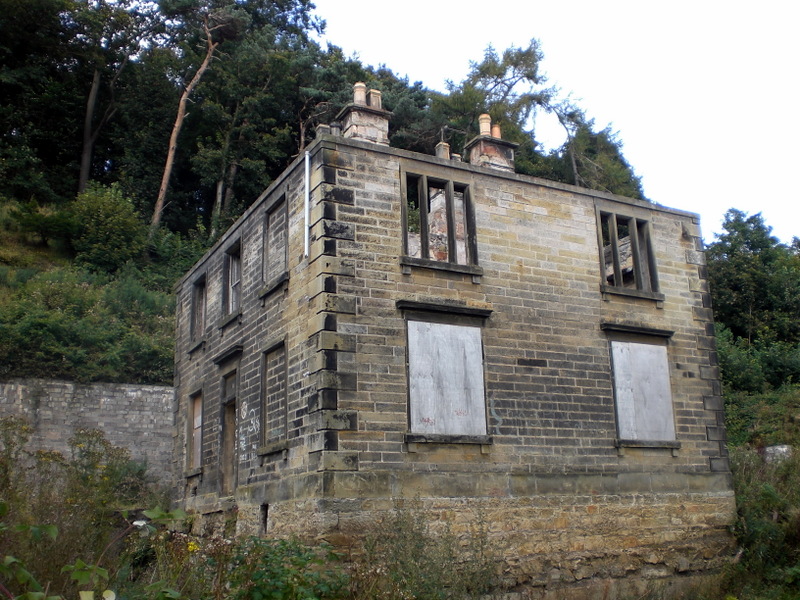
Abandoned House Dalgety Bay
Roofless and abandoned, it looks as if all of the surrounding land has been sucked away from the foundations leaving it sitting like an old tooth stump.
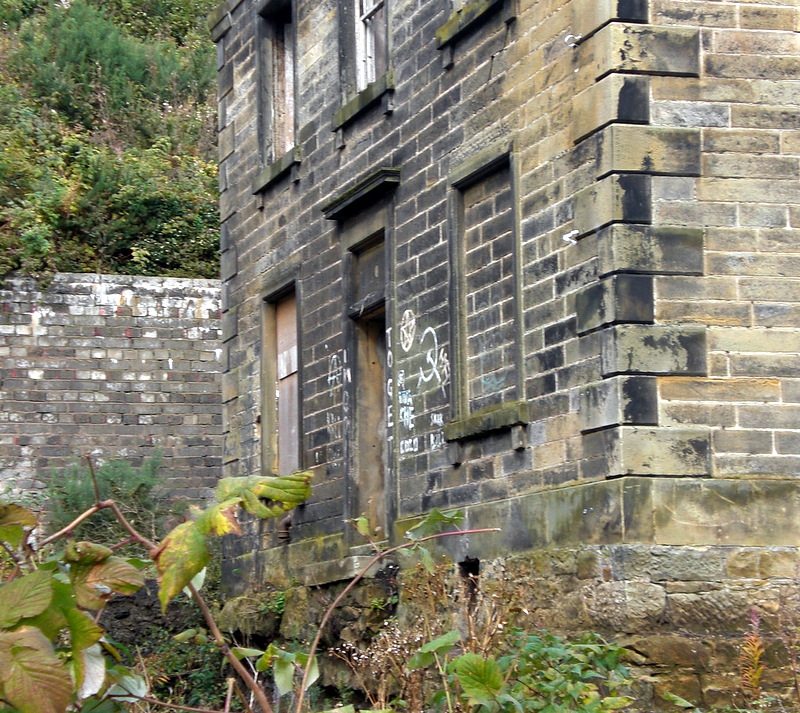
Doorway to Nowhere
We try to piece together a narrative here but fail. Why has it been abandoned? Why left to ruin? It was clearly a property that had wealth behind it at some point, sitting in its walled garden. Enquiries are made of a few passing locals but yield nothing. “It’s always been like that” says a man who looks to be in his forties. “Ever since I was a wee kid”. He doesn’t know the story though.
~~~
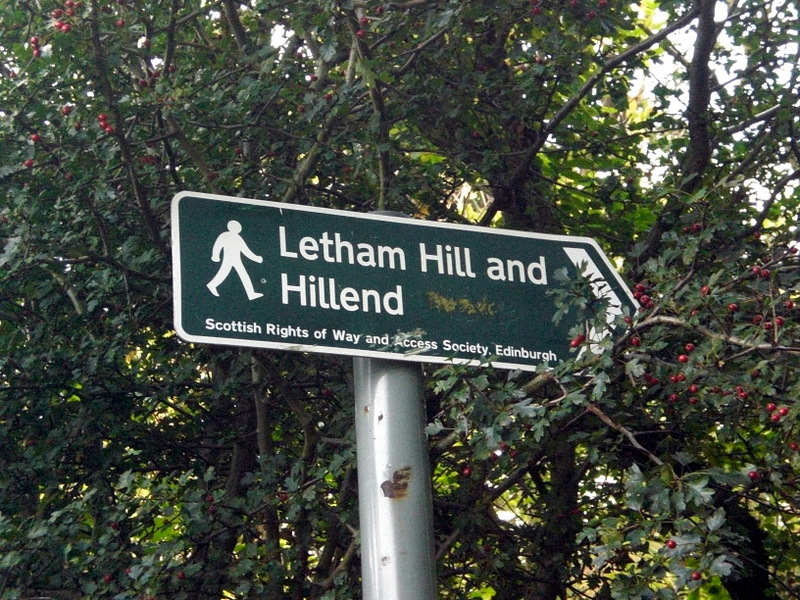
We are on the reverse trip back to Inverkeithing when we spot a small opening in the stone wall with a signpost:
How could we resist? Off up the rickety path which didn’t appear overly well trodden.
We find a beetle on its back on one of the steps clearly distressed. A multitude of legs. flailing wildly, unable to right itself. We soon tip it on to its feet and the little jet black shell scuffles off into the grass.
The path ascends fairly steeply and it’s not long before we find ourselves on a high ridge which slopes away towards Letham Wood. That will have to wait for another day. Our immediate area of interest lies off to the left. Another barbed wire fence and it’s as easy to circumvent as the last one. This is what we had been leading up to. We could already feel what we were about to witness but were unprepared for the sheer scale of it. Compared to the ground level, water-filled heart of the quarry, we could now gain a perspective of the entire void and walk right up to peer over the edge.
The VoidThe Void IIThe Void III
Peering over the side, into the void, it’s as if a vacuum is trying to suck your insides out. I’m reminded of Aragon in Paris Peasant and the ‘suicide bridge’ in Buttes Chaumont park – coincidentally built in a reclaimed stone quarry. Before metal grilles were erected along the side of the bridge, it would supposedly claim victims from passers-by who had had no intention whatsoever of killing themselves but found themselves suddenly tempted by the invocation of the abyss.
Our photographic skills are unable to adequately capture the scale of this almost mournful absence, hewn from the Earth. It’s a place to simply sit and stare for a while.
.
.
.
.
.
.
It’s often easy to forget to raise our heads to the horizon. Having escaped the seduction of the void, we now realise how high up on the ridge we are. It changes our sense of the whole topography of the area. We can see how connected we are to the East side of Inverkeithing and marvel at the long view over to Dunfermline. We can see Spinner in the distance with the distorted perspective making it appear as if it is growing out of a housing estate.
Spinner
We later discover that there is also an abandoned WW2 radio station complete with intact pill boxes not too far away but don’t see them today. Another time.
We descend back down the hill to the coastal path and reflect on our experience. What we had anticipated as a short, local coastal walk had been transformed into something else. A journey through a zonal space teeming with encounters and traces of the human, non-human and even the animistic. A co-existence of dumping ground, liminal playground, gathering place and nature sanctuary. The transient narrative of human activity inscribed in the abandoned house and the mute quarries and jetties a reminder of how financial capital abandons one exhausted void to migrate to the next site of profitable extraction.
Above all of this, the continually changing drama in the sky:
Sometimes it’s in the sky when you look – Buzzard dotsLooking to Arthur’s Seat and Edinburgh
Eye in the Sky
And as we return to Inverkeithing we can smell the sweet wood lying in the still functioning timber yard and take one last photo. It’s only later, that we notice that in this photograph, and almost all of the others, there is some intimation of wild nature straying into the frame.
An alert wildness, observing, perhaps patiently waiting for its moment to come.
Buildings loom over us and persist beyond us. They have the perfect memory of materiality
Longevity has no chance without a serious structure
Stewart Brand – How Buildings Learn
We finally got the chance to have a good investigative wander around the Summerhall building. Just in time before the Edinburgh Art Festival exhibitions close.
Summerhall is the old Dick Vet building (The Royal (Dick) School of Veterinary Studies of the University of Edinburgh) which has now been transformed into what must be one of the most unique art and performance spaces in the UK. (Europe/World/Cosmos?).
A previous visit was during the full-on party atmosphere of the Edinburgh Festival. Archie Shepp was performing in the Dissection Room, blowing his fire music and détourning jazz standards for the animal spirits. Quite a contrast to a September Saturday when you could wander through the building and its environs and rarely encounter another soul. With over 500 rooms, located over three floors, a basement and outbuildings, wandering the footprint of Summerhall is more like exploring a Borgesian labyrinth where encounters and exhibits are chanced upon and randomly discovered. Quite unlike the mapped-out, directional flow of the conventional gallery experience. Even spending most of the day at Summerhall, we still didn’t ‘find’ everything that was here – around thirty discrete exhibitions that are incorporated into the existing fabric of the building.
And what a building. Whispering from the walls and corridors, you can sense the stories and sounds that are soaked into this space. Stories not only of the human, but also the animals who have inhabited and passed through here: the corridors, the stables, the animal hospital, the dissection rooms…
Above the Entrance to 7x7th Street
First exhibition stop is the, rather playful, outdoor installation 7×7 by Jean Pierre Muller in collaboration with seven musicians: Robert Wyatt, Archie Shepp, Sean O’Hagan, Mulatu Astatke, Kassin, Nile Rodgers and Terry Riley. Muller and his stellar band of sonic explorers have created 7x7th Street consisting of seven wooden huts linked to a letter, a colour of the rainbow, a day of the week, a chakra, and a specific place. Riffing on these associations, each musician has then created an interactive sound sculpture tapping into their own diverse personal histories to create “new connections of knowledge, meaning and poetry”.
Robert Wyatt’s hut is ‘A’ for the Alhambra, the Red Palace. Monday, the first day of the week, so the day of the Moon.
Robert Wyatt 7×7
Inside Wyatt’s Alhambra, everything is under the influence of Clair de Lune. Audrey Hepburn strums a guitar and sings Moon River, Louis Hardin, aka Moondog, keeps watch over the lunar rockets and Neil Armstrong prepares for take-off.
Robert Wyatt 7×7 Interior
Archie Shepp’s hut is ‘B’ for the Blues and the B-line to Brooklyn. The colour of orange sits well with Tuesday, the day of Mars.
Archie Shepp 7×7Archie Shepp 7×7 Interior detail
Perhaps our favourite is Terry Riley’s ‘G’ for Galaxies, the colour violet and seventh day of the week, Sunday, day of the Sun. A hut of the Cosmos, the domain of The Sun King,
Terry Riley 7×7Terry Riley 7×7 Interior detail
What is noticeable in Terry Riley’s interior panel is a much reduced number of visual elements. Instead, symbols and motifs are treated to repetition, distortion, diffraction and linked up through connecting space. Much like Riley’s music!
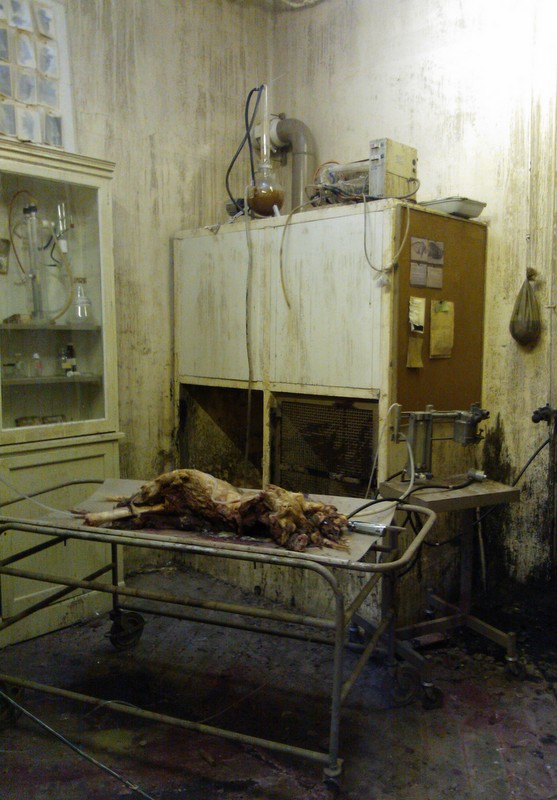
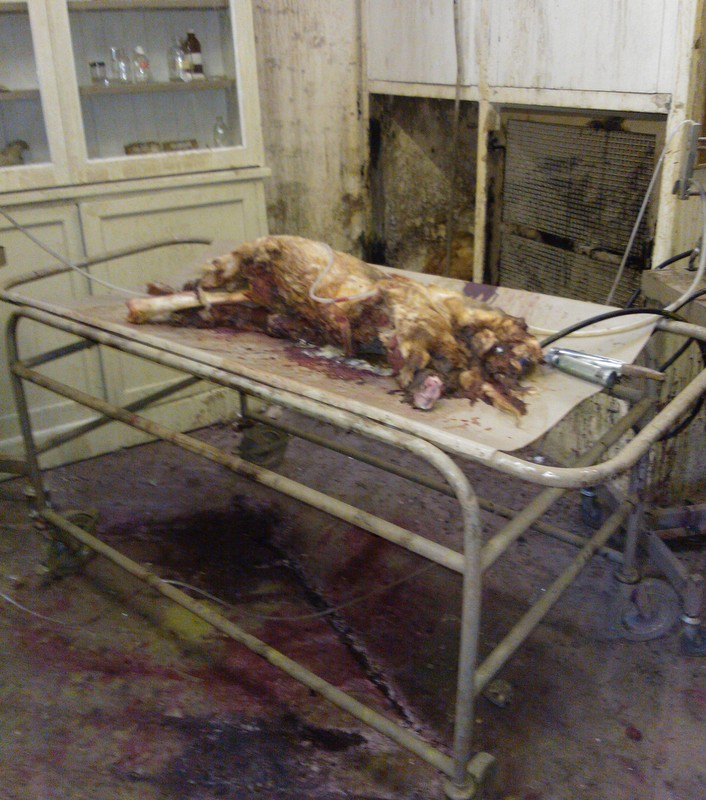
After the jaunty, neo-pop art of 7x7th Street, a sharper contrast could not be made visiting the Old Stables. Tucked in behind Robert Wyatt’s hut, this is the scene of Robert Kuśmirowski’s installation Pain Thing. There is a palpable change in atmosphere as you enter the building from the street. The colours of 7×7 Street leach out of the retina and fade to dirty cream and grey. Flecks of what looks like dried blood stain the floor and an oppressive air starts to envelop and smother. When we arrive in the main room – an asthmatic room – it feels like we are witnessing the aftermath of some post-apocalyptic scene. An animal experimentation zone where something has gone horribly wrong. The paraphernalia and apparatus of the medical research establishment lies around, test tubes, bell jars, pumps and instruments, some scattered on the floor. The torso of a unidentified creature lies on a hospital style trolley, limbs severed, bone sliced through:
.
.
.
.
.
.
This is not a place we wish to linger.
Inside Summerhall, the building retains its institutional air. Long corridors, unmarked closed doors, stairwells and the cell like structures of the basement. Signage still indicates past functions: The Post-Mortem Room, The Demonstration Room, The Anatomy Lecture Theatre. It is a great place to simply wander around, listening out for whispered narratives layered into stone, wood and glass. The fabric of the building is also used to good effect. The original laboratory benches are used for display purposes and basement cells exude a sinister ambience. One room hosts what looks like some restraining, torture chair and in another a dark sticky ooze spreads on the floor, apparently the residue from some long decomposed water melons.
.
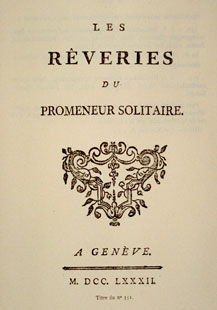
Chance discovered highlights include stumbling into Ian Hamilton Finlay’sFewer Laws, More Examples which examines Finlay’s response to and fascination with The French Revolution. An ambivalent mash-up of principle and virtue, but also fear and terror. Robin Gillanders’sThe Philosopher’s Garden Redux portrays ten photographs taken in the Parc Jean-Jacques Rousseau at Emenonville where Rousseau spent the last years of his life. Each photograph represents one of the ten walks of Rousseau’s last (uncompleted) book Les Reveries du Promeneneur Solitaire (1782).
“These hours of solitude and meditation are the only time of the day when I am completely myself”
Jean-Jacques Rousseau
The Richard Demarco Archives host a treasure trove of photographs and posters and are a wonderful tribute to Demarco’s visionary approach to curating art. There are legendary documented events featuring Joseph Beuys, Marina Abramovich and Tadeusz Kantor and Scottish artists such as George Wyllie and Jimmy Boyle. There is also a reminder that Demarco would take his productions over to Fife with photographs of Valery Anisenko’s production of Macbeth at Ravenscraig Castle, Kirkcaldy in 1996. A hand scribbled NB reads:
“MacDuff was the Thane of Fife. His Castle lies 8 miles down the Coast”
which indeed it still does at East Wemyss. Now a ruin, the site is associated with the MacDuff Earls of Fife, the most powerful family in Fife in the Middle Ages.
Venus with Severed Leg is a collection of photographs by William English documenting the early days of Vivienne Westwood and Malcolm McLaren’s ‘ Sex’ shop. The crucible for the birth of The Sex Pistols and Westwood’s influential punk stylings.
Venus-With-Severed-Leg (c) Summerhall
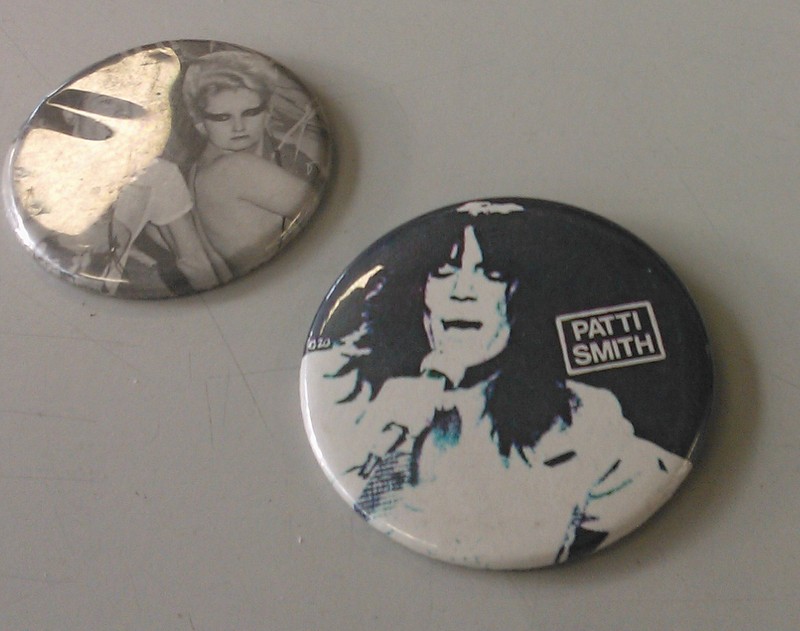
Phenotype Genotype (PhG) is a collection of documents, artists books, object multiples catalogues and other ephemera from 1900 to the present day. Displayed on the original college laboratory benches, it is perhaps a bit strange and even disconcerting to see Debord’s La Société du spectacle and Patti Smith pinbutton badges, displayed like museum exhibits, encased behind glass.
.
.
.
.
.
.
.
Also in the same room, painted directly on to the wall is The Periodic Table of Art. Executed with a certain touch of humour and perhaps also playing upon what appears to be a fundamental human need to catalogue, and document almost anything into a ‘meaningful’ taxonomy.
The Periodic Table of Art (Extract)Michaelek-After-Muybridge (c) Summerhall
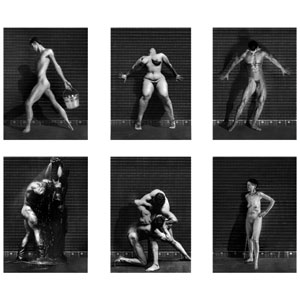
The absolute standout piece, however, is David Michalek’sFigure Studies and Slow Dancing. An utterly mesmerising, beautiful and thought-provoking 3-screen film installation inspired by the pioneering photography of Eadweard Muybridge. Michalek works with choreographers, dancers, actors and people from the streets of New York and has filmed them, unclothed, performing various 5 second human ‘actions’ in extreme high-resolution. These 5-second actions are then played back over a period of 7 minutes with every nuance of movement captured on the human body over this elongated time frame. The rich diversity of human form is portrayed across age, gender, ethnic diversity, shape and size. It also raises the question of whether ‘class’ is written on the unclothed body. This is a work that not only enriches and enthralls but helps you to see the world afresh outside of clock time. The work is further enhanced by the (uncredited) soundtrack which is used to great effect to compliment the images. The unmistakable slow breathing of Morton Feldman’s Piano and String Quartet.
Just before closing, we are trying to find our way out when we turn a corner and find ourselves facing the iconic image of Joseph Beuys. It is as if he is walking towards us, puposefully, the reflecting light creating a halo around him. As we leave, it is good to know that the spirit of Joseph Beuys is patrolling the corridors of Summerhall. We wonder if the vets ever treated a Coyote?
Beuys Halo – Summerhall
Now Playing: Terry Riley – Descending Moonshine Dervishes
Retain your memories
but détourn them
so that they correspond with your era.
Asger Jorn
We are in Berlin travelling on the U-Bahn to Kottbusser Tor in Kreuzberg. It is a gloriously warm April morning with fists of sunlight starting to punch through the clouds. From the elevated train tracks we can survey the sweeping spread of the city below. In the foreground, a graffiti inscribed, cubist assemblage written on to the earth. “How do they manage to get up there to paint it? asks R, pointing to a 3-D effect trompe l’oeil covering the entire gable end of a tall building. A and I marvel at the scale and ambition. An exploding riot of colour and illusion. We both shrug our shoulders…
I had been in Kreuzberg the previous evening at a gig in the HAU 2 theatre complex. (As an aside, I was delighted to discover later that this building was the original site of the Zodiak Free Arts Lab formed by Conrad Schnitzler, Hans-Joachim Roedelius and Boris Schaak in 1968. More on this below if interested. (1)). I didn’t have much time to stroll around the streets beforehand but picked up a little of the night ambiance. Clearly the zest to inscribe almost any available surface with graffiti and street art was alive and well. I realised that my previous visit to Berlin had been when the Wall was still standing and Kreuzberg was the beating heart of a chaotic, edgy, alternative radicalism. An enclave of squatters, artists and musicians, living cheek by jowl with the, largely Turkish, immigrant population. At the time it felt like some bunkered interzone within the island of Berlin. A city trapped and adrift in topography, history and cold war paranoia. Inter-railing around Europe, I remember having to scrape up the Deutschmarks to buy a ticket and visa to allow travel through the DDR from Hamburg. Walking out of Zoo Station with a head full of Berlin tropes: Bowie, Iggy, Lou Reed and Christiane F. I could imagine witnessing scenes of Blixa Bargeld and Nick Cave holding court in the bars of SO36 underneath the watch towers. On reflection, a romanticised, pop-culture depiction of the city shaped more by the NME than by any history or guide-book.
Around twenty-five years later I’m walking out of Kottbusser Tor station with the family still carrying these ghosts of memory. It feels a bit surreal to experience the bright sunshine and languid air of the street as we set off in search of the Turkish market down on the banks of the Landwehrkanal. We pass the grocery stores and a few cafes where groups of men (and it is all men) are sitting outside sipping Turkish coffee and gossiping. It’s only a short walk to the canal and it evidently becomes apparent that we have either got the day or our directions wrong. There is no sign of any Turkish market. Perhaps Bowie, Iggy and Blixa can help guide us? Feed us a few signs? However, R is already off. A nine-year old is not going to hang around whilst our putative tour guides attempt to get their shit together.
♦
Unburdened by worldly cares, unfettered by learning, free of ingrained habit, negligent of time, the child is open to the world.
Yi-Fu Tuan
Children are natural and consummate psychogeographers. They can happily drift through any environment, urban or rural, seeking out and following the signs of place that speak to them. With the city as potential playground R, starts to saunter on ahead of us, leading the drift, although, of course, not aware or caring that this is what is happening. We wander along the tree-lined canal path for a good stretch and apart from the dog shit, and occasional jogger, the city takes on an almost rural feel. Bowie, Iggy and Blixa are struggling to keep up. I think they may have stopped for a fag. The sunlight is clearly not agreeing with them.
I could feel the interest of our spectral trio dissolve even further as we sat down on a bench to marvel at two magnificent white swans and a group of mallards bobbing on the canal. “How do the swans keep so white in the city?” A pleasure boat chugs past and the gentle wake lip-lips against the canal sides. Our quiet reverie is broken when the larger swan rises out of the water, and extends its full wingspan. For a moment it looks as if the wingtips will almost touch either side of the canal. A few strong beats and the swan takes to the air. We wonder where it can be heading and whether the birds flew freely between East and West when the Wall was up.
Against a riot of cubist, Kreuzberg colour – “Fuck Yuppies – Reclaim the Streets”
a white swan rises from the water
outstretched wings unfurling,
almost pushing
the canal walls apart.
We can feel ourselves being pulled into another city world as a ladybird lands on A’s arm. I love how ladybirds always look hand painted. After watching it run over her skin, it pauses to open its tiny wings as if basking in the sun. R lets it run on to her fingers and kneels down to reunite the hand daubed, smudge of colour with the greenery beneath the lime trees. She discovers the bustling activities of an ant colony and we observe the industry of the leaf carrying comrades, marching in their regimented lines – lugging, organising, creating. Sucked in closer to the unfolding drama of this animistic, micro world, we start to notice other flecks of red and black moving amongst the earthy shades of leaf mould. They are not ladybirds. We are looking at hordes of small insects that are completely unknown to us. Some scurry around alone, whilst others pile on top of each other to accumulate into little shuffling balls of red and black. Too absorbed in the moment, we ‘forget’ to take a picture of them. It is only once we are home that we eventually manage to find an image and identify these mysterious little creatures as firebugs. From now on they will be known as The Firebugs of Kreuzberg.
Time has dissolved as we eventually head away from the canal and start to re-enter Kreuzberg street life. We start to notice the hum of cars again. A Mad Max biker type walks past with a tiny dog on a pink lead. The dog is sporting a bandanna. Our drift takes us up the entire length of Oranienstrasse, the main street of the district. It is still pretty quiet in daylight and we pass the door of SO36, the club where Bowie and Iggy used to hang out and, by now, have probably once again, taken refuge. R has commandeered the camera and is now taking photographs, still drifting through a city more akin to Hayao Miyazaki’s animistic universe than my one populated with spectral ghosts. The signs are speaking:
The Détourned Red Bulls of Oranienstrasse
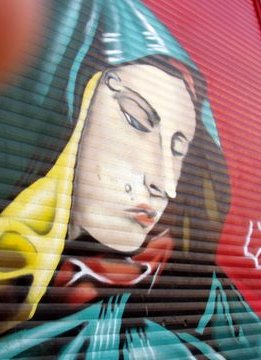
The Goddess and Protector of Oranienstrasse
The Visitor (detail from the side of a parked van)
We eventually return full circle and ascend the steps back up to Kottbusser Tor station. Our quest to find Turkish markets, and gain enlightenment from Bowie, Iggy and Blixa has failed. They have all remained spectral and elusive. Our drift has pulled us into another dimension of Kreuzberg. One of canal paths, white swans, mallards, ants, and détourned red bulls. Above all, we have discovered and witnessed something mysterious and new. The red and black insects that we now know as The Firebugs of Kreuzberg.
That’s all from the Berlin holiday. It’ll be back to Fife next. Possibly Cowdenbeath!
Now playing: Kluster – Klopfzeichen
♦ ♦
(1) HAU 2 and The Zodiak Free Arts Lab
I was excited to learn that, after a hiatus of twelve years, Keith Rowe, Oren Ambarchi, Christian Fennesz, Peter Rehberg (Pita) and Pimmon were reconvening their curiously named Afternoon Tea project for one night only in Kreuzberg. It was delightful happenstance to discover that this was happening on one of the nights of our holiday. I headed down to the HAU 2 venue and certainly wasn’t disappointed. One long piece saw this stellar ensemble layer up a set of dark, fractured shards of glitch improv, punctuated with blankets of shimmering serenity. A deep, meditative, all embracing sound. An unfolding. Ambarchi sat almost motionless unleashing his trademark sonic ‘depth charges’. The aural equivalent of watching and feeling a lava lamp. The bass resonance of the note entering through the feet and traveling up and out of the body. It was also good to see Keith Rowe having to play in a much louder and busier sound environment than the last couple of times I’ve encountered him. Fennesz couldn’t help but attempt to excavate and instil some melodic fragments into the proceedings whilst Rehberg and Pimmon intervened with pincer movements of laptop noise assault. All in all a fabulous event to witness and experience in the dark, minimal space of HAU 2.
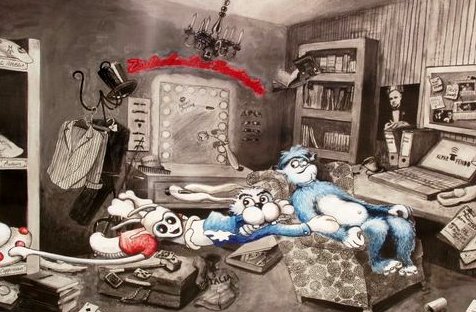
The happenstance of this event was further enhanced when I later discovered that HAU 2 was actually the original site of the Zodiak Free Arts Lab or Zodiac Club, formed by Conrad Schnitzler, Hans-Joachim Roedelius and Boris Schaak in 1968. Whilst only open for a few months, the Zodiak was a melting pot where “freaks and avant-gardists of all stripes could enjoy live psychedelia, free jazz, free performance and freakout”. (A1). It was a space also directly responsible for the emergence of Kluster (Schnitzler/Roedelius/Moebius) and Tangerine Dream, at that time with Schnitzler and Klaus Schulz in the ranks. This early incarnation of the Tangs is light years away from the vapid new-age pap that they later embraced in the 1980s.
The first few Kluster albums were engineered by a young Conny Plank who brought his experience of working with Edgar Varese to give some shape and coherence to the brutalist improvised chaos of this embryonic kosmische music. With the subsequent exit of Schnitzler and a later name change to Cluster, the sound took on a softer edge and the recording of classic kosmische albums such as Cluster II, Zuckerzeit, Sowiesoso and Cluster& Eno. The Zodiak also hosted performances by, amongst others, Agitation Free, Ash Ra Tempel, Human Being, Peter Brotzmann and Alexander Von Schlippenbach.
I love it when buildings can reveal their embedded memories like this. From a few months activity, the ripples from the epicentre are still being felt.
(A1) Nikolaos Kotsopoulos (Ed), (2009), Krautrock: Cosmic Rock and It’s Legacy, (London: black dog publishing).
I rediscovered this photograph recently which was taken a couple of years ago at Machrie Moor on the Isle of Arran. We were on holiday and I went out at around 6.00am to go for a walk before the family were up. It’s about 2.5km to the stones from the closest road, which is long enough to immerse yourself in the feeling of the place. The photograph is of the main grouping of stones which stand amongst a ritual landscape consisting of seven stone circles, several chambered cairns and hut circles. A highly evocative liminal landscape to wander alone in the thin morning light wrapped in light drizzle. Whilst written at a different time of the day, I cannot better the feeling described by John McArthur in The Antiquities of Arran (1861):
We have never witnessed a wilder and more grandly solemn scene than these old circles on the Mauchrie Moor, looming in shadowy indistinctiveness of an autumn moonlight…as we wandered amongst the old ruins, the weirdly stirring legends of the past haunted our mind, til the wreaths of mist seemed to float about like shadowy phantoms and the circling monoliths and hoary cromlech appeared to rise from the heath, like ghosts of the heroes of old, bending around the grave of their buried chief.
On my way back to the road, I’m reflecting on the tales of local folklore and particularly the stories of the bocans (malign spirits) which are said to inhabit the area. I’m rolling some sheep trintle in my hand – those soft wisps of wool which get snagged on fences or whin. It was as quiet as a remote landscape could be. Only the occasional bird call, a tuft of wind, the soft fizz of drizzle. Amongst all the greens and browns, I’m distracted by an impressive growth of witches butter, that bright yellow, almost golden fungus and head over for a closer look. I’m just about to step over a large tuft of moor grass, when, as is their wont, a pheasant takes wing from almost underneath my foot, squawking like a banshee. As the bird ascends in that awkward, unbalanced, flapping squall a tail feather whirligigs down from the sky which I manage to catch just before it hits the ground.
A gift from the moor dwellers to soothe my pounding heart.
Pheasant Feather/Sheep Trintle Cloud
Now playing: Eliane Radigue – Koumé, the third part of Trilogie de la Mort.
We are in dangerous territory, walking westward out of the town of Rosyth, along the A985, one of ‘Britain’s killer roads’. This arterial incision into the connective tissue of the Rosyth edgelands is to fully engage with the disruptive polarities emanating from two monolithic structures, which have recently appeared on either side of the road. There is a real sense that the landscape, skyscape and mindscape have all been irretrievably altered. Whether this is benign or malevolent who can say? It is this that we must investigate and address head-on with our dérive. Establish relations, resist, remap, and reclaim as necessary.
As we set off, along the ridgeline of the A985, there is an undercurrent of fear that a vortex of radiant, colliding energies may threaten to rip us, stalking walkers, apart or even lure us into the path of oncoming traffic on the killer road. This is a risk that we are prepared for and must take.
♦
The first stretch of road between two roundabouts is almost classic edgeland topography. On the right hand side, the small favela of allotments, with waves of canes, poles, pallet fencing and water butts; shanty sheds and corrugated iron knitted together with plastic pipework. There is a disordered/orderliness about the place; a charivari of utility and resourceful exchange, which resists the carefully manicured garden porn displayed in garden centres and lifestyle magazines. You can tell that this is land that is worked, loved and loves back.
On the other side of the road, past the football pitch, stands the ‘old Lexmark building’, supposedly the location of ‘the factory’ in Gregory Burke’s play Gagarin Way. We have investigated this building before and continue to monitor its energy levels , but no sign of the smoked salmon fishes as yet.
As we traverse over the second roundabout, there are clear intimations that the interzone between the town and edgelands has been breached. For the car driver, flooring it off the roundabout and opening up to the straight road ahead it’s as if the gravitational pull of the town loses its grip, supplanted by a carnivalesque impulse to wind down the window and toss the debris of consumer society into the hedgecomb of trees and shrubs edging the road. Here lies a graveyard of inert excess, an inventory of impulse purchases; eating and drinking on the hoof and a veritable time capsule of the non-biodegradable floatsam of consumer culture. Like true twitchers, we must record our spoils:
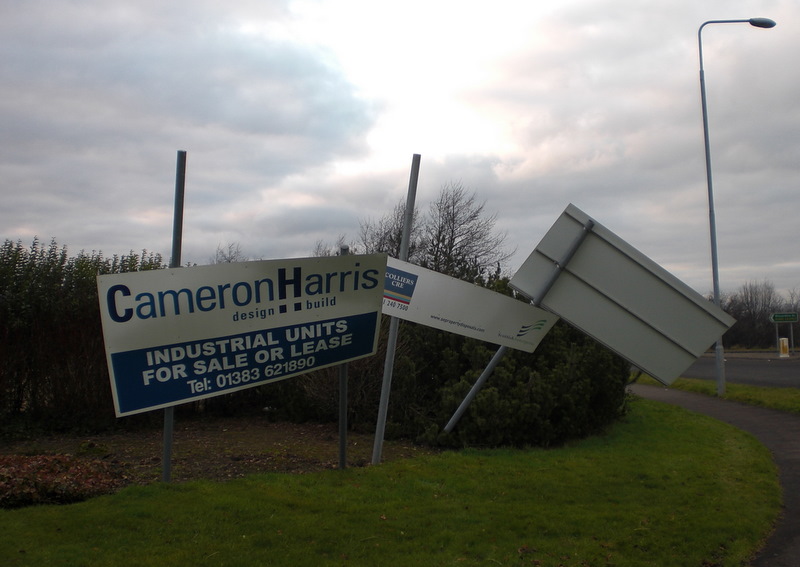
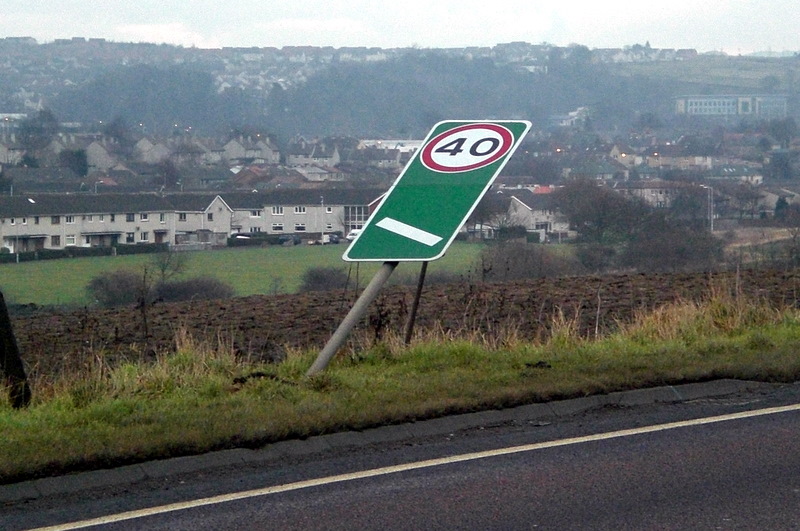
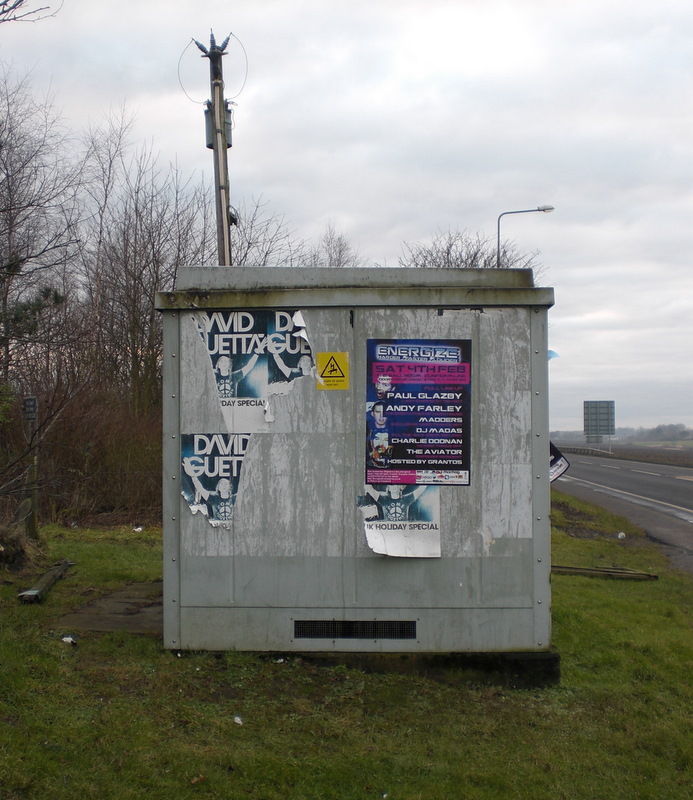
We are also struck by how the edgelands are places where things are simply forgotten about. Advertising signs from a more benign economic environment offering ‘Industrial Units for Sale or Lease’ are falling down and are never replaced; road signs tilt at 45 degrees; posters on substations intimate long forgotten concerts and doors on the mysterious roadside bunkers have all disappeared.
We are now out in the true edgelands, hugging the ribbon of verge by the side of the road as every vehicle utterly tanks it past us. We are pebbledashed by huge swathes of road spray and the draught, from the huge artic lorries that pass, threatens to pull us foot-powered perambulators into the middle of road. However, the objects of our effort and attention can now be clearly seen on either side of the road. We can feel their energies drilling into us and can only marvel at the scale of their transforming presence on this stretch of the edgelands. As long as we can stay vigilant and remain on the ribbon verge, we can resist the siren call urging us into the killer road.
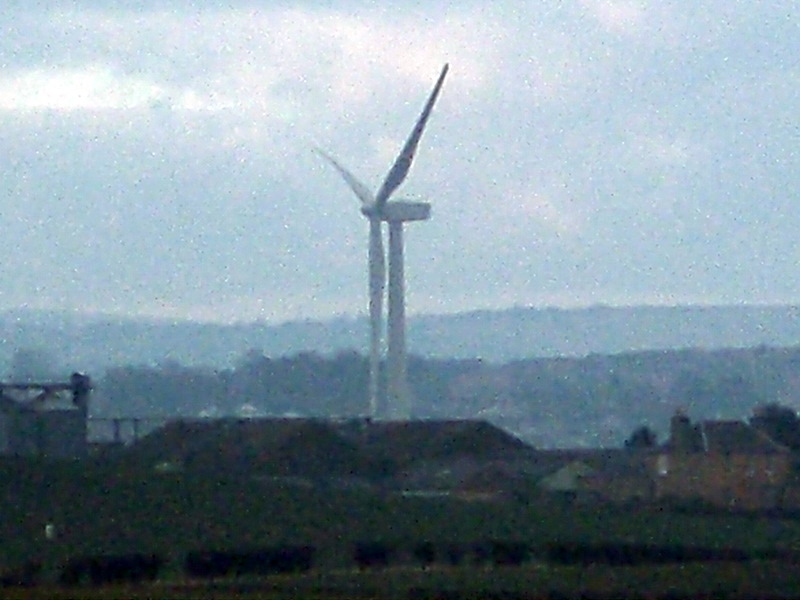
Over to the right, in the middle distance, is a 100 metre column, on top of which sits a rotating turbine with three, colossal, scythe -like blades. This somehow reminds us of the free gifts of plastic spinners that you used to get sellotaped to the front cover of children’s comics like The Beano and The Dandy. Thus we have a name for our monster – Spinner – a vital part of the engagement and neutralisation process. Spinner is of such a scale that it doesn’t look quite real. It’s as if it is projecting some perspective morphing force field which shrinks or obliterates the elements within the landscape which offer any indication of human scale.
Spinner belongs to FMC Technologies, a Houston, Texas headquartered business, which manufactures subsea systems for the oil and gas and renewables industry. The 1.5MW turbine is projected to supply up to 40% of their energy needs at their Dunfermline facility and was financed by Triodos, the ethical bank. We stand and watch the strange poetry of the rotating blades dancing with the wind, quite hypnotic and completely silent from our vantage point. There is some some sense of good energy radiating from this structure and there is a fluidity and engagement with the elements. Spinner could probably only be a product of the edgelands. A place where a turbine of this size can be erected then lost and forgotten, despite it’s landscape transforming qualities.
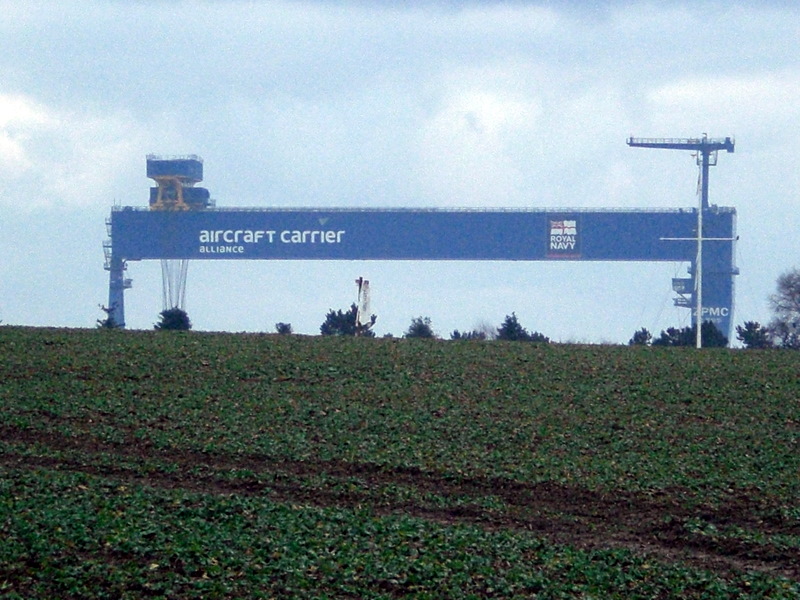
If Spinner has a slightly ethereal, alchemical quality, transforming wind into electricity, over to our left is a structure that looks as if it is marauding up towards the ridge, like a mechanised robotic toy about to attack. This is the aptly named Goliath crane recently transported from China’s Shanghai Zhenhua Port Machinery Co Ltd, where it was manufactured. Goliath is the largest crane installed in the UK and across its 120m beam is the clearly visible signage:
aircraft carrier alliance
Goliath sits in Rosyth Dockyard which lies over the hill down on the Forth. In effect, we are only seeing the top of the crane which at 90m high almost rivals Spinner in height. Goliath is part of the most expensive project in British naval history with two aircraft carriers presently being constructed at £3 billion a pop. We have already been told that once constructed, one will be mothballed immediately and the other will have no planes to fly from it. Try explaining this logic to a five year old. The carriers are to be named HMS Queen Elizabeth and HMS Prince of Wales. The sheer folly, financial carnage and symbolism of this whole escapade is such that it almost fries our collective brain into meltdown. However, very soon we are all whistling and singing Elvis Costello’s Shipbuilding – the Robert Wyatt version naturally – so we can hum the piano solo with our kazoos. This has the desired effect, tames the beast and calm descends. As we walk further along the road, we can gain a better vantage point to look down over the dockyard and see the true scale of Goliath. Our fear turns to pity as we realise that all we are looking at is simply a dumb, beast of burden, a heavy lifter, on which has been foisted the indignity of jingoistic colours, the White Ensign flag and the reek of failed empire. Also lurking down there, somewhere in the bowels are seven decommissioned nuclear submarines, still radioactive and we are reminded of some possibly apocryphal tales of technicians metal-capped boots glowing green in the dark. Isn’t it amazing what can be buried in the edgelands.
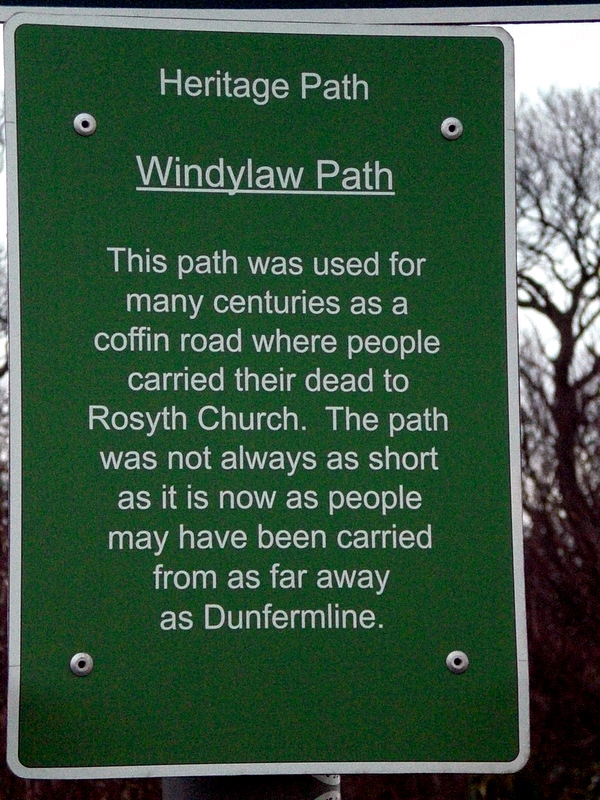
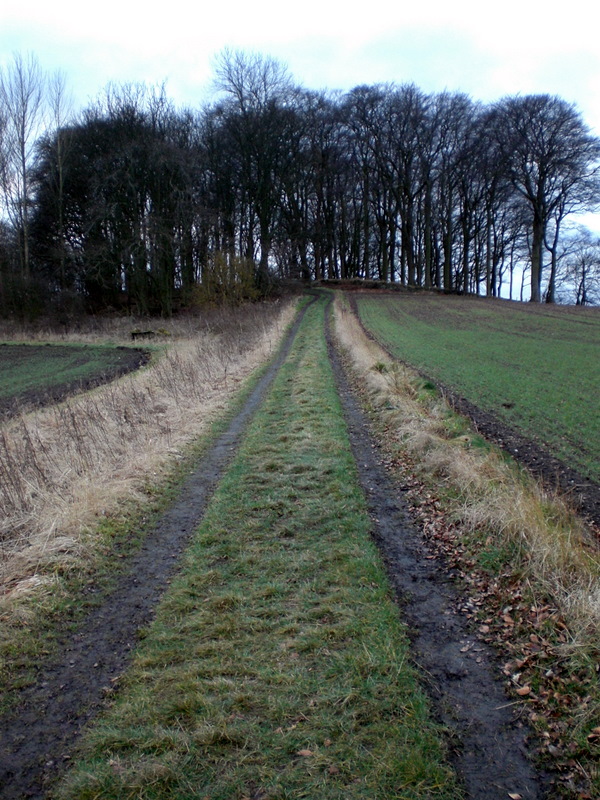
Back on the A985 and another juggernaut threatens to drag us into the road as we alight on Windylaw Path which leads down to the villages of Limekilns and Charlestown. We’ve had enough of the road but happy to have got the measure of Spinner and Goliath. Our dérive receptors are once again activated when we read that Windylaw Path is a coffin road.
Who could resist that and was Limekilns not mentioned in Stevenson’s Kidnapped?
As we head up the coffin road, a buzzard soars overhead…
One of the most direct ways to immerse yourself in Fife’s liminal energies is to walk the Coastal Path. Out on the edge at the intersection of land and sea is always a receptive place to be. However, for the more expedient traveller, or slacker psychogeographer, the short train journey that hugs the coastline from Inverkeithing to Kirkcaldy can be a sensory delight as the train rattles through the villages of Aberdour, Burntisland and Kinghorn. Position yourself on the right hand side of the train and open up the synapses to the field of vision that floods the senses.
If I have a taste, it’s for scarcely more than earth and stones.
I eat air, rock, earth, iron.
Arthur Rimbaud [1].
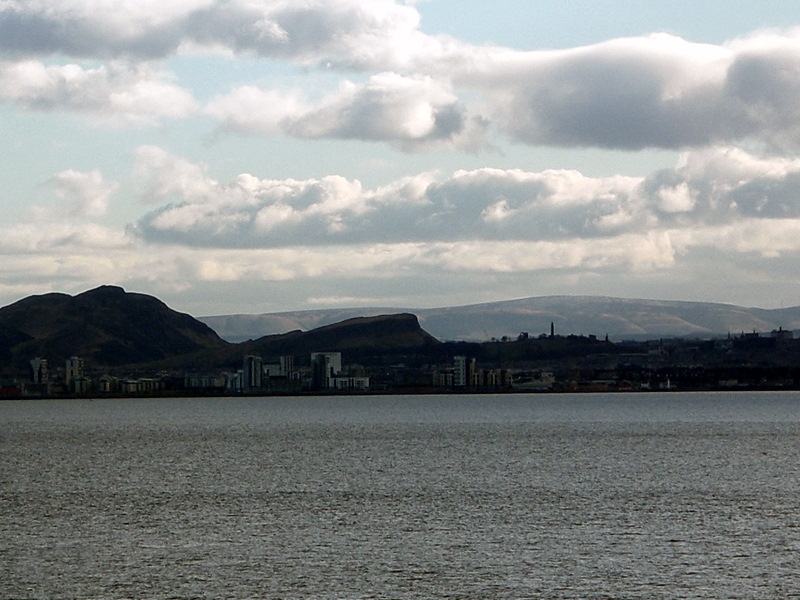
Arthur's Seat and the Salisbury Crags from Fife
Gazing out over the Firth of Forth to Arthur’s Seat and the dolerite and columnar basalt of the Salisbury Crags. Like some striated, cosmic sombrero, angled and poised ready for take-off over the needle teeth of Edinburgh’s gothic spires. The castle nesting atop its volcanic plug. In the foreground stands the stillborn Edinburgh Riviera a Ballardian monument to pre-credit crunch architectural and financial hubris.
Deep Time / City Time / Hubris Time
♦
There is a solidity of presence to the Salisbury Crags that radiates over the Forth. Layered custodian of the longue durée, deep time is encoded in these rocks. Thoughts turn to James Hutton (1726-1797) amateur geologist whose pioneering discoveries, on these very stones, challenged two prevailing ‘scientific’ shibboleths. Firstly, the notion of the Genesis creation myth which suggested that the earth was only a few thousand years old and secondly, the Neptunist theory that all rocks had precipitated from a single primordial ocean.
“the mind seemed to grow giddy by looking so far into the abyss of time.” [2]
I like the idea of Hutton’s work being rooted in direct observation of the rock layers that he could walk on, see, pick up, touch and feel. Open to the calling of the rocks and stones:
“The result, therefore, of our present enquiry is, that we find no vestige of a beginning,– no prospect of an end” [3].
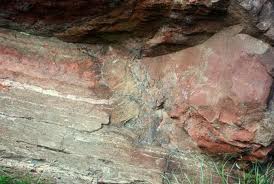
The Hutton Section
By observing what is now known as the Hutton Section, Hutton arrived at a theory that the Salisbury Crags ‘sill’ was formed when a much younger layer of fluid, hot magma intruded into older layers of sedimentary rock and solidified. It is now known that this sill is at least 25 million years younger. Hutton’s theory of ‘deep time’ was presented in his revolutionary Theory of the Earth, (1785), which proposed that Planet Earth was the literal bedrock of all history, long predating the appearance of the human and would endure long after they had gone. The age of the Earth is now believed to be 4.54 billion years old.
♦
“Those of us who grew up in the sixties, when we put men on the Moon, now have to watch as every Republican candidate for this year’s presidential election denies the science behind climate change and evolution. That is a staggering state of affairs and it is very worrying,”
Professor Naomi Oreskes, University of California, San Diego. [4]
♦
The train rattles along the coast between Aberdour and Burntisland. Over the shimmering Forth:
The space of the Crags
floods the imagination
singing their presence
of encoded deep time
and time yet to come.
a need to start from the ground
on which we stand.
more magma needed
Levitate the Crags!
Caravans at Pettycur Bay
As the train approaches Kinghorn on a bright morning, the sun reflects off the rows of caravans , draped like rows of emerald jewels on the hill above Pettycur Bay. Look seaward and it’s possible to see basking seals sunning themselves on the rocks.
Perhaps today? Tide is out.
When taking this journey, I am always alert to the possibility of a sighting of the fish “which they could find no name for”.
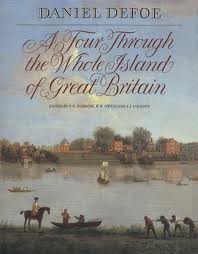
Daniel Defoe’s visit to Fife is recounted in Letter XIII of his A Tour Through the Whole Islands of Great Britain, published in 1724. At Kinghorn he observes how the men ‘carry’d on an odd kind of trade, or sport, of shooting of porpoises of which very great numbers are seen almost constantly in the Firth’. Defoe explains how the porpoises are brought on shore and their fat boiled off for oil, which they also do with other fish such as ‘grampusses, finn fish, and several species of the small whale kind’. However, in one particular year, ‘there came several such fish on shore which they could find no name for’. Defoe records seeing eight or nine of these fish lying on the shore from ‘Kinghorn to the Easter Weems, some of which were twenty-foot long and upward’. [5]
It is intriguing to reflect that a well established sea trading community would be unable to name this mysterious fish? A surprise manifestation in a world already mapped, named and territorialized. Perhaps only nine of these creatures ever existed? Perhaps these were the last nine?
♦
The train pulls into Kinghorn,
there they lie on the shore:
cut, boiled and rendered for oil.
the last ones.
♦
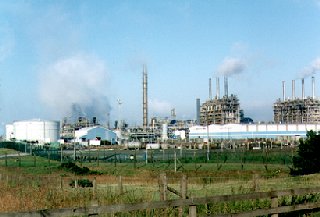
Fifteen minutes from Kinghorn there are two petrochemical installations run by global energy giant ExxonMobil. Our train journey has meant we have seen neither. Sometimes the advantages of walking are abundantly clear. On foot the psychogeographic receptors are more finely attuned.
The Fife Ethylene Plant (“FEP”) at Mossmorran, near Cowdenbeath is one of the largest in Europe with an annual output of 830,000 tonnes. Initially, Brent – the largest oil and gas field in the North Sea UK sector – provided the gas feedstock, but with the decline of Brent production, gas from the Norwegian sector is now also used with 50% of feedstock coming from the Stratfjord and Goja-Vega fields. The natural gas is brought ashore at St Fergus, north of Peterhead and then travels to Mossmoran through a 222km underground pipeline. 12 million tonnes litres of water are pumped every day from Glendevon reservoir to generate steam used in the ethylene cracking process. Four miles away on the Firth of Forth, just west of Aberdour, lies the Braefoot Brae marine terminal where the ethylene is shipped to Antwerp and the rest of Europe.
All of these hidden entrails of energies radiate far and wide.
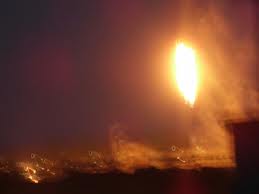
The Mossmorran flare is a well known local phenomenon, which can light up the sky like a surreal, Lynchian, ignited match diffusing its uncanny hue throughout night and day:
The Mossmoran flare
“I live at the top end of Lochgelly and the noise keeps me awake most of the night. It sounds like constant thunder or a plane overhead. The roar is ridiculous and the constant light also disturbs my sleep. Through the day I have to keep all the windows shut to cut down on the noise but even with the windows shut you can still hear the constant roar. The flaring and the noise gives me sore heads and I just feel constantly ill with it. It’s ridiculous that we have to put up with this type of noise pollution. If I made that type of noise or a normal industry made that type of a noise I would soon find myself in trouble with complaints against me. How come they are being allowed to get away with this, year in year out. So much for the quality of life for the residents of central Fife”
Margaret. Lochgelly Resident [6]
“FEP is proud of its environmental record in both waste management and emissions”. [7]
ExxonMobil, 2010
♦
Not really knowing where I’m going with all of this, I take a gander at the news headlines on Sunday morning 19th February 2012. I learn two things:
It is reported for the first time today that The ExxonMobil oil company has been fined £2.8 million for failing to report 33,000 tonnes of greenhouse gas emissions from the Fife Ethylene Plant at Mossmorran. It is the largest ever fine for an environmental offence in British history.
ExxonMobil is an active funder of the Heartland Institute whose mission is to: “discover, develop, and promote free-market solutions to social and economic problems”. Global warming and climate change is a particular bête noir of Heartland and they make vociferous attacks against the environmental movement and scientists who support the evidence based claims for global warming. Their website features a list of ‘experts’ and like-minded conservative policy think-tanks, many of whom have also received funding from ExxonMobil. [8]


 Devilla Forest is located just North East of Kincardine and the name is said to come from the Gaelic “dubh” and “eilean” meaning “black island”. The forest is now run as a commercial tree plantation by the Forestry Commission and consists mainly of Scots Pine, Norway Spruce and Larch. However, the area has a long history of land use with Prehistoric coffins, stone circles and Roman urns all found in different parts of the forest.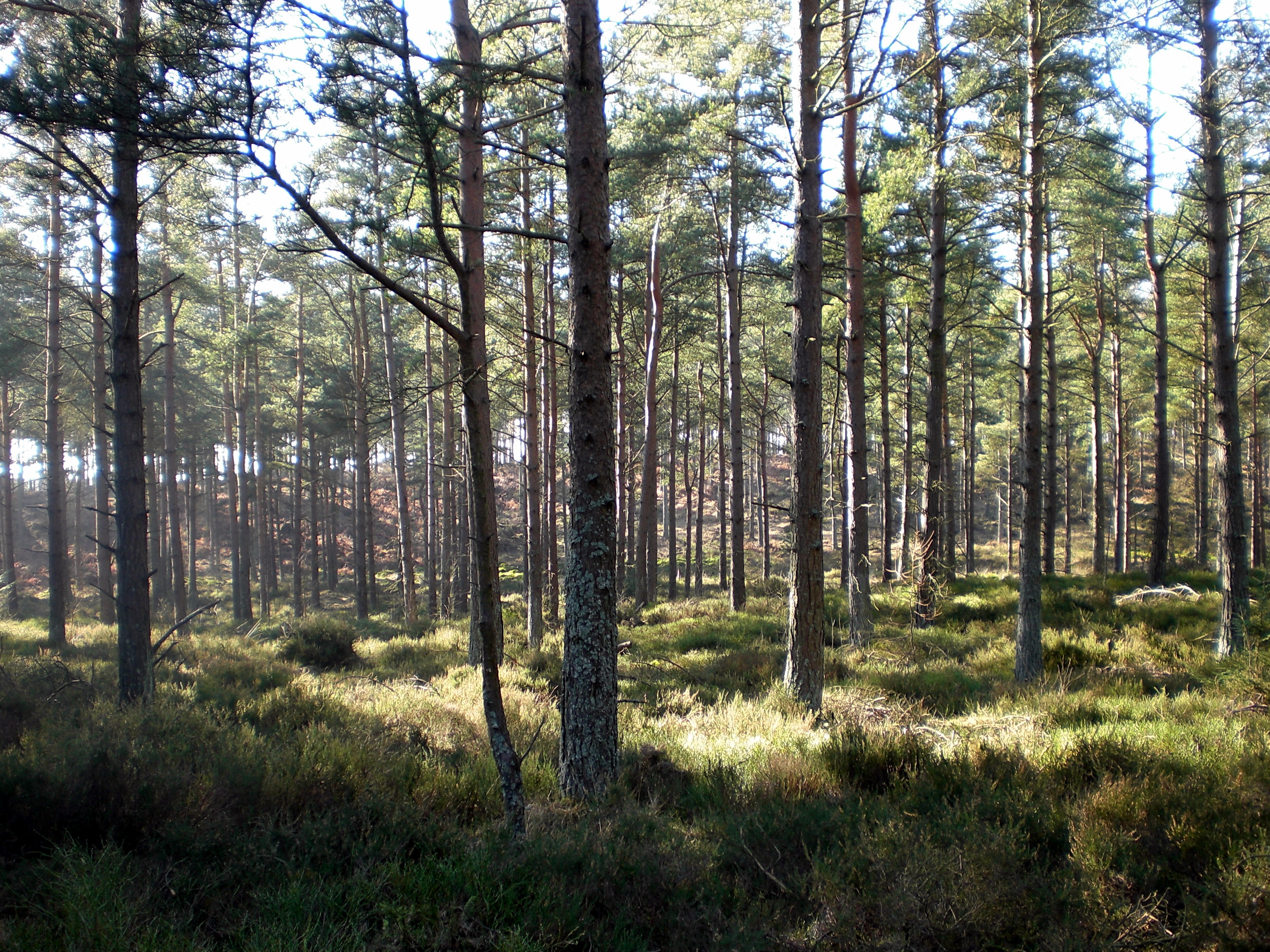

 This is a Meith Stone which has the St Andrews Cross carved in the top. The stones were used to mark land boundaries and sometimes initials were inscribed on each side of the stone denoting land ownership. Apparently five stones have been found along what would have been the old drove road between Kincardine and Culross.
 This enigmatic looking stone is known locally as The Standard Stone, which according to local legend marks the spot where a Danish Army defeated Duncan and his generals Macbeth and Banquo in The Battle of Bordie Moor. (1038). The stone could also have been where the Scots army placed their battle standards, but is more likely to be the base of a medieval stone cross on a parish boundary or a wooden gallows.













































 Murdo Eason - From Hill to Sea