With apologies to Deep Topographers Nick Papadimitriou and John Rodgers! Anyone unfamiliar with their podcasts of ‘wayward topographical rambles’ is highly recommended to check them out at Ventures and Adventures in Topography.
We are in dangerous territory, walking westward out of the town of Rosyth, along the A985, one of ‘Britain’s killer roads’. This arterial incision into the connective tissue of the Rosyth edgelands is to fully engage with the disruptive polarities emanating from two monolithic structures, which have recently appeared on either side of the road. There is a real sense that the landscape, skyscape and mindscape have all been irretrievably altered. Whether this is benign or malevolent who can say? It is this that we must investigate and address head-on with our dérive. Establish relations, resist, remap, and reclaim as necessary.
As we set off, along the ridgeline of the A985, there is an undercurrent of fear that a vortex of radiant, colliding energies may threaten to rip us, stalking walkers, apart or even lure us into the path of oncoming traffic on the killer road. This is a risk that we are prepared for and must take.
♦
The first stretch of road between two roundabouts is almost classic edgeland topography. On the right hand side, the small favela of allotments, with waves of canes, poles, pallet fencing and water butts; shanty sheds and corrugated iron knitted together with plastic pipework. There is a disordered/orderliness about the place; a charivari of utility and resourceful exchange, which resists the carefully manicured garden porn displayed in garden centres and lifestyle magazines. You can tell that this is land that is worked, loved and loves back.
On the other side of the road, past the football pitch, stands the ‘old Lexmark building’, supposedly the location of ‘the factory’ in Gregory Burke’s play Gagarin Way. We have investigated this building before and continue to monitor its energy levels , but no sign of the smoked salmon fishes as yet.
As we traverse over the second roundabout, there are clear intimations that the interzone between the town and edgelands has been breached. For the car driver, flooring it off the roundabout and opening up to the straight road ahead it’s as if the gravitational pull of the town loses its grip, supplanted by a carnivalesque impulse to wind down the window and toss the debris of consumer society into the hedgecomb of trees and shrubs edging the road. Here lies a graveyard of inert excess, an inventory of impulse purchases; eating and drinking on the hoof and a veritable time capsule of the non-biodegradable floatsam of consumer culture. Like true twitchers, we must record our spoils:
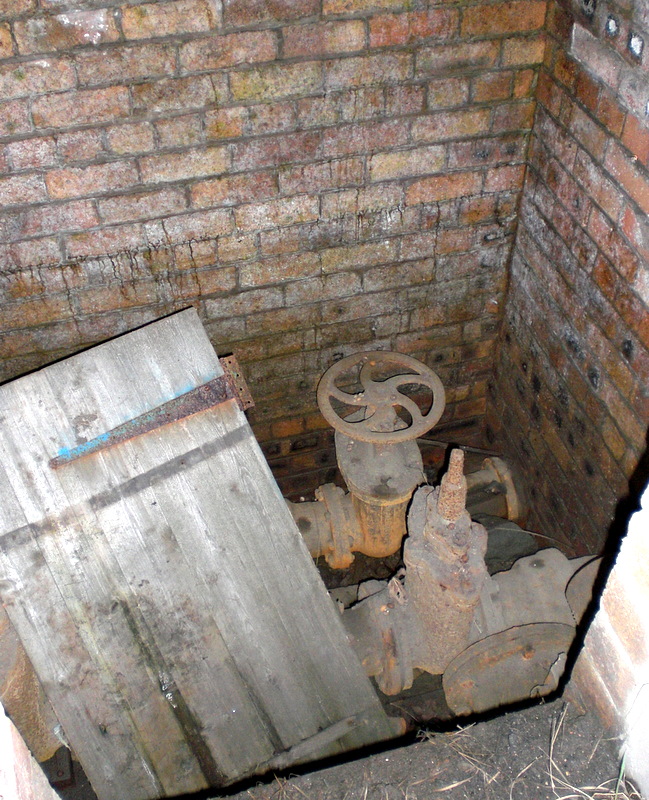
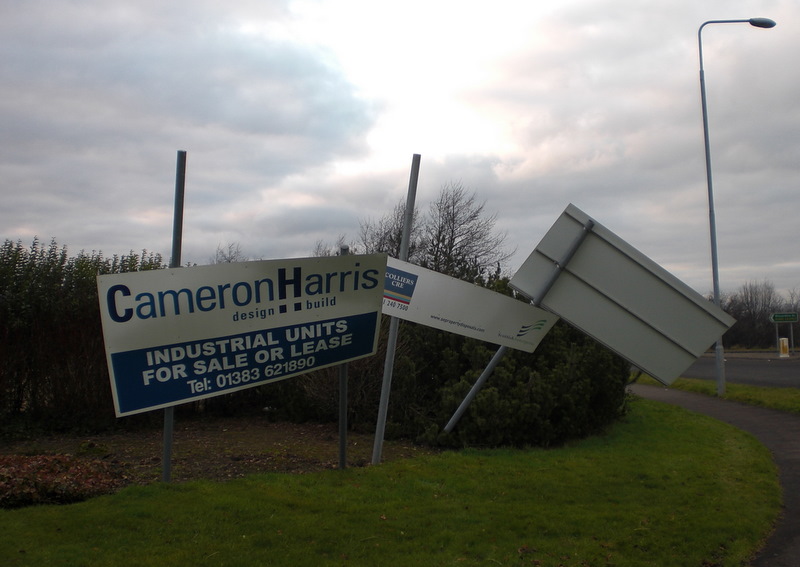
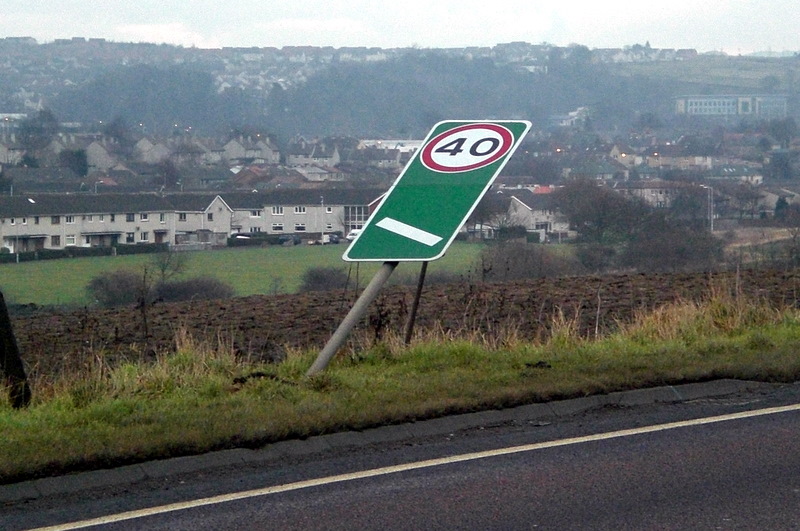
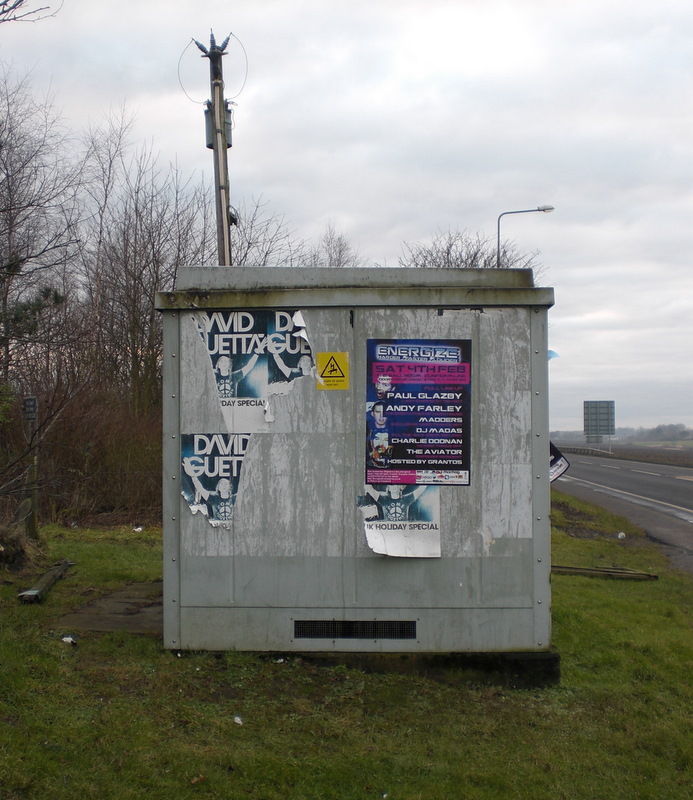
We are also struck by how the edgelands are places where things are simply forgotten about. Advertising signs from a more benign economic environment offering ‘Industrial Units for Sale or Lease’ are falling down and are never replaced; road signs tilt at 45 degrees; posters on substations intimate long forgotten concerts and doors on the mysterious roadside bunkers have all disappeared.
We are now out in the true edgelands, hugging the ribbon of verge by the side of the road as every vehicle utterly tanks it past us. We are pebbledashed by huge swathes of road spray and the draught, from the huge artic lorries that pass, threatens to pull us foot-powered perambulators into the middle of road. However, the objects of our effort and attention can now be clearly seen on either side of the road. We can feel their energies drilling into us and can only marvel at the scale of their transforming presence on this stretch of the edgelands. As long as we can stay vigilant and remain on the ribbon verge, we can resist the siren call urging us into the killer road.
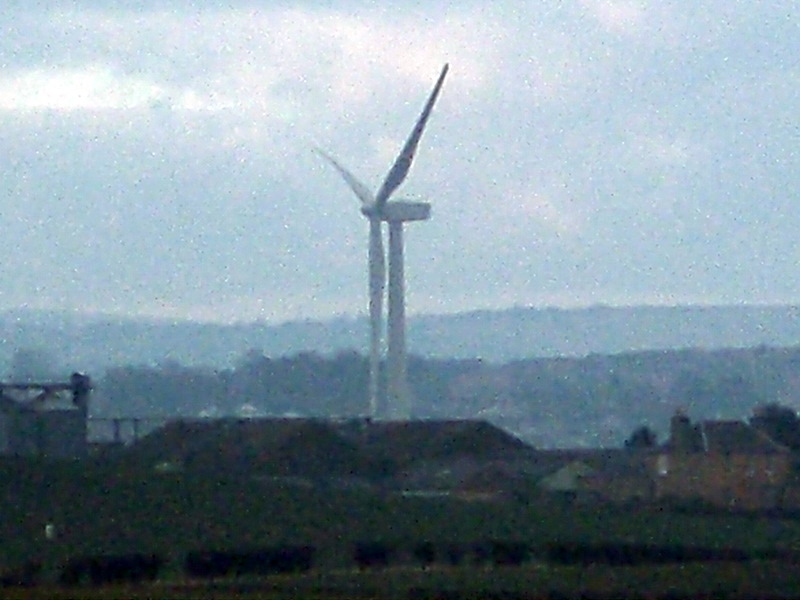
Over to the right, in the middle distance, is a 100 metre column, on top of which sits a rotating turbine with three, colossal, scythe -like blades. This somehow reminds us of the free gifts of plastic spinners that you used to get sellotaped to the front cover of children’s comics like The Beano and The Dandy. Thus we have a name for our monster – Spinner – a vital part of the engagement and neutralisation process. Spinner is of such a scale that it doesn’t look quite real. It’s as if it is projecting some perspective morphing force field which shrinks or obliterates the elements within the landscape which offer any indication of human scale.
Spinner belongs to FMC Technologies, a Houston, Texas headquartered business, which manufactures subsea systems for the oil and gas and renewables industry. The 1.5MW turbine is projected to supply up to 40% of their energy needs at their Dunfermline facility and was financed by Triodos, the ethical bank. We stand and watch the strange poetry of the rotating blades dancing with the wind, quite hypnotic and completely silent from our vantage point. There is some some sense of good energy radiating from this structure and there is a fluidity and engagement with the elements. Spinner could probably only be a product of the edgelands. A place where a turbine of this size can be erected then lost and forgotten, despite it’s landscape transforming qualities.
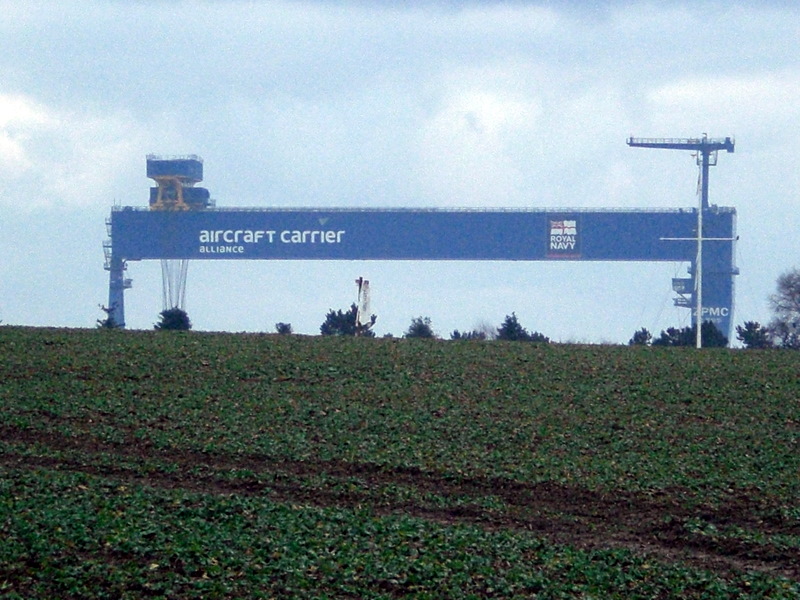
If Spinner has a slightly ethereal, alchemical quality, transforming wind into electricity, over to our left is a structure that looks as if it is marauding up towards the ridge, like a mechanised robotic toy about to attack. This is the aptly named Goliath crane recently transported from China’s Shanghai Zhenhua Port Machinery Co Ltd, where it was manufactured. Goliath is the largest crane installed in the UK and across its 120m beam is the clearly visible signage:
aircraft carrier alliance
Goliath sits in Rosyth Dockyard which lies over the hill down on the Forth. In effect, we are only seeing the top of the crane which at 90m high almost rivals Spinner in height. Goliath is part of the most expensive project in British naval history with two aircraft carriers presently being constructed at £3 billion a pop. We have already been told that once constructed, one will be mothballed immediately and the other will have no planes to fly from it. Try explaining this logic to a five year old. The carriers are to be named HMS Queen Elizabeth and HMS Prince of Wales. The sheer folly, financial carnage and symbolism of this whole escapade is such that it almost fries our collective brain into meltdown. However, very soon we are all whistling and singing Elvis Costello’s Shipbuilding – the Robert Wyatt version naturally – so we can hum the piano solo with our kazoos. This has the desired effect, tames the beast and calm descends. As we walk further along the road, we can gain a better vantage point to look down over the dockyard and see the true scale of Goliath. Our fear turns to pity as we realise that all we are looking at is simply a dumb, beast of burden, a heavy lifter, on which has been foisted the indignity of jingoistic colours, the White Ensign flag and the reek of failed empire. Also lurking down there, somewhere in the bowels are seven decommissioned nuclear submarines, still radioactive and we are reminded of some possibly apocryphal tales of technicians metal-capped boots glowing green in the dark. Isn’t it amazing what can be buried in the edgelands.
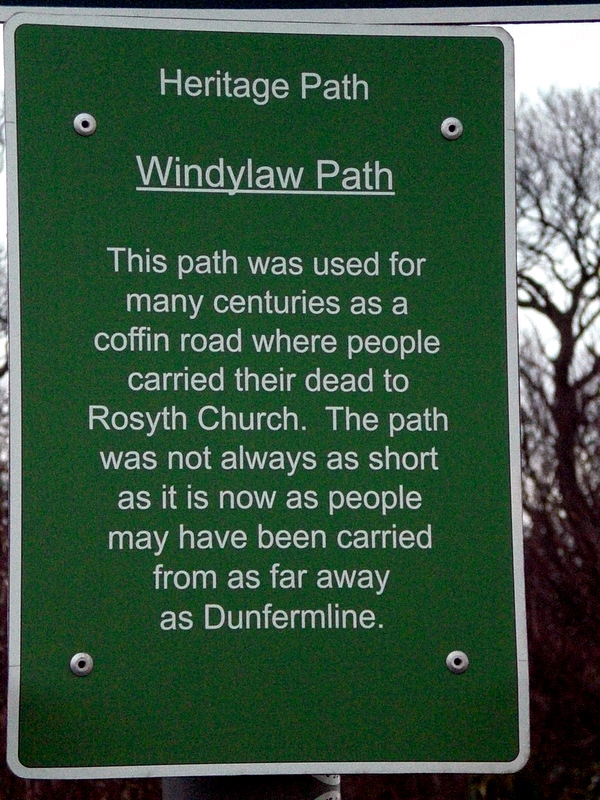
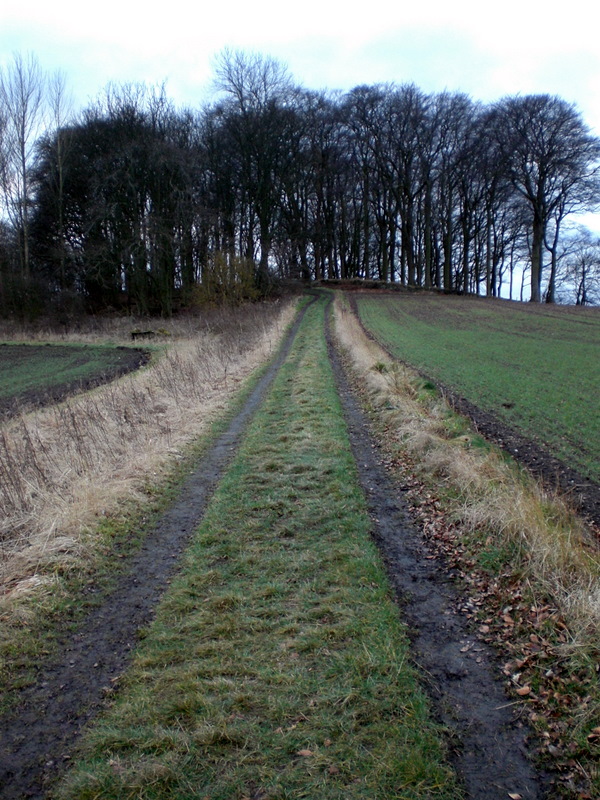
Back on the A985 and another juggernaut threatens to drag us into the road as we alight on Windylaw Path which leads down to the villages of Limekilns and Charlestown. We’ve had enough of the road but happy to have got the measure of Spinner and Goliath. Our dérive receptors are once again activated when we read that Windylaw Path is a coffin road.
Who could resist that and was Limekilns not mentioned in Stevenson’s Kidnapped?
As we head up the coffin road, a buzzard soars overhead…
Magical, Moondog moonbeams of metre. Celestial songs and canons.
(After the Art Ensemble of Fife, Duglas T Stewart and Davie Scott’s wonderful Moondog evening at The Fife Jazz Festival).
Soundtracks (Past few weeks)
Nate Wooley – The Almond
Oren Ambarchi – Audience of One
Jean Claude Eloy – Yo-In
Alog – Unemployed (4xLP version)
Jah Wobble/Keith Levene – EP
Stephen O’Malley/Steve Noble – St Francis Duo
Erstlaub – The Last Few Seconds Before Sleep
Erstlaub – I Am The Line Drawn In The Sand Between The Living And The Dead
Erstlaub – Unfolding Inwards
Julian Cope – Psychedelic Revolution
William Basinki – Disintegration Loops I & II
Lambchop – Mr.M
The Pop Group – ‘Y’
The Caretaker – Patience (After Sebald)
The Caretaker – Extra Patience (After Sebald)
Motorpsycho and Ståle Storløkken – The Death Defying Unicorn
Supersilent – Supersilent 9
Valerio Tricoli – Did They, Did I
Django Django – s/t
The Coral – Butterfly House, Acoustic version
Errors – Have Some Faith in Magic
Mogwai – Hardcore Will Never Die But You Will
Robbie Basho – The Seal of the Blue Lotus
John Coltrane – Kulu Se Mama
Kraftwerk – The Man Machine
Miles Davis – Dark Magus
Arthur Russell – Calling Out of Context
Jonathan Harvey – Mythic Figures
Jonathan Harvey – Imaginings
Jonathan Harvey – Complete String Quartets
The Thirteenth Assembly (Mary Halvorson/Jessica Pavone etc) Jazz on Three session
The Red Krayola – The Parable of Arable Land
John Surman – Where Fortune Smiles
Scorch Trio – s/t
Scorch Trio – Brolt!
Max Roach – Members Don’t Git Weary
Moondog – In Europe
Frederic Rzewski – The People United Will Never Be Defeated
and in celebration of 35 years of Marquee Moon, a bunch of Television boots.
One of the most direct ways to immerse yourself in Fife’s liminal energies is to walk the Coastal Path. Out on the edge at the intersection of land and sea is always a receptive place to be. However, for the more expedient traveller, or slacker psychogeographer, the short train journey that hugs the coastline from Inverkeithing to Kirkcaldy can be a sensory delight as the train rattles through the villages of Aberdour, Burntisland and Kinghorn. Position yourself on the right hand side of the train and open up the synapses to the field of vision that floods the senses.
If I have a taste, it’s for scarcely more than earth and stones.
I eat air, rock, earth, iron.
Arthur Rimbaud [1].
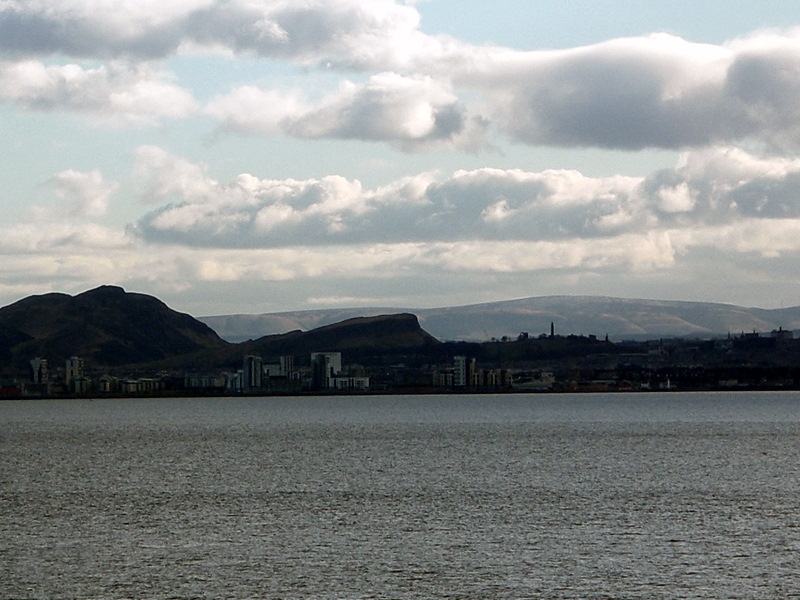
Arthur's Seat and the Salisbury Crags from Fife
Gazing out over the Firth of Forth to Arthur’s Seat and the dolerite and columnar basalt of the Salisbury Crags. Like some striated, cosmic sombrero, angled and poised ready for take-off over the needle teeth of Edinburgh’s gothic spires. The castle nesting atop its volcanic plug. In the foreground stands the stillborn Edinburgh Riviera a Ballardian monument to pre-credit crunch architectural and financial hubris.
Deep Time / City Time / Hubris Time
♦
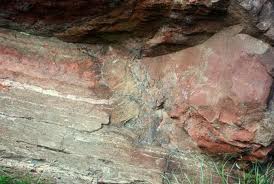
There is a solidity of presence to the Salisbury Crags that radiates over the Forth. Layered custodian of the longue durée, deep time is encoded in these rocks. Thoughts turn to James Hutton (1726-1797) amateur geologist whose pioneering discoveries, on these very stones, challenged two prevailing ‘scientific’ shibboleths. Firstly, the notion of the Genesis creation myth which suggested that the earth was only a few thousand years old and secondly, the Neptunist theory that all rocks had precipitated from a single primordial ocean.
“the mind seemed to grow giddy by looking so far into the abyss of time.” [2]
I like the idea of Hutton’s work being rooted in direct observation of the rock layers that he could walk on, see, pick up, touch and feel. Open to the calling of the rocks and stones:
“The result, therefore, of our present enquiry is, that we find no vestige of a beginning,– no prospect of an end” [3].
The Hutton Section
By observing what is now known as the Hutton Section, Hutton arrived at a theory that the Salisbury Crags ‘sill’ was formed when a much younger layer of fluid, hot magma intruded into older layers of sedimentary rock and solidified. It is now known that this sill is at least 25 million years younger. Hutton’s theory of ‘deep time’ was presented in his revolutionary Theory of the Earth, (1785), which proposed that Planet Earth was the literal bedrock of all history, long predating the appearance of the human and would endure long after they had gone. The age of the Earth is now believed to be 4.54 billion years old.
♦
“Those of us who grew up in the sixties, when we put men on the Moon, now have to watch as every Republican candidate for this year’s presidential election denies the science behind climate change and evolution. That is a staggering state of affairs and it is very worrying,”
Professor Naomi Oreskes, University of California, San Diego. [4]
♦
The train rattles along the coast between Aberdour and Burntisland. Over the shimmering Forth:
The space of the Crags
floods the imagination
singing their presence
of encoded deep time
and time yet to come.
a need to start from the ground
on which we stand.
more magma needed
Levitate the Crags!
Caravans at Pettycur Bay
As the train approaches Kinghorn on a bright morning, the sun reflects off the rows of caravans , draped like rows of emerald jewels on the hill above Pettycur Bay. Look seaward and it’s possible to see basking seals sunning themselves on the rocks.
Perhaps today? Tide is out.
When taking this journey, I am always alert to the possibility of a sighting of the fish “which they could find no name for”.
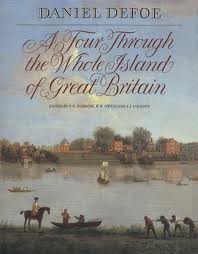
Daniel Defoe’s visit to Fife is recounted in Letter XIII of his A Tour Through the Whole Islands of Great Britain, published in 1724. At Kinghorn he observes how the men ‘carry’d on an odd kind of trade, or sport, of shooting of porpoises of which very great numbers are seen almost constantly in the Firth’. Defoe explains how the porpoises are brought on shore and their fat boiled off for oil, which they also do with other fish such as ‘grampusses, finn fish, and several species of the small whale kind’. However, in one particular year, ‘there came several such fish on shore which they could find no name for’. Defoe records seeing eight or nine of these fish lying on the shore from ‘Kinghorn to the Easter Weems, some of which were twenty-foot long and upward’. [5]
It is intriguing to reflect that a well established sea trading community would be unable to name this mysterious fish? A surprise manifestation in a world already mapped, named and territorialized. Perhaps only nine of these creatures ever existed? Perhaps these were the last nine?
♦
The train pulls into Kinghorn,
there they lie on the shore:
cut, boiled and rendered for oil.
the last ones.
♦
Fifteen minutes from Kinghorn there are two petrochemical installations run by global energy giant ExxonMobil. Our train journey has meant we have seen neither. Sometimes the advantages of walking are abundantly clear. On foot the psychogeographic receptors are more finely attuned.
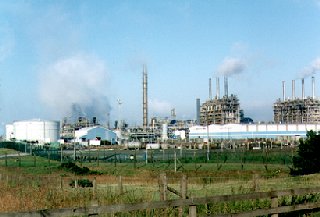
The Fife Ethylene Plant (“FEP”) at Mossmorran, near Cowdenbeath is one of the largest in Europe with an annual output of 830,000 tonnes. Initially, Brent – the largest oil and gas field in the North Sea UK sector – provided the gas feedstock, but with the decline of Brent production, gas from the Norwegian sector is now also used with 50% of feedstock coming from the Stratfjord and Goja-Vega fields. The natural gas is brought ashore at St Fergus, north of Peterhead and then travels to Mossmoran through a 222km underground pipeline. 12 million tonnes litres of water are pumped every day from Glendevon reservoir to generate steam used in the ethylene cracking process. Four miles away on the Firth of Forth, just west of Aberdour, lies the Braefoot Brae marine terminal where the ethylene is shipped to Antwerp and the rest of Europe.
All of these hidden entrails of energies radiate far and wide.
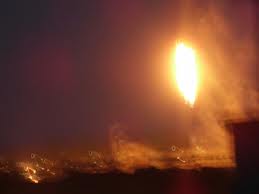
The Mossmorran flare is a well known local phenomenon, which can light up the sky like a surreal, Lynchian, ignited match diffusing its uncanny hue throughout night and day:
The Mossmoran flare
“I live at the top end of Lochgelly and the noise keeps me awake most of the night. It sounds like constant thunder or a plane overhead. The roar is ridiculous and the constant light also disturbs my sleep. Through the day I have to keep all the windows shut to cut down on the noise but even with the windows shut you can still hear the constant roar. The flaring and the noise gives me sore heads and I just feel constantly ill with it. It’s ridiculous that we have to put up with this type of noise pollution. If I made that type of noise or a normal industry made that type of a noise I would soon find myself in trouble with complaints against me. How come they are being allowed to get away with this, year in year out. So much for the quality of life for the residents of central Fife”
Margaret. Lochgelly Resident [6]
“FEP is proud of its environmental record in both waste management and emissions”. [7]
ExxonMobil, 2010
♦
Not really knowing where I’m going with all of this, I take a gander at the news headlines on Sunday morning 19th February 2012. I learn two things:
It is reported for the first time today that The ExxonMobil oil company has been fined £2.8 million for failing to report 33,000 tonnes of greenhouse gas emissions from the Fife Ethylene Plant at Mossmorran. It is the largest ever fine for an environmental offence in British history.
ExxonMobil is an active funder of the Heartland Institute whose mission is to: “discover, develop, and promote free-market solutions to social and economic problems”. Global warming and climate change is a particular bête noir of Heartland and they make vociferous attacks against the environmental movement and scientists who support the evidence based claims for global warming. Their website features a list of ‘experts’ and like-minded conservative policy think-tanks, many of whom have also received funding from ExxonMobil. [8]
Scribbling away this morning and consulting Daniel Defoe’s A Tour Through the Whole Island of Great Britain.
Walking in the afternoon near the beach at Kinghorn, and thinking about Defoe’s visit which he recounts in Letter XIII. Thoughts also turn to Alexander Selkirk who, not that far up the coast at Lower Largo, gazes out, projecting his own haunting presence into the psychogeographic mindscape. If Selkirk was the inspiration for Defoe’s Robinson Crusoe, it is the ghost of Robinson who wanders and stalks through many a tract of the psychogeographic imagination. Witness Rimbaud’s supposedly derived verb robinsonner (to travel mentally, or let the mind wander) or the unseen and unheard researcher in Patrick Keiller’s films London and Robinson in Space.
Later on, in the afternoon, cooking the tea. Stuart Maconie’s Freak Zone on as usual. A haunting over the airwaves: The Robert Mellin Orchestra playing the soundtrack to The Adventures of Robinson Crusoe. The particular track: (A) Drift.
Now Playing: Erstlaub – I Am the Line Drawn in the Sand Between the Living and the Dead
“I had no books at home. I started to frequent a public library in Lisbon. It was there, with no help except curiosity and the will to learn, that my taste for reading developed and was refined”.
Jose Saramago
“Libraries aren’t in the real world, after all. They’re places apart, sanctuaries of pure thought. In this way I can go on living on the moon for the rest of my life”.
Paul Auster
“The library was my salvation. Through the library I got to see the world, to read books from every century. It was my temple.”
Patti Smith
I am what libraries and librarians have made me, with little assistance from a professor of Greek and poets.
Low growl of wind
worries the bins
Lids yapping
like pack dogs.
III
Over there,
fingers,
da dah dah dat dat
dat dah dah DA
earphone fizz, foaming
through the carriage,
Billy Idol’s White Wedding.
Soundtracks:
The Caretaker – Patience (After Sebald)
Bill Ryder Jones – If
The Fall – The Unutterable
Mick Karn – Dreams of Reason Produce Monsters
Ben Frost and Daniel Bjarnason – Solaris
Jean-Claude Eloy – Shanti
King Creosote and Jon Hopkins – Diamond Mine
Kevin Drumm – Don’t Ask
Alog – Miniatures
Julian Cope – 20 Mothers
El Doom and the Born Electric – s/t
Kayo Dot – Gamma Knife
Jah Wobble and Julie Campbell – Psychic Life
Matana Roberts – COIN COIN Chapter One: Gens de couleur libres
Pete Swanson – Man With Potential
Hallock Hill – The Union
A fox’s brush is
as rare
as a unicorn’s horn,
or dragons teeth
on the island of Colonsay.
At Scalasaig,
alone, on the road,
Reynard, vulpes vulpes,
imagined presence,
bleeding violence.
The island of Colonsay has, been fox-free and is officially recorded as such in documents dating back to 1892. This week a lone red fox was found dead at Scalasaig with a large gash behind its left ear. It is believed to have bled to death. How the animal reached Colonsay remains a mystery. The nearest place is Islay which is 15 miles away by sea.
‘Unexpected item in the bagging area,
please remove item before continuing.’
Does every barcode scanned,
capture part of the human soul?
II
Ship’s horns sounding
on The Firth of Forth,
make me think, of
Julia Holter’s Tragedy.
III
Ice cracking
on the lily pond
in Dunfermline Glen.
Soundtracks:
Ben Frost and Daniel Bjarnason – Solaris
Jean-Claude Eloy – Anahata
Albert Ayler – Love Cry/The Last Album
Howard Roberts – Antelope Freeway/Equinox Express Elevator
Battles – Gloss Drop
Morton Subotnick – Echoes from the Silent Call/A Fluttering of Wings
The Fall – Complete Peel Sessions
Aidan Moffat & The Best-Ofs – How to Get to Heaven From Scotland
Hallock Hill – The Union








 Murdo Eason - From Hill to Sea