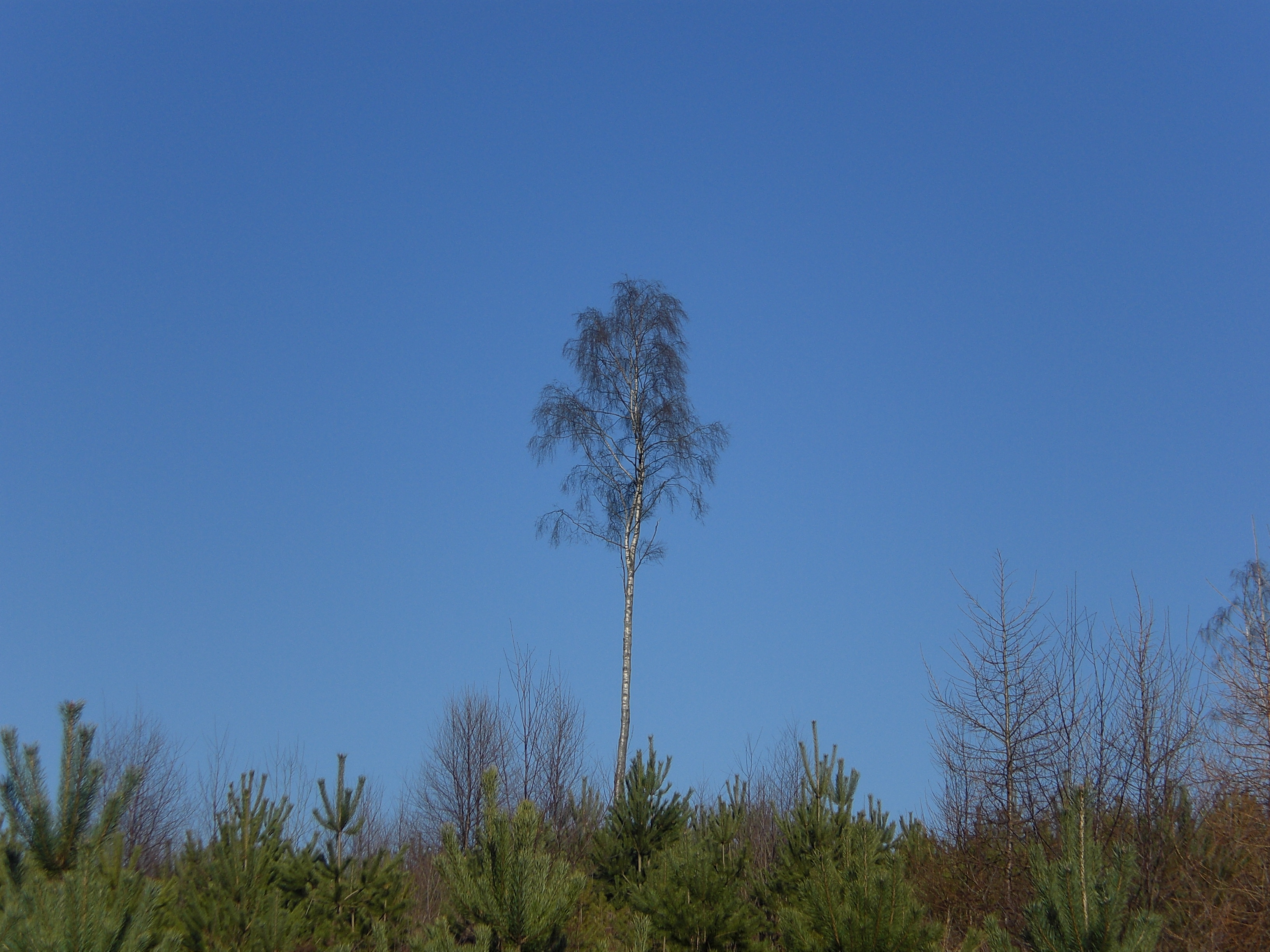
Looking up to the ridge, over the evergreen crowns, two spectral trees hang mid-air in the limpid heat. A smoke spiral, all coiled movement, settles to stillness as a Rorschach blot of charcoal smudge bleeds into sun saturated blue. The universe melts into my hands. A sublime stasis cupped and held close.
For how long is not the right question – linear time is of no help to us here.
The “caw caw” of a black craw – pierces the membrane of this no-time. The moment trickles away, dissolves on the ground, scattering the seeds of its eternal recurrence as memory…
Memory is not an instrument for exploring the past but its theatre. It is the medium of past experience, as the ground is the medium in which dead cities lie interred.
Walter Benjamin
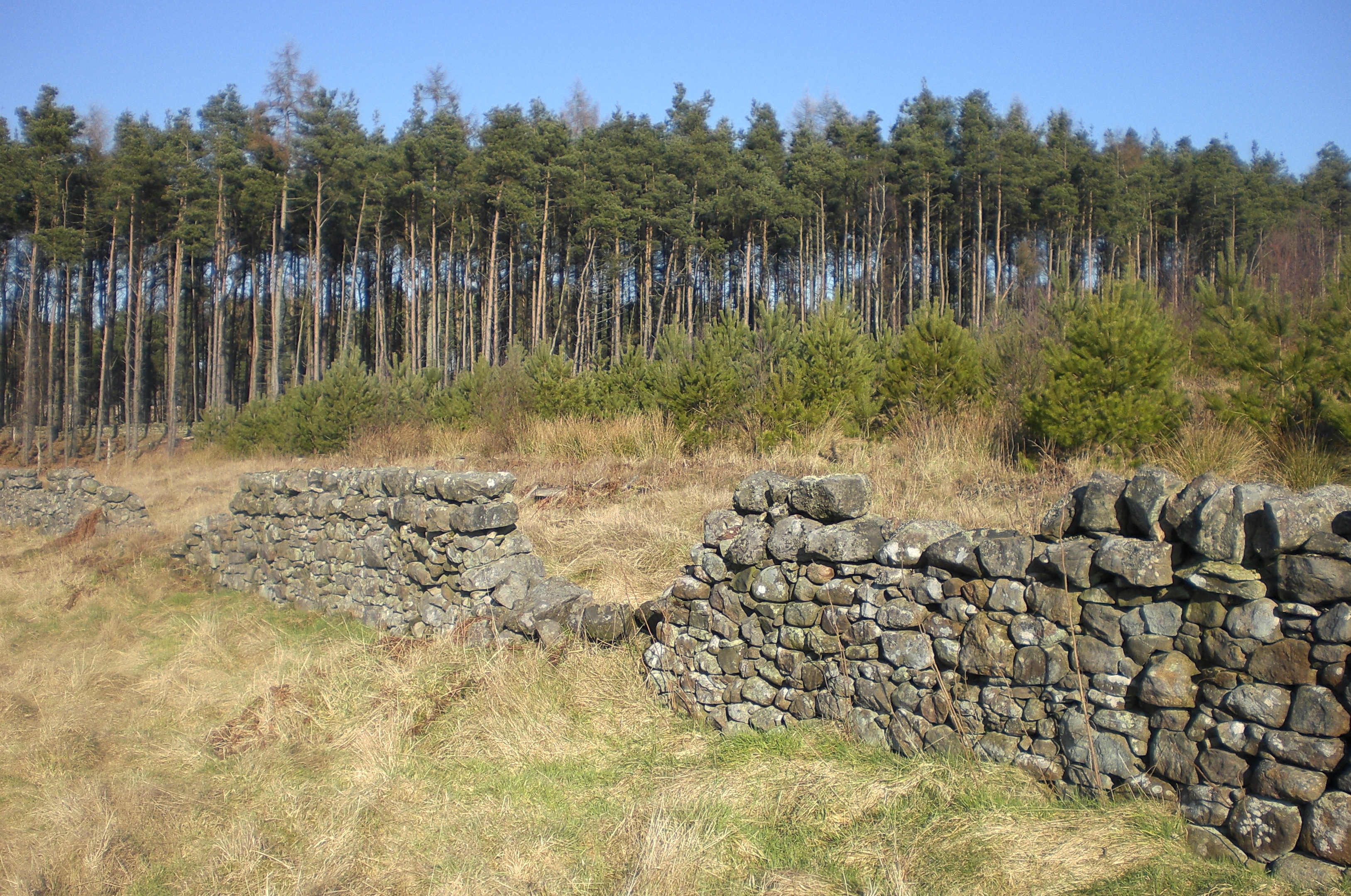
Just a brief extract from what will eventually develop into a longer piece or a series of shorter pieces. We have made a couple of visits to Devilla Forest, near Kincardine, recently and it is clear that it will take us a good few more trips to really get the measure of this place. Our foray into the heart of the forest last week was an exercise in getting hopelessly lost which coupled with the first intimation of Spring was no bad result. The overhead sky, was a cloudless colour field of bleached blue and once the sun was up it felt like the last of the winter murk was being cleansed away. We eventually ended up North of the forest climbing up to a ridge above the tree tops. Here we found the spectral trees and a curious weather mast amongst crumbling drystane dykes.
Devilla Forest is located just North East of Kincardine and the name is said to come from the Gaelic “dubh” and “eilean” meaning “black island”. The forest is now run as a commercial tree plantation by the Forestry Commission and consists mainly of Scots Pine, Norway Spruce and Larch. However, the area has a long history of land use with Prehistoric coffins, stone circles and Roman urns all found in different parts of the forest.
There are also plague graves, a stone which a local legend says is marked by the grooves from a witches apron string and the remains of a World War II explosives research establishment within the forest area. Combine all of that with four lochs/ponds, burns, meadowland and rich wildlife – including red squirrels – and it’s easy to see why this site should we worthy of further investigation.
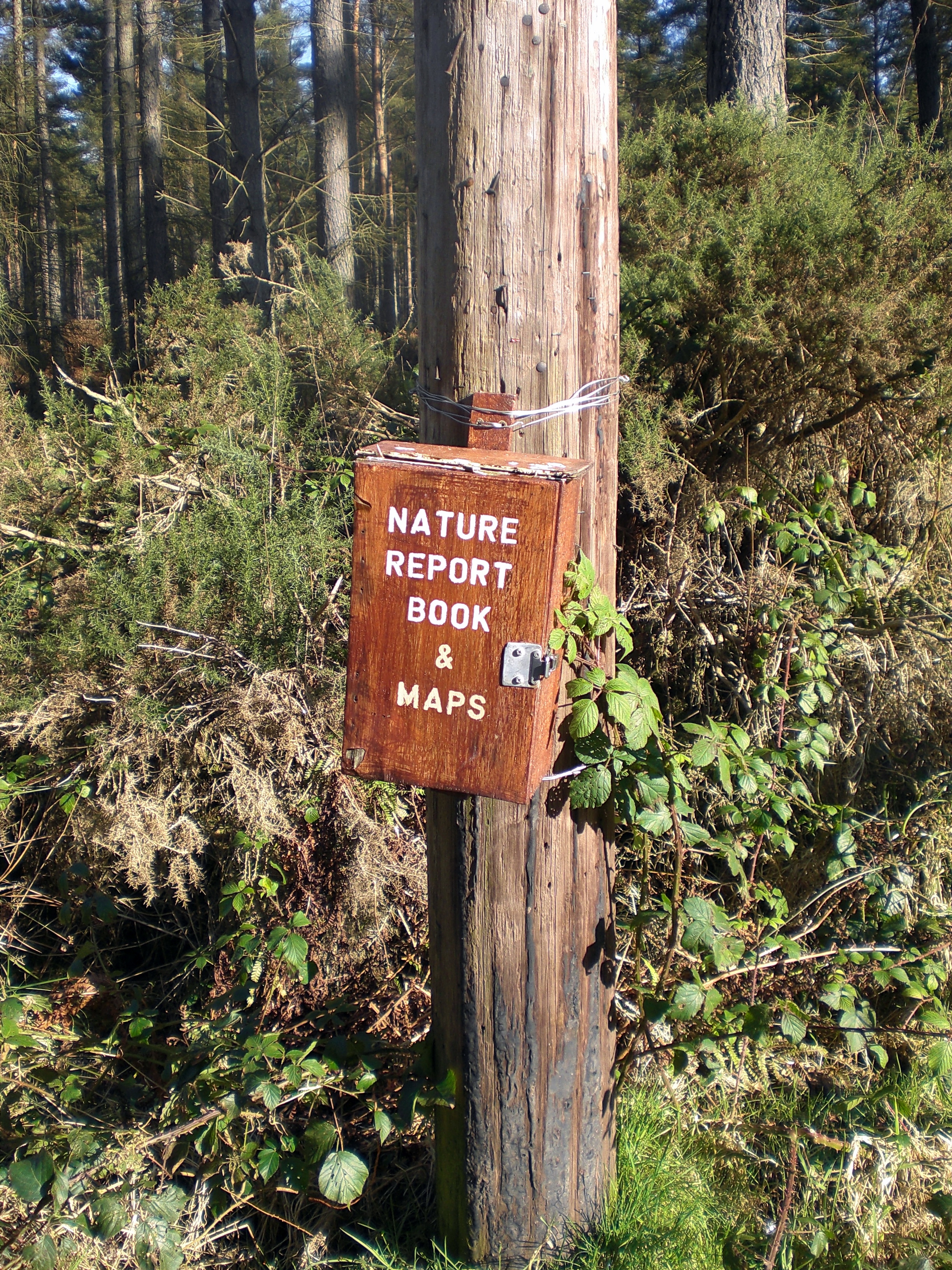
Oh and there is also a history of Big Black Cat sightings. We may have the chance to record one ourselves in The Nature Report Book.
Unfortunately there were no maps:
“I hunt among stones” – Charles Olson.
Prior to last week, we had made one previous brief visit to the forest on 23rd February. This date coincided with Terminalia, the ancient Roman Festival in honour of the god Terminus who presided over boundaries. Often his statue was merely a post or stone stuck in the ground to mark the boundaries between land. Aware that some psychogeographers throughout the country were commemorating Terminalia in some fashion, it was perhaps a serendipitous discovery to find some wonderful local examples in the forest:
This is a Meith Stone which has the St Andrews Cross carved in the top. The stones were used to mark land boundaries and sometimes initials were inscribed on each side of the stone denoting land ownership. Apparently five stones have been found along what would have been the old drove road between Kincardine and Culross.
This enigmatic looking stone is known locally as The Standard Stone, which according to local legend marks the spot where a Danish Army defeated Duncan and his generals Macbeth and Banquo in The Battle of Bordie Moor. (1038). The stone could also have been where the Scots army placed their battle standards, but is more likely to be the base of a medieval stone cross on a parish boundary or a wooden gallows.
From our initial couple of visits, we can feel that Devilla is going to yield up some interesting discoveries if we can manage to avoid getting lost next time. Then again that may be no bad thing.
The Owl is awaiting our return.
Now Playing: Boards of Canada – ‘You Could Feel the Sky’ from Geogaddi.
The white centre … is both an emptiness and an energy generator. Your eye is continually drawn back to its white silence, its void-ness. Then your attention is propelled out again along the twisting road-ways. The eye cycles back and forth between “something” and “nothing”.
First Rauschenberg laid down a base coat of white paint on a 48-by-32 inch piece of masonite. Then on the top four-fifths of this white ground, he pasted pieces of maps of American cities: Minneapolis, Pittsburgh, St Louis, New Orleans Boston, Denver…
The twisting spidery roadways – dark lines radiating across off-white backgrounds crackle with shivery linear energy. This frenetic activity is silenced at the pictures centre by a great white circular void that hovers like a pulsating energy field. This void isn’t empty. Literally it’s a layer of brushed white paint that laps over the cut edges of the maps. Visually, the painted surface dematerialises into a humming whiteness.
Kay Larson on Robert Rauschenberg’s Mother of God
I recently finished Kay Larson’s wonderful book Where the Heart Beats: John Cage, Zen Buddhism and the Inner Life of Artists. I don’t particularly want to offer a review here but if you have any interest in John Cage then I guess that you will be well rewarded by reading it.
Like any great book, it’s the ideas that linger around afterwards that are of greatest value. They push, prod and poke. Unconscious spectres haunting the edges of conscious thought before demanding some form of engagement, application or reflection. This perhaps explains why, for a few minutes last weekend I stood, in the dark, on a motorway bridge at Charing Cross, Glasgow. A walk back to the station interrupted by thoughts about “something” and “nothing”. The traffic of the M8 motorway cascading underneath my feet and I’m recording it on my phone…
Well clearly my silent piece…expresses the acceptance of whatever happens in that emptiness. And the same thing was expressed by that empty painting, that white painting of Bob Rauschenberg.
John Cage
One of the most fascinating parts of Larson’s book deals with Cage’s conceptual evolution leading up to his (in)famous ‘silent’ piece 4’33”. Larson makes the case that prior to 4’33”, Cage’s thinking was expressed in Either / Or dualities. His two lectures: Lecture on Something and Lecture on Nothing bookend this approach. Increasingly inspired by the Zen lectures of D. T. Suzuki at Columbia University and the white paintings of Robert Rauschenberg, Cage moved towards the idea of the radical act that was required to detonate these dualisms. His famous visit to the anechoic (sound-proof) chamber at Harvard had shown Cage that ‘silence’ could never be an absolute absence of sound. Even in the scientifically quietest place on Earth he could still hear sounds. The high whine of his own nervous system and dull roar of his blood circulation. He heard the sound of his life in process and Cage concluded that there is no such thing as silence.
Silence is not acoustic. It is a change of mind, a turning around.
4’33” embodies the idea of life and art as a process. As Larson says: “before anything else, it’s an experience.” It is a proposition that says, in notational shorthand: stop for a moment and look around you and listen; stop and look; stop and listen. “Something” and “Nothing” can never be divided.
Well I use it (4’33”) constantly in my life experience. No day goes by without my making use of that piece in my life and in my work…I turn my attention towards it. I realize that it’s going on continuously…
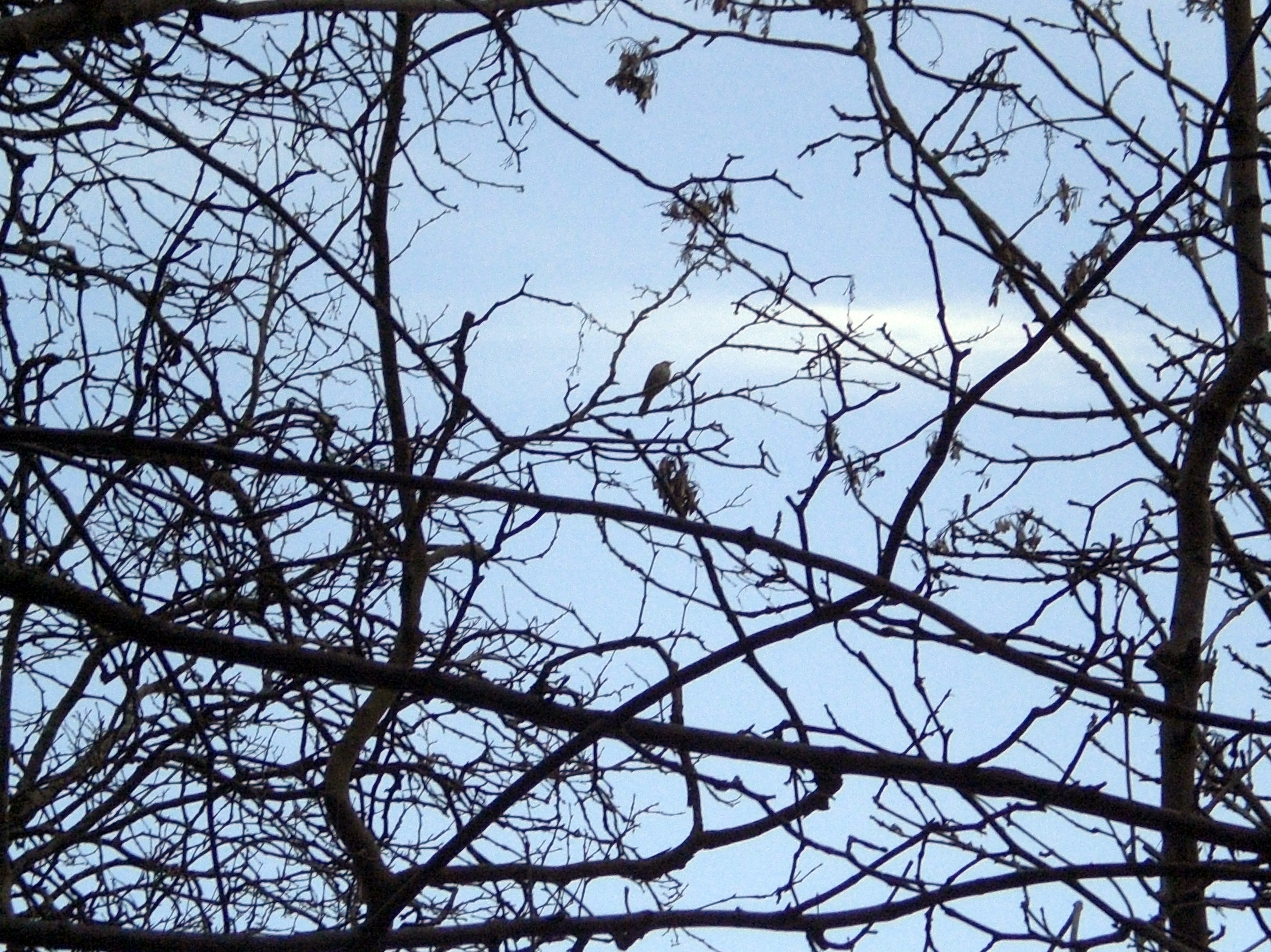
This may all sound pretty abstract but two events from a recent afternoon wander through Glasgow bring it all home. Heading back from the West End, the energetic bustle of Byers Road noticeably slips off the shoulders as you enter Kelvingrove Park. Welcomed into the crisp and brittle air by the bare winter trees, very few people are around and circumstances are conspiring to shift towards something approaching an urban ‘silence’. (The ubiquitous, low hum of traffic is always there, much like the sound of Cage’s blood circulation). Slipping into a kind of unconscious walking reverie, measured out in the rhythm of movement, I was brought completely into the moment by the spooling song of possibly a mistle thrush or song thrush high in a tree. What an enchanting experience to simply stop and listen to the cadences and Fi-ga-ro Fi-ga-ro refrains weaving a thread of song through the urban silence. An oscillation between something and nothing. Lives in process. I managed to capture around 40 seconds on a pretty rough phone recording, by which time several people had gathered around wondering what I was looking at:
.
.
[sometimelater]
.
.
I wanted to be quiet in a nonquiet situation.
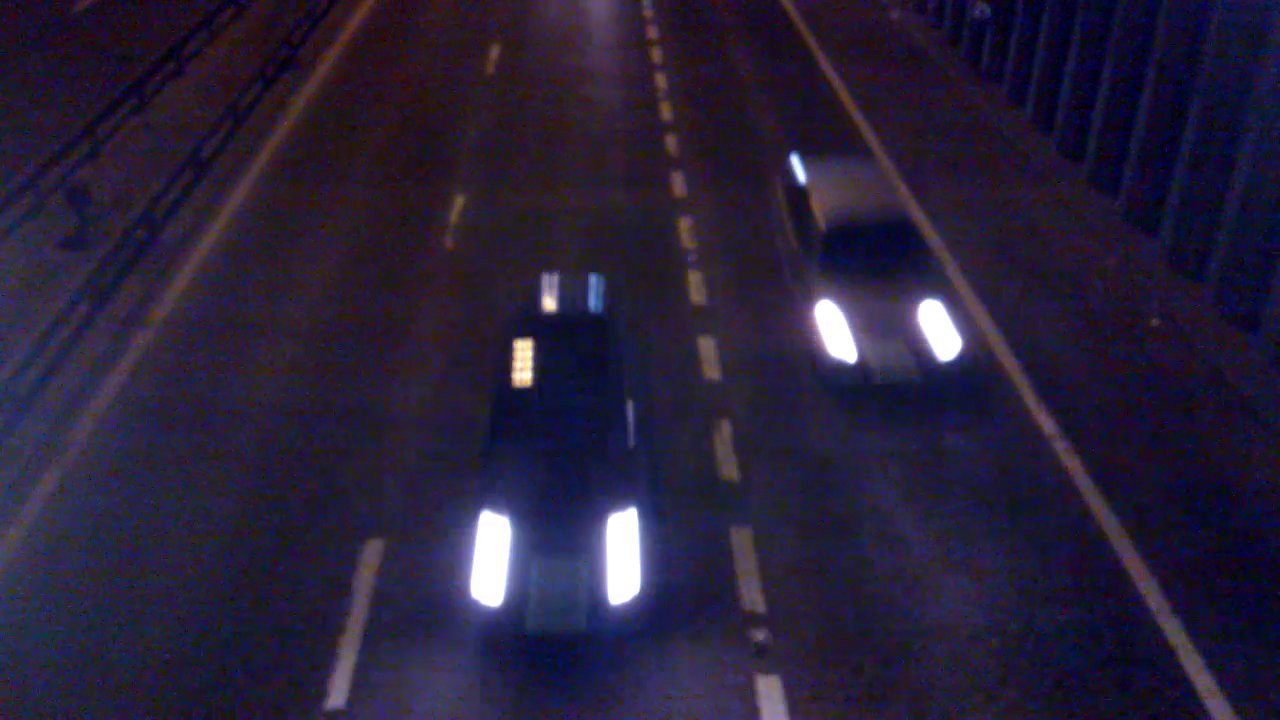
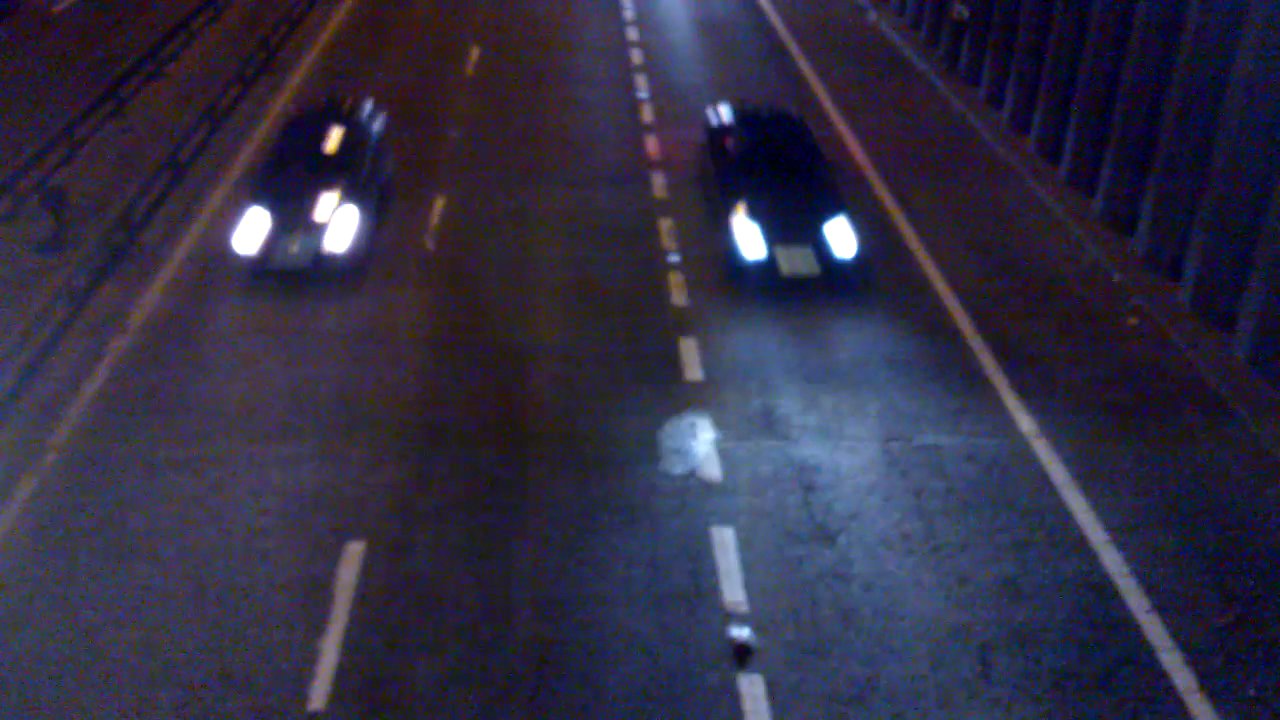
Later in the early evening, it is already dark and I’m walking back into the town centre . I stop on the motorway flyover bridge at Charing Cross. For a short time I just watch the traffic swoosh past underneath. Pools of light flooding the motorway and dispersing within seconds. The experience is strangely mesmerising and calming. The rhythms of sound vary depending on the sequence and number of cars across the three lanes. Like a childhood game, I start to guess which lane a car will appear in next. A chance operation in process. I then notice that occasionally there can be an almost complete drop out towards a momentary void of sound. For a few seconds no cars are in view in any of the lanes. Once again this is a rough recording but within this short clip it happens a couple of times:
.
.
After a few minutes of this hypnotic experience, I realise that I’ve been in the white centre of Rauschenberg’s painting. The void. Quiet in a nonquiet situation. As I lift my head to look around, the roads and paths of the city spiral off in every direction. Energies of neon, arteries of possibility, encounters, histories and stories yet to come.
I walk towards Sauchiehall Street, always poised between something and nothing.
Now playing: Kevin Drumm – Tannenbaum
References:
Richard Konstelanetz (ed), Conversing with Cage (London: Omnibus Press, 1989).
Kay Larson, Where the Heart Beats: John Cage, Zen Buddhism and the Inner Life of Artists, (New York: The Penguin Press. 2012).
Robert Rauschenberg, Mother of God, 1950. San Francisco Museum of Modern Art.
Special thanks to Fraser Macdonald and Louise Arber for offering suggestions as to the identity of the singing bird. The wonder of Twitter.
At the Edinburgh International Festival. Saturday 1st September, 2012.
Royal Scottish National Orchestra conducted by David Robertson.
Coptic tunic ornament
◊
A sounded weave ‘pedals’
on spectral slubs of
small differences.
Time’s flow, slows, to stasis
a colour field revealed,
in asymmetries of warp and weft.
There is no horizon here – only
a fullness of field, the patterning
of an essence, stretched
into aura.
All around is sound
All here is light.
◊
Sabine Shawl, 6AD in The Louvre Paris
Coptic Light (1985) is a late work by Morton Feldman which was first performed by the New York Philharmonic, in 1986, just a year before he died. In many ways, Coptic Light is an atypical late-Feldman piece, lasting just under thirty minutes. His major compositions from 1977 onwards had been exploring longer – and some would say extreme – duration with the vast sonic canvases of For Christian Wolff (1986) at around three hours; For Philip Guston (1984) lasting over four hours and String Quartet No. 2 (1983) clocking in at up to six hours.
In Give My Regards to Eighth Street (2000), Feldman reveals some of his inspirations for Coptic Light. Commenting on an earlier composition, Crippled Symmetry, (1983) Feldman notes how his growing interest in Middle Eastern rugs had made him question what is symmetrical and what is not. In particular, he noticed the great variations in shades of colour in the rugs, as a result of the yarn having been dyed in small quantities. Similarly, the mirror image and patterns in many of these rugs was characterised by small variations and less concern with the exact accuracy of replication. This prompted Feldman to think of a disproportionate symmetry in repeating patterns – “a conscious attempt at formalizing a disorientation of memory”.
Writing about Coptic Light, Feldman expresses his “avid interest in all varieties of arcane weaving of the Middle East” and in particular the stunning examples of early Coptic textiles on permanent display in The Louvre. What struck Feldman about these fragments of coloured cloth was “how they conveyed an essential atmosphere of their civilization”. Applying this idea to his music, he asked himself what aspects of music, since Monteverdi, might determine its atmosphere if heard two thousand years from now.
An important technical aspect of the composition was prompted by Sibelius’s observation that the orchestra differs from the piano in that it has no pedal. Feldman therefore set out to create an ‘orchestral pedal’ continually varying in nuance. This chiaroscuro is both the compositional and instrumental focus of Coptic Light.
In this particular concert, Coptic Light was performed alongside Charles Ives’s The Unanswered Question, (1906), which was perhaps the perfect choice. Two great American explorers, of the sonic landscape, bookending the 20th Century. Ives’s own subtitle for The Unanswered Question was ‘A Cosmic Landscape’. As the plaintive trumpet intones and repeats ‘The Perennial Question of Existence’, The Question remains Unanswered and eventually all fades to silence.
Now Playing: Morton Feldman – Coptic Light. New World Symphony Orchestra conducted by Michael Tilson Thomas
Reference:
Give My Regards to Eighth Street: Collected Writings of Morton Feldman, edited and with an introduction by B.H. Friedman, afterword by Frank O’Hara (Boston: Exact Change, 2000).
Our modest contribution to the John Cage centennial celebrations. On 5th September 2012, we decided to undertake a performance of 4’33″on the train from Falkirk High to Glasgow Queen Street. Raising and lowering the seat tray served to mark the three movements. During our ‘silent’ performance this is what we heard:
Low bass throb
– of train thrum.
occasional>>>>>stabs
– of pitched track squeal.
a sigh
a cough
a sneeze.
earphones fizzzzz and
crisps crunch.
fingers tap on digital screens
as turning pages – fan
distant carriage whispers.
The shuddering recoil – from
– the slap of a passing train
all sound and silence cocooned
– underneath a bridge.
Out in the landscape
– an imagined Williams Mix:
Doppler-shifted siren,
birdsong and turbine whirr.
a ratttttttttttttling window
“tickets please”
tacet
the seat tray creaks.
Happy 100th birthday John Cage. In another place you are walking around Walden Pond with Henry Thoreau looking for mushrooms.
Now Playing: John Cage and David Tudor – Rainforest II / Mureau – A Simultaneous Performance (Part I)
Retain your memories
but détourn them
so that they correspond with your era.
Asger Jorn
We are in Berlin travelling on the U-Bahn to Kottbusser Tor in Kreuzberg. It is a gloriously warm April morning with fists of sunlight starting to punch through the clouds. From the elevated train tracks we can survey the sweeping spread of the city below. In the foreground, a graffiti inscribed, cubist assemblage written on to the earth. “How do they manage to get up there to paint it? asks R, pointing to a 3-D effect trompe l’oeil covering the entire gable end of a tall building. A and I marvel at the scale and ambition. An exploding riot of colour and illusion. We both shrug our shoulders…
I had been in Kreuzberg the previous evening at a gig in the HAU 2 theatre complex. (As an aside, I was delighted to discover later that this building was the original site of the Zodiak Free Arts Lab formed by Conrad Schnitzler, Hans-Joachim Roedelius and Boris Schaak in 1968. More on this below if interested. (1)). I didn’t have much time to stroll around the streets beforehand but picked up a little of the night ambiance. Clearly the zest to inscribe almost any available surface with graffiti and street art was alive and well. I realised that my previous visit to Berlin had been when the Wall was still standing and Kreuzberg was the beating heart of a chaotic, edgy, alternative radicalism. An enclave of squatters, artists and musicians, living cheek by jowl with the, largely Turkish, immigrant population. At the time it felt like some bunkered interzone within the island of Berlin. A city trapped and adrift in topography, history and cold war paranoia. Inter-railing around Europe, I remember having to scrape up the Deutschmarks to buy a ticket and visa to allow travel through the DDR from Hamburg. Walking out of Zoo Station with a head full of Berlin tropes: Bowie, Iggy, Lou Reed and Christiane F. I could imagine witnessing scenes of Blixa Bargeld and Nick Cave holding court in the bars of SO36 underneath the watch towers. On reflection, a romanticised, pop-culture depiction of the city shaped more by the NME than by any history or guide-book.
Around twenty-five years later I’m walking out of Kottbusser Tor station with the family still carrying these ghosts of memory. It feels a bit surreal to experience the bright sunshine and languid air of the street as we set off in search of the Turkish market down on the banks of the Landwehrkanal. We pass the grocery stores and a few cafes where groups of men (and it is all men) are sitting outside sipping Turkish coffee and gossiping. It’s only a short walk to the canal and it evidently becomes apparent that we have either got the day or our directions wrong. There is no sign of any Turkish market. Perhaps Bowie, Iggy and Blixa can help guide us? Feed us a few signs? However, R is already off. A nine-year old is not going to hang around whilst our putative tour guides attempt to get their shit together.
♦
Unburdened by worldly cares, unfettered by learning, free of ingrained habit, negligent of time, the child is open to the world.
Yi-Fu Tuan
Children are natural and consummate psychogeographers. They can happily drift through any environment, urban or rural, seeking out and following the signs of place that speak to them. With the city as potential playground R, starts to saunter on ahead of us, leading the drift, although, of course, not aware or caring that this is what is happening. We wander along the tree-lined canal path for a good stretch and apart from the dog shit, and occasional jogger, the city takes on an almost rural feel. Bowie, Iggy and Blixa are struggling to keep up. I think they may have stopped for a fag. The sunlight is clearly not agreeing with them.
I could feel the interest of our spectral trio dissolve even further as we sat down on a bench to marvel at two magnificent white swans and a group of mallards bobbing on the canal. “How do the swans keep so white in the city?” A pleasure boat chugs past and the gentle wake lip-lips against the canal sides. Our quiet reverie is broken when the larger swan rises out of the water, and extends its full wingspan. For a moment it looks as if the wingtips will almost touch either side of the canal. A few strong beats and the swan takes to the air. We wonder where it can be heading and whether the birds flew freely between East and West when the Wall was up.
Against a riot of cubist, Kreuzberg colour – “Fuck Yuppies – Reclaim the Streets”
a white swan rises from the water
outstretched wings unfurling,
almost pushing
the canal walls apart.
We can feel ourselves being pulled into another city world as a ladybird lands on A’s arm. I love how ladybirds always look hand painted. After watching it run over her skin, it pauses to open its tiny wings as if basking in the sun. R lets it run on to her fingers and kneels down to reunite the hand daubed, smudge of colour with the greenery beneath the lime trees. She discovers the bustling activities of an ant colony and we observe the industry of the leaf carrying comrades, marching in their regimented lines – lugging, organising, creating. Sucked in closer to the unfolding drama of this animistic, micro world, we start to notice other flecks of red and black moving amongst the earthy shades of leaf mould. They are not ladybirds. We are looking at hordes of small insects that are completely unknown to us. Some scurry around alone, whilst others pile on top of each other to accumulate into little shuffling balls of red and black. Too absorbed in the moment, we ‘forget’ to take a picture of them. It is only once we are home that we eventually manage to find an image and identify these mysterious little creatures as firebugs. From now on they will be known as The Firebugs of Kreuzberg.
Time has dissolved as we eventually head away from the canal and start to re-enter Kreuzberg street life. We start to notice the hum of cars again. A Mad Max biker type walks past with a tiny dog on a pink lead. The dog is sporting a bandanna. Our drift takes us up the entire length of Oranienstrasse, the main street of the district. It is still pretty quiet in daylight and we pass the door of SO36, the club where Bowie and Iggy used to hang out and, by now, have probably once again, taken refuge. R has commandeered the camera and is now taking photographs, still drifting through a city more akin to Hayao Miyazaki’s animistic universe than my one populated with spectral ghosts. The signs are speaking:
The Détourned Red Bulls of Oranienstrasse
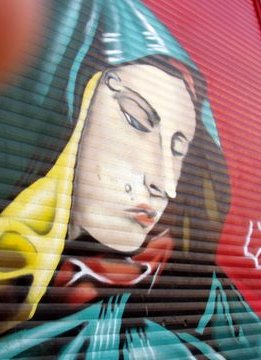
The Goddess and Protector of Oranienstrasse
The Visitor (detail from the side of a parked van)
We eventually return full circle and ascend the steps back up to Kottbusser Tor station. Our quest to find Turkish markets, and gain enlightenment from Bowie, Iggy and Blixa has failed. They have all remained spectral and elusive. Our drift has pulled us into another dimension of Kreuzberg. One of canal paths, white swans, mallards, ants, and détourned red bulls. Above all, we have discovered and witnessed something mysterious and new. The red and black insects that we now know as The Firebugs of Kreuzberg.
That’s all from the Berlin holiday. It’ll be back to Fife next. Possibly Cowdenbeath!
Now playing: Kluster – Klopfzeichen
♦ ♦
(1) HAU 2 and The Zodiak Free Arts Lab
I was excited to learn that, after a hiatus of twelve years, Keith Rowe, Oren Ambarchi, Christian Fennesz, Peter Rehberg (Pita) and Pimmon were reconvening their curiously named Afternoon Tea project for one night only in Kreuzberg. It was delightful happenstance to discover that this was happening on one of the nights of our holiday. I headed down to the HAU 2 venue and certainly wasn’t disappointed. One long piece saw this stellar ensemble layer up a set of dark, fractured shards of glitch improv, punctuated with blankets of shimmering serenity. A deep, meditative, all embracing sound. An unfolding. Ambarchi sat almost motionless unleashing his trademark sonic ‘depth charges’. The aural equivalent of watching and feeling a lava lamp. The bass resonance of the note entering through the feet and traveling up and out of the body. It was also good to see Keith Rowe having to play in a much louder and busier sound environment than the last couple of times I’ve encountered him. Fennesz couldn’t help but attempt to excavate and instil some melodic fragments into the proceedings whilst Rehberg and Pimmon intervened with pincer movements of laptop noise assault. All in all a fabulous event to witness and experience in the dark, minimal space of HAU 2.
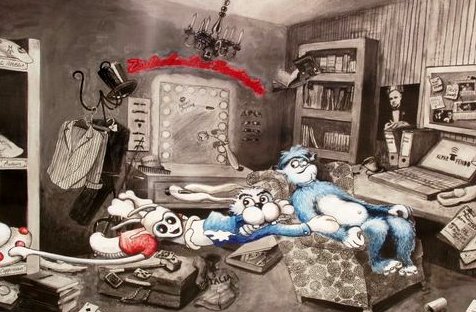
The happenstance of this event was further enhanced when I later discovered that HAU 2 was actually the original site of the Zodiak Free Arts Lab or Zodiac Club, formed by Conrad Schnitzler, Hans-Joachim Roedelius and Boris Schaak in 1968. Whilst only open for a few months, the Zodiak was a melting pot where “freaks and avant-gardists of all stripes could enjoy live psychedelia, free jazz, free performance and freakout”. (A1). It was a space also directly responsible for the emergence of Kluster (Schnitzler/Roedelius/Moebius) and Tangerine Dream, at that time with Schnitzler and Klaus Schulz in the ranks. This early incarnation of the Tangs is light years away from the vapid new-age pap that they later embraced in the 1980s.
The first few Kluster albums were engineered by a young Conny Plank who brought his experience of working with Edgar Varese to give some shape and coherence to the brutalist improvised chaos of this embryonic kosmische music. With the subsequent exit of Schnitzler and a later name change to Cluster, the sound took on a softer edge and the recording of classic kosmische albums such as Cluster II, Zuckerzeit, Sowiesoso and Cluster& Eno. The Zodiak also hosted performances by, amongst others, Agitation Free, Ash Ra Tempel, Human Being, Peter Brotzmann and Alexander Von Schlippenbach.
I love it when buildings can reveal their embedded memories like this. From a few months activity, the ripples from the epicentre are still being felt.
(A1) Nikolaos Kotsopoulos (Ed), (2009), Krautrock: Cosmic Rock and It’s Legacy, (London: black dog publishing).
Magical, Moondog moonbeams of metre. Celestial songs and canons.
(After the Art Ensemble of Fife, Duglas T Stewart and Davie Scott’s wonderful Moondog evening at The Fife Jazz Festival).
Soundtracks (Past few weeks)
Nate Wooley – The Almond
Oren Ambarchi – Audience of One
Jean Claude Eloy – Yo-In
Alog – Unemployed (4xLP version)
Jah Wobble/Keith Levene – EP
Stephen O’Malley/Steve Noble – St Francis Duo
Erstlaub – The Last Few Seconds Before Sleep
Erstlaub – I Am The Line Drawn In The Sand Between The Living And The Dead
Erstlaub – Unfolding Inwards
Julian Cope – Psychedelic Revolution
William Basinki – Disintegration Loops I & II
Lambchop – Mr.M
The Pop Group – ‘Y’
The Caretaker – Patience (After Sebald)
The Caretaker – Extra Patience (After Sebald)
Motorpsycho and Ståle Storløkken – The Death Defying Unicorn
Supersilent – Supersilent 9
Valerio Tricoli – Did They, Did I
Django Django – s/t
The Coral – Butterfly House, Acoustic version
Errors – Have Some Faith in Magic
Mogwai – Hardcore Will Never Die But You Will
Robbie Basho – The Seal of the Blue Lotus
John Coltrane – Kulu Se Mama
Kraftwerk – The Man Machine
Miles Davis – Dark Magus
Arthur Russell – Calling Out of Context
Jonathan Harvey – Mythic Figures
Jonathan Harvey – Imaginings
Jonathan Harvey – Complete String Quartets
The Thirteenth Assembly (Mary Halvorson/Jessica Pavone etc) Jazz on Three session
The Red Krayola – The Parable of Arable Land
John Surman – Where Fortune Smiles
Scorch Trio – s/t
Scorch Trio – Brolt!
Max Roach – Members Don’t Git Weary
Moondog – In Europe
Frederic Rzewski – The People United Will Never Be Defeated
and in celebration of 35 years of Marquee Moon, a bunch of Television boots.
One of the most direct ways to immerse yourself in Fife’s liminal energies is to walk the Coastal Path. Out on the edge at the intersection of land and sea is always a receptive place to be. However, for the more expedient traveller, or slacker psychogeographer, the short train journey that hugs the coastline from Inverkeithing to Kirkcaldy can be a sensory delight as the train rattles through the villages of Aberdour, Burntisland and Kinghorn. Position yourself on the right hand side of the train and open up the synapses to the field of vision that floods the senses.
If I have a taste, it’s for scarcely more than earth and stones.
I eat air, rock, earth, iron.
Arthur Rimbaud [1].
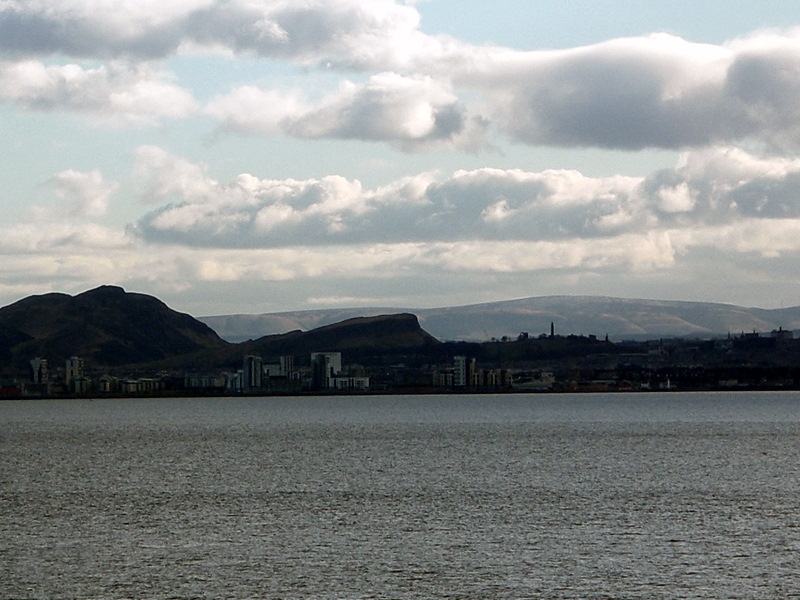
Arthur's Seat and the Salisbury Crags from Fife
Gazing out over the Firth of Forth to Arthur’s Seat and the dolerite and columnar basalt of the Salisbury Crags. Like some striated, cosmic sombrero, angled and poised ready for take-off over the needle teeth of Edinburgh’s gothic spires. The castle nesting atop its volcanic plug. In the foreground stands the stillborn Edinburgh Riviera a Ballardian monument to pre-credit crunch architectural and financial hubris.
Deep Time / City Time / Hubris Time
♦
There is a solidity of presence to the Salisbury Crags that radiates over the Forth. Layered custodian of the longue durée, deep time is encoded in these rocks. Thoughts turn to James Hutton (1726-1797) amateur geologist whose pioneering discoveries, on these very stones, challenged two prevailing ‘scientific’ shibboleths. Firstly, the notion of the Genesis creation myth which suggested that the earth was only a few thousand years old and secondly, the Neptunist theory that all rocks had precipitated from a single primordial ocean.
“the mind seemed to grow giddy by looking so far into the abyss of time.” [2]
I like the idea of Hutton’s work being rooted in direct observation of the rock layers that he could walk on, see, pick up, touch and feel. Open to the calling of the rocks and stones:
“The result, therefore, of our present enquiry is, that we find no vestige of a beginning,– no prospect of an end” [3].
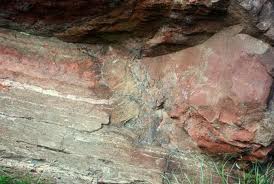
The Hutton Section
By observing what is now known as the Hutton Section, Hutton arrived at a theory that the Salisbury Crags ‘sill’ was formed when a much younger layer of fluid, hot magma intruded into older layers of sedimentary rock and solidified. It is now known that this sill is at least 25 million years younger. Hutton’s theory of ‘deep time’ was presented in his revolutionary Theory of the Earth, (1785), which proposed that Planet Earth was the literal bedrock of all history, long predating the appearance of the human and would endure long after they had gone. The age of the Earth is now believed to be 4.54 billion years old.
♦
“Those of us who grew up in the sixties, when we put men on the Moon, now have to watch as every Republican candidate for this year’s presidential election denies the science behind climate change and evolution. That is a staggering state of affairs and it is very worrying,”
Professor Naomi Oreskes, University of California, San Diego. [4]
♦
The train rattles along the coast between Aberdour and Burntisland. Over the shimmering Forth:
The space of the Crags
floods the imagination
singing their presence
of encoded deep time
and time yet to come.
a need to start from the ground
on which we stand.
more magma needed
Levitate the Crags!
Caravans at Pettycur Bay
As the train approaches Kinghorn on a bright morning, the sun reflects off the rows of caravans , draped like rows of emerald jewels on the hill above Pettycur Bay. Look seaward and it’s possible to see basking seals sunning themselves on the rocks.
Perhaps today? Tide is out.
When taking this journey, I am always alert to the possibility of a sighting of the fish “which they could find no name for”.
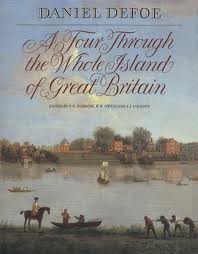
Daniel Defoe’s visit to Fife is recounted in Letter XIII of his A Tour Through the Whole Islands of Great Britain, published in 1724. At Kinghorn he observes how the men ‘carry’d on an odd kind of trade, or sport, of shooting of porpoises of which very great numbers are seen almost constantly in the Firth’. Defoe explains how the porpoises are brought on shore and their fat boiled off for oil, which they also do with other fish such as ‘grampusses, finn fish, and several species of the small whale kind’. However, in one particular year, ‘there came several such fish on shore which they could find no name for’. Defoe records seeing eight or nine of these fish lying on the shore from ‘Kinghorn to the Easter Weems, some of which were twenty-foot long and upward’. [5]
It is intriguing to reflect that a well established sea trading community would be unable to name this mysterious fish? A surprise manifestation in a world already mapped, named and territorialized. Perhaps only nine of these creatures ever existed? Perhaps these were the last nine?
♦
The train pulls into Kinghorn,
there they lie on the shore:
cut, boiled and rendered for oil.
the last ones.
♦
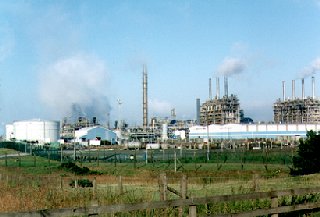
Fifteen minutes from Kinghorn there are two petrochemical installations run by global energy giant ExxonMobil. Our train journey has meant we have seen neither. Sometimes the advantages of walking are abundantly clear. On foot the psychogeographic receptors are more finely attuned.
The Fife Ethylene Plant (“FEP”) at Mossmorran, near Cowdenbeath is one of the largest in Europe with an annual output of 830,000 tonnes. Initially, Brent – the largest oil and gas field in the North Sea UK sector – provided the gas feedstock, but with the decline of Brent production, gas from the Norwegian sector is now also used with 50% of feedstock coming from the Stratfjord and Goja-Vega fields. The natural gas is brought ashore at St Fergus, north of Peterhead and then travels to Mossmoran through a 222km underground pipeline. 12 million tonnes litres of water are pumped every day from Glendevon reservoir to generate steam used in the ethylene cracking process. Four miles away on the Firth of Forth, just west of Aberdour, lies the Braefoot Brae marine terminal where the ethylene is shipped to Antwerp and the rest of Europe.
All of these hidden entrails of energies radiate far and wide.
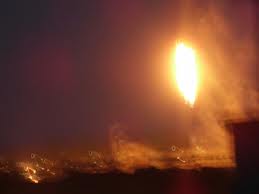
The Mossmorran flare is a well known local phenomenon, which can light up the sky like a surreal, Lynchian, ignited match diffusing its uncanny hue throughout night and day:
The Mossmoran flare
“I live at the top end of Lochgelly and the noise keeps me awake most of the night. It sounds like constant thunder or a plane overhead. The roar is ridiculous and the constant light also disturbs my sleep. Through the day I have to keep all the windows shut to cut down on the noise but even with the windows shut you can still hear the constant roar. The flaring and the noise gives me sore heads and I just feel constantly ill with it. It’s ridiculous that we have to put up with this type of noise pollution. If I made that type of noise or a normal industry made that type of a noise I would soon find myself in trouble with complaints against me. How come they are being allowed to get away with this, year in year out. So much for the quality of life for the residents of central Fife”
Margaret. Lochgelly Resident [6]
“FEP is proud of its environmental record in both waste management and emissions”. [7]
ExxonMobil, 2010
♦
Not really knowing where I’m going with all of this, I take a gander at the news headlines on Sunday morning 19th February 2012. I learn two things:
It is reported for the first time today that The ExxonMobil oil company has been fined £2.8 million for failing to report 33,000 tonnes of greenhouse gas emissions from the Fife Ethylene Plant at Mossmorran. It is the largest ever fine for an environmental offence in British history.
ExxonMobil is an active funder of the Heartland Institute whose mission is to: “discover, develop, and promote free-market solutions to social and economic problems”. Global warming and climate change is a particular bête noir of Heartland and they make vociferous attacks against the environmental movement and scientists who support the evidence based claims for global warming. Their website features a list of ‘experts’ and like-minded conservative policy think-tanks, many of whom have also received funding from ExxonMobil. [8]
Low growl of wind
worries the bins
Lids yapping
like pack dogs.
III
Over there,
fingers,
da dah dah dat dat
dat dah dah DA
earphone fizz, foaming
through the carriage,
Billy Idol’s White Wedding.
Soundtracks:
The Caretaker – Patience (After Sebald)
Bill Ryder Jones – If
The Fall – The Unutterable
Mick Karn – Dreams of Reason Produce Monsters
Ben Frost and Daniel Bjarnason – Solaris
Jean-Claude Eloy – Shanti
King Creosote and Jon Hopkins – Diamond Mine
Kevin Drumm – Don’t Ask
Alog – Miniatures
Julian Cope – 20 Mothers
El Doom and the Born Electric – s/t
Kayo Dot – Gamma Knife
Jah Wobble and Julie Campbell – Psychic Life
Matana Roberts – COIN COIN Chapter One: Gens de couleur libres
Pete Swanson – Man With Potential
Hallock Hill – The Union
‘Unexpected item in the bagging area,
please remove item before continuing.’
Does every barcode scanned,
capture part of the human soul?
II
Ship’s horns sounding
on The Firth of Forth,
make me think, of
Julia Holter’s Tragedy.
III
Ice cracking
on the lily pond
in Dunfermline Glen.
Soundtracks:
Ben Frost and Daniel Bjarnason – Solaris
Jean-Claude Eloy – Anahata
Albert Ayler – Love Cry/The Last Album
Howard Roberts – Antelope Freeway/Equinox Express Elevator
Battles – Gloss Drop
Morton Subotnick – Echoes from the Silent Call/A Fluttering of Wings
The Fall – Complete Peel Sessions
Aidan Moffat & The Best-Ofs – How to Get to Heaven From Scotland
Hallock Hill – The Union


 Devilla Forest is located just North East of Kincardine and the name is said to come from the Gaelic “dubh” and “eilean” meaning “black island”. The forest is now run as a commercial tree plantation by the Forestry Commission and consists mainly of Scots Pine, Norway Spruce and Larch. However, the area has a long history of land use with Prehistoric coffins, stone circles and Roman urns all found in different parts of the forest.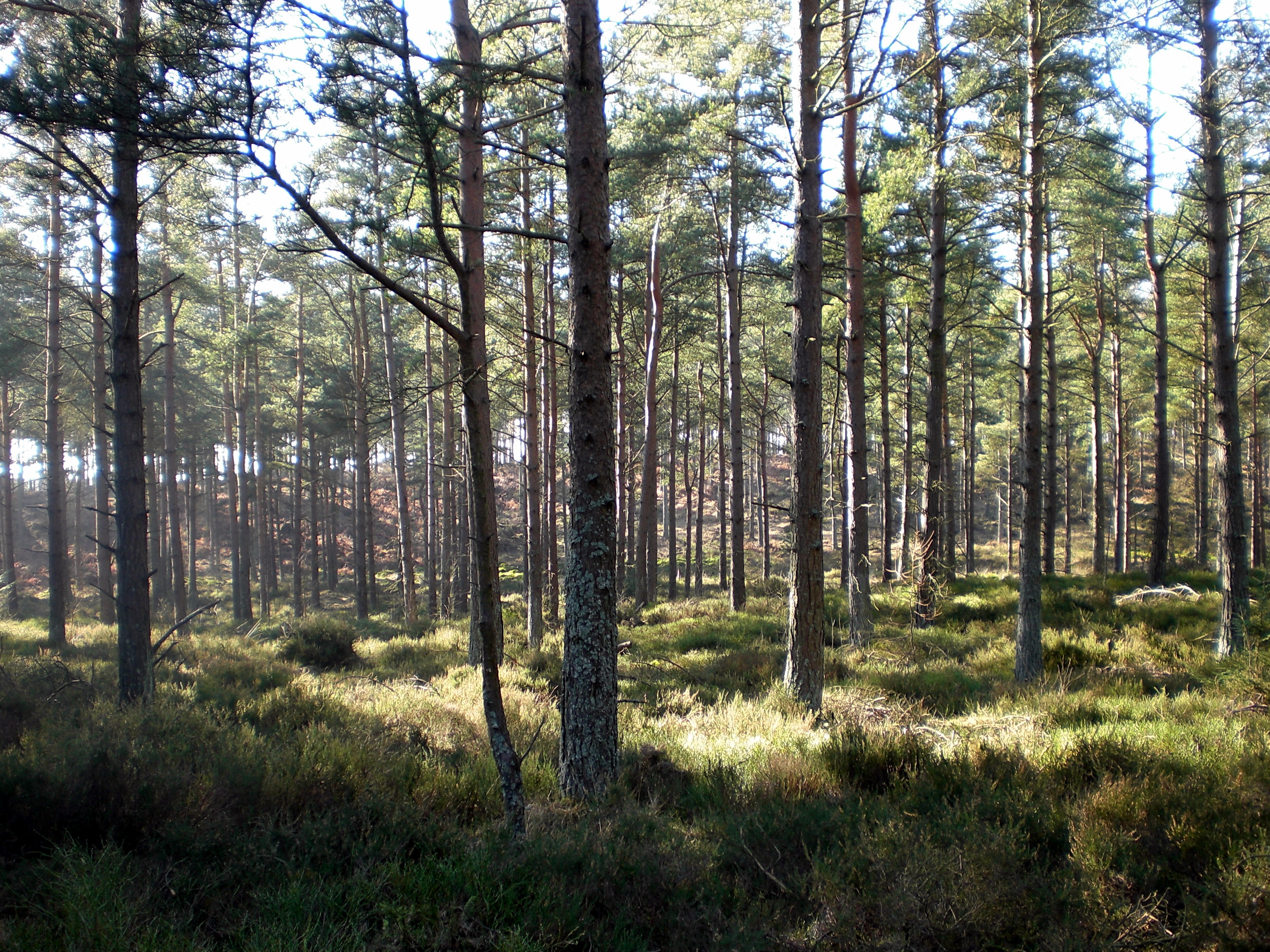

 This is a Meith Stone which has the St Andrews Cross carved in the top. The stones were used to mark land boundaries and sometimes initials were inscribed on each side of the stone denoting land ownership. Apparently five stones have been found along what would have been the old drove road between Kincardine and Culross.
 This enigmatic looking stone is known locally as The Standard Stone, which according to local legend marks the spot where a Danish Army defeated Duncan and his generals Macbeth and Banquo in The Battle of Bordie Moor. (1038). The stone could also have been where the Scots army placed their battle standards, but is more likely to be the base of a medieval stone cross on a parish boundary or a wooden gallows.










 Murdo Eason - From Hill to Sea