
.
A short history of breathing
≈

.
A short history of writing
(scratch wall)
≈
.
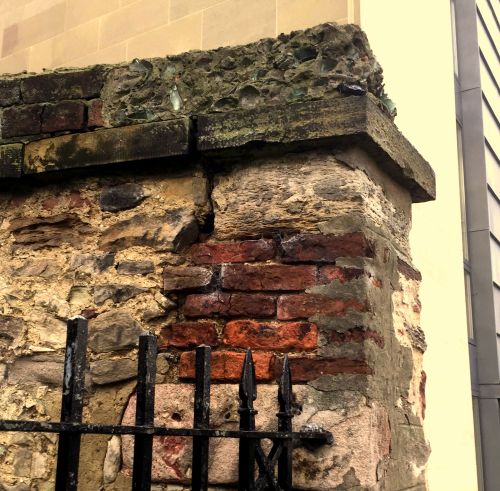
A short history of building
…
stone
brick
mortar (concrete)
iron
glass
plastic
…
≈
Now playing: Claire M Singer – Solas
Murdo Eason - From Hill to Sea
walking / writing / between world and word
.
A short history of breathing
≈
.
A short history of writing
(scratch wall)
≈
.
A short history of building
…
stone
brick
mortar (concrete)
iron
glass
plastic
…
≈
Now playing: Claire M Singer – Solas

Last setting of the light – 2016
Leaves will return
≈
(Saw a kingfisher today, for only the second time, so 2016 has largely redeemed itself).
Best wishes to all in 2017 and thanks for the support, collaboration, discussion and walking. More to come …
Now playing: Anna Thorvaldsdottir – In the Light of Air, performed by the International Contemporary Ensemble (ICE).
To begin the journey, we congregate almost four hundred years after Jonson. In front of the Palace walls, a set of variations in muted ochre, the orange pantile roof catches weak strands of sunlight on this September morning …
≈≈≈
Tales for Travellers and Travellers Tales … walking in the footsteps of Ben Jonson
It was a delight to be part of this wonderful project where we took Ben Jonson out for a walk in September.
Rebecca Crowther has documented the activities of all who took part in a new website which records our nine mile social walk from Culross to Dunfermline. Here you’ll find some background to the project, photographs, a short video, sound recordings of our interactive stops along the way and our own contribution from Murdo Eason.
Some extracts below:
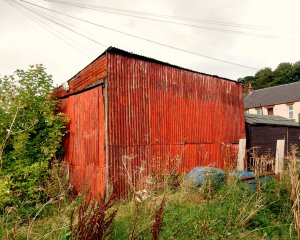
still
s
i
t
t
i
n
g
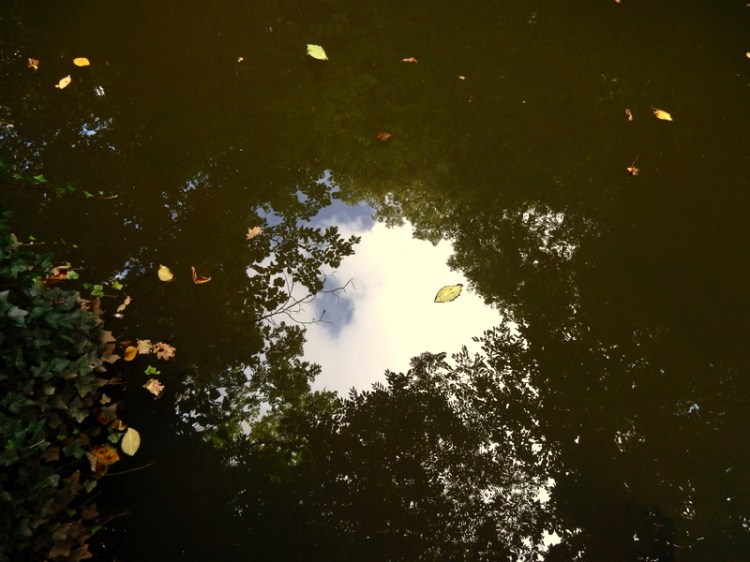
In a quiet place
I watch the sky
fall to earth.
.
A few leaves
cast adrift, circle
as clouds and trees
slip silently below
the skin of water
≈≈≈
The sock & coulter symbol of the plough. A farmer’s life, turning soil, slowly returning to the land

You can find it all here:
Tales for Travellers and Travellers Tales … walking in the footsteps of Ben Jonson
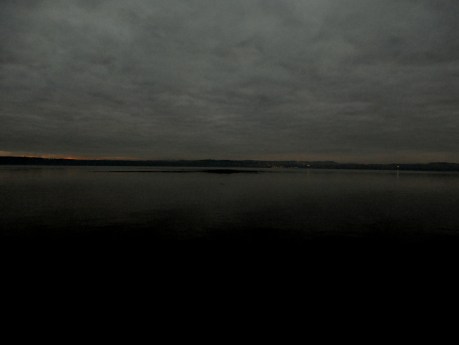
That time of day in December when the last flicker of light gives way to shadow and smothering darkness
The sea a dark mirror, pulling down the sky
Time of the Vanishing ( )
.
Time of retreat
≈≈≈
From the shore at Limekilns, 3rd December 2016, around 16.50.
Now playing: Loren Connors – Blues: The Dark Paintings of Mark Rothko

The concept includes the fact that many foreigners have settled in Scotland and contributed to its identity. Indeed, the notions of geology as destiny, the Rock People, and the Atlantic People that plied the shores from Galicia to Norway (from roughly 5,000-1,500 BC) are part of the larger Scottish World …
Charles Jencks
Anyone who has driven up the M90 motorway in the last twenty years could hardly have failed to notice the St Ninians open-cast coal mine near Kelty.
A landscape transformed and consumed through raw material extraction, technology and human labour. The coloured flecks of jabbing industrial machinery appearing to shrink to insect scale as the vast grey void opened up. An unfolding Burtynsky portrait of post-industrial scarring:

In 2003, the international landscape artist and cultural theorist Charles Jencks was commissioned by the mine owners, Scottish Resources Group, to develop a landform proposal to regenerate the area. Jencks is perhaps best known as an architectural theorist of postmodernism and in Scotland, for landscape design projects such as his own Garden of Cosmic Speculation, the recently completed Crawick Multiverse and smaller scale works at Jupiter Artland (Cells of Life) and The Scottish National Gallery of Modern Art (Landform Ueda).
Jencks coined the project The Scottish World which was based on ideas of the Scottish diaspora and immigration. There was no doubt as to the physical scale of its ambition with four colossal earth mounds representing four continents where Scots had travelled and settled.
Whilst work commenced on the restoration project, and was originally due to complete in 2012, the scheme collapsed in 2013 when Scottish Resources Group went into administration. The site was subsequently taken over by Hargreaves Resources and an agreement was made with Fife Council that would see a degree of the restoration project completed, in exchange for a licence to extract the remaining coal still to be mined. However, it soon became clear that the project would not be completed according to Jencks’ original design although elements already completed would be kept and maintained. Despite occasional mutterings in the local press about potential futures for the site, it appears to exist today in a state of limbo ‘officially’ out of bounds to the general public.
We thought we would go and take a look.

It seemed barely credible that this was the first weekend in October as we headed in a vague direction towards the contours of the limbo landscape. First, a short detour to Loch Fitty, looking serene, underneath brilliant blue skies punctuated by billowing clouds scudding overhead. A solitary duck on the water placed like a calligraphy mark on a sheet of blue marbled paper.

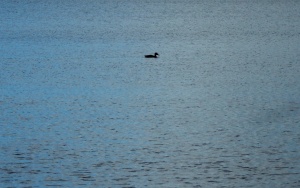
Looking out over the loch today, it is difficult to comprehend that in 2013, there was a consented planning proposal on the table to drain the water and excavate 7.4m tonnes of coal underneath. (How do you actually drain a loch?) The scheme was only curtailed with the afore-mentioned collapse of Scottish Resources Group. However, the presence of coal workings in the landscape remains evident with a line of black, sooty debris drawn along the shoreline.
From the loch, we couldn’t find any obvious path towards the Jencks landscape but as the ‘European Continent’ mound dominates the area it is easy to set a course towards what looks like a primitive temple complex at the apex of this earth shifted landform.
The weather clearly helped, but the biggest surprise is how the black scarred earth is now re-seeded with lush golden grasses and whilst waterlogged in parts is perfectly suited to walking. At the bottom of Jencks’ colossal mound, it is identifiably one of his structures, but a rustic, wild version on an explosive scale. All ragged gorse and tufted grasses compared to the carefully turfed manicured versions displayed as artworks. The walk to the top of the earthwork is like walking around the structure of a snail’s shell. An ascent around the unfolding whorls giving spectacular views as we circle higher. Looking to the north, a large body of hidden water provides a sanctuary for a sizeable colony of birds – too far away to identify what they are:

Further around the structure, we look upon another of the completed mounds redolent of Silbury Hill. Will this structure also retain its mysteries when future generations ponder who built it and why?

At the top of the European Continent mound, three tyre and tree structures point to the heavens. Postmodern totems evoking some sense of being placed in a ceremonial landscape. From the highest point, sight lines lock into the elevated energies of the recumbent figure of Benarty Hill, Falkland Hill and what Julian Cope calls the mother mountain of Largo Law.

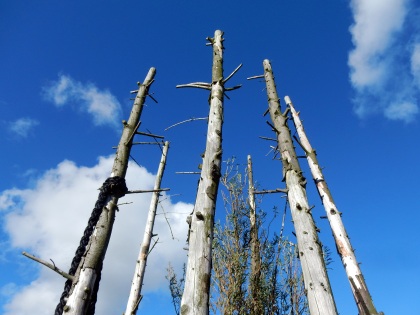
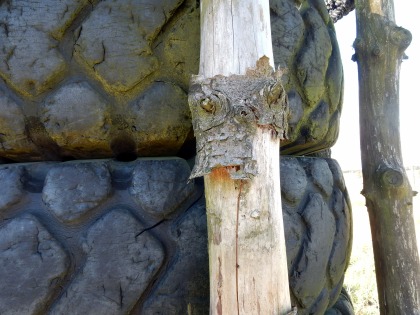
The earth spread out beneath us is a material energy landscape still in flux as it has been for thousands of years. The extracted open-cast void surrounding us directly below. To the east and west a landscape shaped by the deep mining of the Fife coalfield and the towns and villages that grew on the back of it: Kingseat, Ballingry, Kelty, Cowdenbeath, Lumphinnans, Lochgelly, Lochore, Cardenden, Auchterderran. The pit winding gear long since removed from all these places. (although we can still see the winding gear structure of the Mary Colliery at Lochore Meadows which has been left as a memorial to Fife deep mining).
There is also an absence. A village now completely erased from the land on which we are pretty much standing:

Lassodie, in the Parish of Beath, was an agricultural community up until the mid-nineteenth century. In 1859, the Lassodie Coal Company was established and a number of pits were sunk which resulted in new housing being built locally for the miners.

By the early 1900’s, Lassodie housed around 1,400 people and included a village school, a number of shops, including two branches of the Co-Op, a Free Church of Scotland and a corrugated iron village hall. However, like many of the Fife towns and villages, the fortunes of the community were inextricably linked to coal. Two pits were closed after the 1921 coal strike which set in motion the gradual drift of families away from the village. By 1931, all the pits had been closed as they had become uneconomical to keep free from flooding. The remaining families were served fourteen days notice to vacate their houses which were owned by the coal company. The church struggled on for a number of years as a Christian retreat and was used at the beginning of the Second World War as a hostel for refugees from Nazi occupied Europe. The buildings of the village were eventually demolished and almost all material traces of it having ever existed disappeared when open-cast mining transformed the land. A memorial to Lassodie villagers killed in the First and Second World Wars now sits in isolation at the side of the B912 road from Kingseat to Kelty. Detached from its physical referent it now also acts as a memorial to the ghost village itself.


To the South East, the Mossmorran natural gas fractionation plant is clearly visible, belching plumes of steam into the sky. A folded mass of metal glinting in the sun. In the far distance, the colossal turbine structures of Little Raith wind farm spin silent songs of wind alchemy.
An avenue of coal machinery parts has been placed on top of the structure. Transformed from utilitarian metal and concrete into slowly changing collection of weathered patinas across the colour spectrum:

.
On a landscape of rust
canyons and deserts
of the colourfield
.

.
Locked rotational
orbits gather
slow accretions
of elemental colours
.

.
On top of
a human-formed hill
.
Eyeing the curve
of concrete shadow
.
Edges and angles
cutting through the blue
.

.
enfolding
shadows
f / o / l / d
spaces
of retreat
.

A causeway of hewn rock offers a puzzle to ponder: Stencilled into two rocks: Danzig and Gdańsk. The same physical place that has oscillated between variants of these two names, Prusso-German rule, Polish rule and as a semi-autonomous city-state between 1920 and 1939.


The stones are likely symbols of the strong trade links that Scotland enjoyed with the Baltic region from the late fourteenth century onwards. Many Scots emigrated to the Baltic region and established themselves as merchants and traders. Robert Gordon was one merchant who made his fortunes through the Aberdeen-Danzig trade route. He subsequently funded the foundation of a hospital in his hometown which four hundred years later still stands, now known as Robert Gordon University. By the 17th century Gdańsk was home to an estimated 30,000 Scots and today two suburbs of the city exist called Nowe Szkoty and Stary Szkoty. (New Scotland and Old Scotland).
On another split stone, a French proverb Fier comme un Écossais (Proud like a Scot) is a reference to the Auld Alliance between Scotland and France, established in 1295.


One of the most surprising aspects of the whole area was the constant presence of dragonflies – if indeed that is what they are? – flitting past, resting, or sunning themselves. Magical, flying shards of stained glass, as if materialising out of light and air. I have never seen so many in one area, so ecological conditions must be very favourable for them. Perhaps tangible evidence of a healing landscape.

On the way back down, we reflect on the connections this walk has tapped into. The sense of landscape always being in flux; old energies transitioning to new energies; the wounds of open-cast mining in a process of environmental healing. Of how an outward looking internationalism has been part of the Scottish (and British) psyche for hundreds of years. How we have welcomed refugees in times of crisis. A reminder of how vital this is as resistance to the current raft of Brexit ideologues, attempting to build walls, retreat to nostalgic notions of a country that never existed and shrink imaginations.
And as for Jencks’ stillborn project, we say open it up as it is. It has developed into a fascinating space for walking; nature appears to be transforming the ecology and it is clear that people have started to use it unofficially. On the way back we pick up a path that is easily navigable as an entry point to the site and encounter a few dog walkers and people out for a stroll around the lower levels. A conversation with one of the miners who used to work here illustrates his pleasure in how the land is usable again. He also regales us with a few tales of tax scams and financial deals that he believes went on regarding the management of the site and the failure to create a sufficiently large sinking fund to enable full restoration to take place.
The land is there. Go walk it!

With very special thanks to Kathryn B, who pointed us in the direction and found gold in these lands!
Now playing: Laurie Spiegel – The Expanding Universe.
References:
Billy Kay, The Scottish World: A Journey into the Scottish Diaspora (Edinburgh: Mainstream Publishing, 2008).
National Library of Scotland – Map Images
George Robertson, The Lost Village of Lassodie (Dunfermline Historical Society).
‘Land art plans for Kelty scrapped’, The Dunfermline Press, 21 October 2014.
Next Sunday, September 25th, we are participating in a social walk which takes its inspiration from tracing Ben Jonson’s journey from Culross Palace to Dunfermline Abbey nearly 400 years ago. The walk is part of a wider project initiated by the University of Edinburgh led by James Loxley and Anna Groundwater. Below you will find full details of the event and you would all be very welcome to join the walk in full or in part. If you require any further information please drop us a comment or contact Miranda Swift directly (miranda.swift (at) @ed.ac.uk)
Hope to see and meet some of you there!
From Miranda Swift:
SUNDAY, SEPTEMBER 25TH
JOIN US IN TRACING BEN JONSON’S WALK FROM CULROSS PALACE TO DUNFERMLINE ABBEY
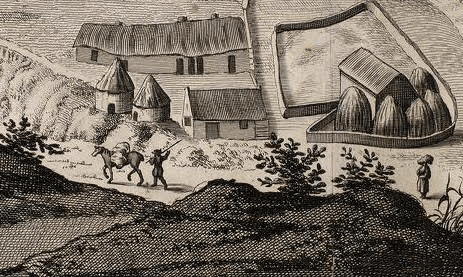
Detail from John Slezer’s Prospect of Dunfermline, 1693
Nearly 400 years ago, Ben Jonson travelled on foot from London to Edinburgh, and from there to Fife. He took his time, stopping at inns and private houses, meeting new people and socialising, listening to stories and telling his own. It’s this kind of travel that we’ve taken as the inspiration for a social walk from Culross Palace to Dunfermline, following the route that not only travellers like Jonson, but local folk as well, have long been taking.
Along with some fantastic collaborators from Forth Pilgrim the Fife Psychogeographical Collective and Fire Station Creative , we’ll be joined by a diverse crew of walkers, including storytellers, artists, musicians, and historians. To help us gather the sights and sounds of the landscape, as well as our responses to it, we’ve invited film and photography students from Fife College to come along, and we’d also like to encourage everyone to get involved with as much or as little participation as you like. Bring a sketchbook, a poem, a camera, or just your walking boots!
The total distance is 9 miles, however you’re welcome to join us at the start and leave at any point along the route, join us at our mid-way stop at Cairneyhill and carry on, or meet us at at the Fire Station Creative in Dunfermline at the end, and join in the party. We’ll be treated to some excellent live music from local Fife musician Andy Shanks, as we swap stories and rest our feet.
For a little bit of background on Ben Jonson’s walk, and the University of Edinburgh project, led by James Loxley and Anna Groundwater, which this walk is a part of, check out Ben Jonson’s Walk. James has also written up a blog post on our upcoming Fife Social walk, delving into Jonson’s attitude towards travel and discovery, which you can read here:
This walk is open to all, so please forward this information on to anyone who you think might be interested, and we look forward to meeting you.
ITINERARY
10:15 – Meet outside the front of Culross Palace in the square, look for the bust of Admiral Cochrane
10:30 – James reads from Jonson’s account of the Palace
10:40 – Set off
13:00 – Refreshment break at The Maltings Hotel, Cairneyhill
16:00 – Finish at The Fire Station Creative, Dunfermline
16:00 – 19:00 – Social gathering with music, poetry, and good company
INTERACTIVE WAY-STATIONS
You may have noticed the yellow marks on our map. These are stopping points where some of our participants will be leading interactive sessions, which will include:
Local stories, myths, legends
Focusing-senses exercise
Local history (George Bruce’s moat pit, Newmills Bridge, etc.)
Poetry readings (Thomas A. Clark’s ‘In Praise of Walking’)
DETAILS
Date: Sunday, September 25th
Time: 10:30 am – 4:00 pm
Start: Culross Palace
Finish: Fire Station Creative in Dunfermline. It is located next door to the new Tesco on Carnegie Drive, KY12 7AN.
Distance: 9 miles. Please refer to the maps attached for details of the route taken, marked in red.
Joining/Leaving: A convenient meeting place should you only want to walk part of the route is The Maltings Hotel, Cairneyhill. We aim to reach it by 1pm for a short refreshment break.
Transportation: Please refer to the bus schedule on Map 1 attached here. Bus 8 leaves stance 11 at Dunfermline Bus Station at 9:35 on Sunday, arriving Culross Palace at 10:03. Further bus information, including bus times from Culross and Cairneyhill to Dunfermline, are also attached to Map 1. Alternatively, visit the Stagecoach website, or ring 01592 645680 for up to date info.
Accessibility: The route will follow footpaths, though be aware that surfaces may be uneven in places, and you are responsible for your own safety when using them. We will be walking along the coast for the first half, and then walking up a couple of hills. It is not a difficult hike, but be prepared for a long walk, and remember to bring enough water with you.
Meal Break: Please bring a packed lunch with you. Due to the number of people and the time restrictions of the walk, we won’t have time to be served lunch in the hotel. There is a shop in Cairneyhill where you can buy a sandwich if you find you forgot yours, or need two!
If you have any further queries please don’t hesitate to get in touch with me, the project administrator, via email or by phone. I’m always happy to chat about the project, and will hopefully be able to answer your questions. Also, if you could let me know if you will be attending, please let me know. Thanks in advance, and I hope to see you on the walk!

foreground / distance
fractured red diamonds
through scattered prisms
to grey horizons
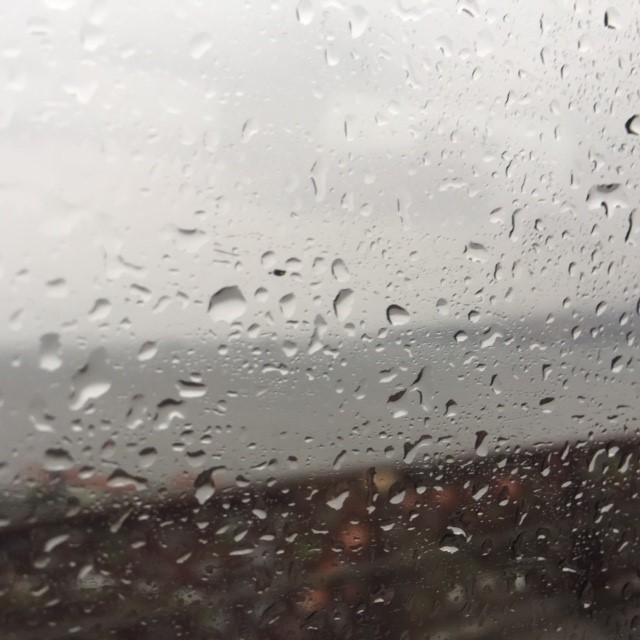
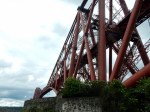
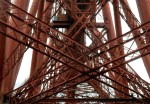
Passing, at speed, on a train through the three red diamonds of the Forth Rail Bridge. The eye drawn to the foreground. Shards of red-painted steel, morph and distort, through shifting prisms of wind-scattered raindrops. The Firth of Forth, a grey blanket folded at the horizon beneath a brightening sky.

Now playing: Tim Hecker – ‘Prism’ from Virgins.
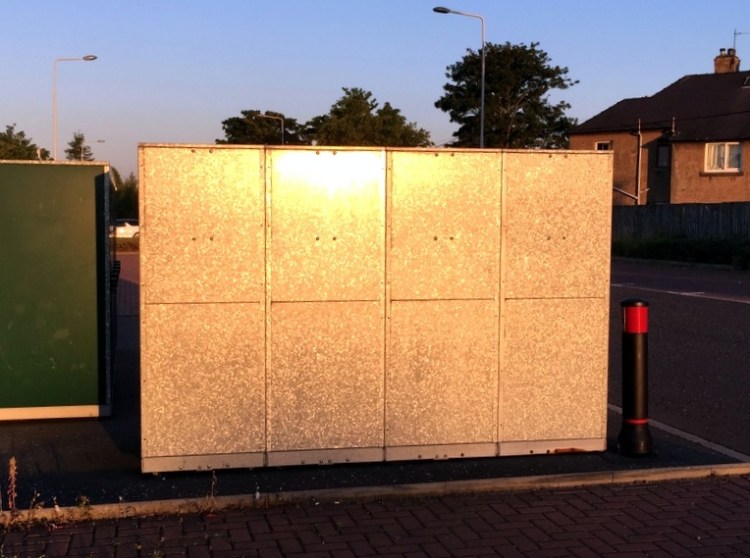
Light Lit
Reflector / \ Conductor
of Car Park
Transmutation

In / \ at the car parks of Rosyth Halt and Inverkeithing railway stations, Fife.
Now playing: Ulrich Krieger – /RAW: ReSpace/

all the shadows of time
since sixteen eighty nine
≈
Now playing: Licht-Akiyama Trios – Tomorrow Outside Tomorrow.

I like maps, because they lie.
Because they give no access to the vicious truth.
they spread before me a world
not of this world.
Wisława Szymborska
There are only shadows here
A Field in England (Dir. Ben Wheatley)
The commuters scurrying down the stairs at Rosyth Halt railway station, are unlikely to give much thought, if any, to the field on their left as they descend to the platform below. Some may notice subtle changes in colour throughout the year. The recent appearance of yellow broom blossom; the overhead sun creating a dappled patchwork of greens, sandy browns and heathery purple. In a few weeks, the hawthorn blossom will sit like scented snow on the ancient hedge.
Standing at a certain part of the station platform, it is possible to hear the gentle purr of the Whinny Burn tracing its route through the field on its way to the River Forth at Inverkeithing Bay. Magpies, rooks and collared doves appear to take a curious interest in the arrivals and departures of station commuters whilst overhead, the sun splinters around the extended wings of a buzzard soaring like Icarus ever higher into the blue.
The field is now bounded on all sides by motorway, dual carriageway and the railway line. A severed island of abandoned agricultural land cast adrift with no easy public access. At the top of the halt steps, there are no particularly distinguishing visual features as we look over the land which we are going to walk through. As a train arrives at the platform below, a late flurry of commuters hurl themselves past us and down the stairs to squeeze into the carriages before the doors close. Most are unlikely to be aware that there may be as many as 2,000 bodies buried somewhere in the vicinity.
The fields between the railway and the A823 (were) where the last and bloodiest part of the battle took place … it is likely to be where the majority of the killing took place. (Historic Scotland).
it is said that the burn ran red with blood for three days.
The casualties on the Scots side were certainly heavy. Most sources agree that about 2,000 were killed and around 1,500 taken prisoner, although various figures are reported for the casualties of the Highland regiments. Cromwell in his letter immediately after the battle reported at least two thousand dead.
July 1651
It was during the night or early morning of 16th /17th July 1651 that the troops of Oliver Cromwell’s New Model Army landed on the north shore of the Forth in the vicinity of Inverkeithing Bay. Whilst they had inflicted a heavy defeat on the Scottish army at Dunbar on 3rd September 1650, they had been thwarted by attempts to advance further into Scotland. Cromwell came to the conclusion that Fife was the key and by 20th July, 4,500 of Cromwell’s Parliamentarian force were dug in on Ferry Hills, whilst a Scottish force of a similar size had grouped at Castland Hill. The threat of Scottish reinforcements coming from Stirling provoked Cromwell’s Parliamentarians to attack and force the Scottish infantry to retreat north towards Pitreavie Castle. On land close to Pitreavie Castle, the Scottish infantry made a final stand but were soon overwhelmed by the more experienced Parliamentarians who had the additional advantage of cavalry. The Scots suffered heavy losses. This became known as The Battle of Inverkeithing (sometimes The Battle of Pitreavie) and was the last major battle of the Wars of the Three Kingdoms in Scotland. From 1652, Scotland was wholly under control of Cromwell’s Protectorate.
Entering the field is not too difficult. Not far from the station steps there is a locked gate but a little further along we find a gap in the hedgerow. If you are prepared to navigate or slide down a steep slope, this will deposit you amongst the discarded plastic bottles and assorted rubbish tossed from the stairs above. At ground level, the topography of the field is much more apparent. Pronounced undulations ahead of us, sloping off to the right towards marshy ground around the Whinny Burn. Ground cover is a mix of meadow type grasses, whin bushes, dandelions and what look like dock leaf plants gone to seed.


You only have to look towards the perimeter of the field to be aware that you are surrounded by human presence. The rooftops of Rosyth to the right and the hum of motorway traffic a constant low-level signal. Yet on the actual land we are walking, it is rare to find an almost complete lack of evidence that humans have recently passed. No litter, no discarded cans or bottles or burnt out barbecues. There are hints of desire lines traversing the space, perhaps made by committed dog walkers or something else. It is only as we move further into the field, that there is a clear sense that we are being watched.

At first, we wonder if it is a dog but it soon becomes apparent that it is the eyes of a tiny roe deer that are fixed on our movements. We are both probably equally surprised to encounter each other. This is not an area where you would typically expect to see deer. Where on earth has it come from? We lock into that non-time state of reciprocal, motionless, staring. Eventually the deer decides to break for it. Great elongated leaps for something so small; as if bouncing off the air itself, not really touching the ground. I manage to retrieve the camera and fire off some random shots in the hope that we obtain some record of this actually having happened.

We notice our presence is also alarming a number of skylarks which appear to have made the field their own. Their nervous, vertical flight and fluted song a mix of terror and beauty as we try to avoid what must be their nesting areas.
The field separates in two at a ridge of hawthorn bushes. On the other side:
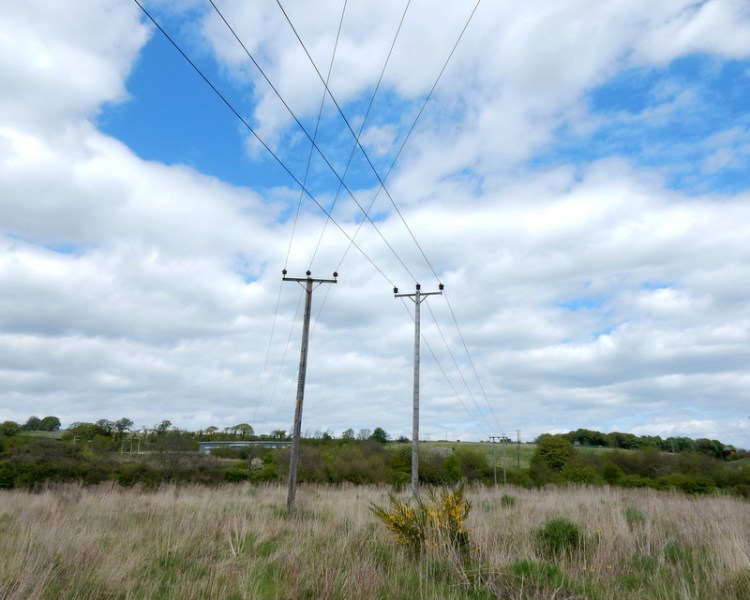

From a distance
criss-cross
to new horizons

A field of time
history layered
on geography.
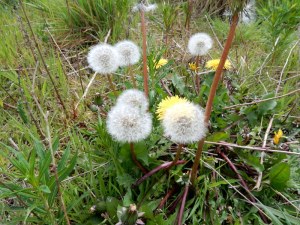
Transparent globes
of wind held tension
time scattered
yellow flowerings
of the eternal return

The field eventually tapers to a point where we can go no further, blocked off by the railway and the smooth, solid concrete structure carrying the A823 motorway spur.
We know that beyond the A823 another field will take us to a concrete flyover of the M90 motorway. We work out a way to access the field and head off on a detour. Our serendipitous findings are recorded in a separate blog: Cartographies of Chance – Underneath the M90 (II).



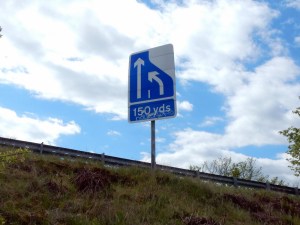
Returning to the field, we walk close to the northern perimeter with only a thin hedgerow between us and the A823. Such a slight threshold separating us from our field of time, skylarks and deer. On the other side, the surveillance cameras, crash barriers, lay-bys and signs – all the material apparatus of the modern motorway.


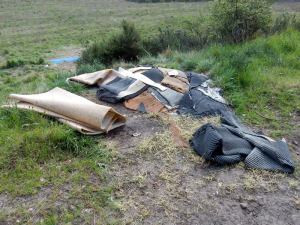
We are quite surprised to come across a footbridge over the motorway that enters the field only to stop at a complete dead-end. The proximity of this easier access results in the usual heaps of fly tipping, something that is hard to understand. It must be much more difficult to dump this stuff here than take it to the municipal waste recycling.


Place and non-place are rather like opposed polarities: the first is never completely erased, the second never totally completed . . . But non-places are the real measure of our time.
Marc Augé
The footbridge takes us over the A823, (Why does an empty motorway always evoke a Ballardian descriptor?) and into the relatively new ‘non-place’ of Carnegie Campus. We know from the old maps and records that this land was also once part of ‘the field’. Being a Sunday, the ‘campus’ is completely deserted as we wander amongst the new build office blocks, many of which still look unoccupied. Roundabouts appear to have been built in hope of a time still to come as roads come to an abrupt end. Rab’s Little Kitchen snack van is closed.


Where the manicured non-space runs out, an explosive wild bouquet of whin sits amongst a covering of red campion:

And yet amongst all the shiny new sheen of this place, older voices intrude. A hexagonal brick structure whose original purpose is unclear:

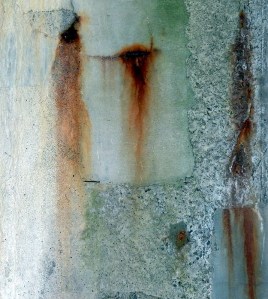
time stacked textures
brick and concrete
.

Nestled in at the side of the main road into the campus we come across the cairn. As far as we are aware it is the only explicit acknowledgement of what happened on this land.
the Scots were driven back to the level ground between Hillfield and Pitreavie. Here, in one of the most famous episodes of the Battle of Inverkeithing, the Clan Maclean of Mull regiment, commanded by their chief, Sir Hector, found themselves surrounded by superior enemy forces. The clansmen fought fiercely in defence of their chief, calling out, “Fear eile airson Eachainn!” (Another for Hector!), as they sacrificed themselves.
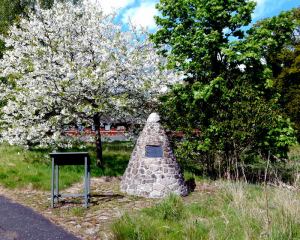
The battle involved musketry, cavalry, pikes, swords and even archery on the Scottish side, with considerable hand to hand fighting

Near here, Sir Hector MacLean of Duart was killed
at the Battle of Inverkeithing
along with some 760 of his men
20th July 1651
“Another for Hector”

Nearby to the cairn, stands another material presence in the layered history of the field. Peering over a substantial stone wall allows us a view of the Dovecot in the grounds of Pitreavie Castle.

Pitreavie Castle was originally built in the early 17th century by Henry Wardlaw of Balmule, later Sir Henry Wardlaw, 1st Baronet of Pitreavie. Wardlaw was Chamberlain to Queen Anne, wife of James VI of Scotland.
The Battle of Inverkeithing/Pitreavie was fought nearby on 20 July 1651, between an English force commanded by Colonel Robert Overton and a Scottish force, including some 800 Highlanders from the Clan Maclean. After the battle, which was a decisive victory for the Cromwellian forces (contemporary reports speak of 2,000 Scots killed and 1,600 captured, all for the loss of 8 of Overton’s troops), a group of Macleans sought refuge in Pitreavie Castle. The Wardlaw family refused them sanctuary and the Macleans were likely to have been captured or killed.
The Maclean dead … are more likely to have been buried in a mass grave.
We pass the old dovecot of the castle, turn left and past the front door where the initials of Henry Beveridge are recorded. Beveridge purchased the Castle in 1883 and extensively remodelled it in 1885.

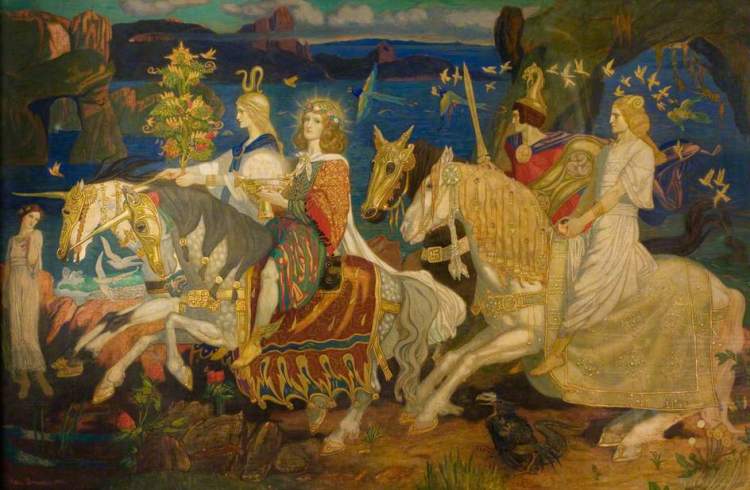
Henry Beveridge was a wealthy mill-owner, philanthropist and educator from Dunfermline. He was an associate of Patrick Geddes having attended Geddes’s summer meetings in Edinburgh. He subsequently became one of the Directors of Geddes’s Edinburgh Town and Gown Association in 1896. As a member of the Carnegie Dunfermline Trust, Beveridge was also partly responsible for arguably Geddes’s greatest work – City Development: a study of parks, gardens and culture institutes. A report to the Carnegie Dunfermline Trust. Geddes also introduced Beveridge to the artists John Duncan and Charles Mackie who painted murals in the castle illustrating the legend of Orpheus and Sir Patrick Spens.

It is believed that these murals may now be at best over-painted and at worst destroyed. A good example of John Duncan’s Symbolist style can be seen in his famous work, The Riders of the Sidhe:
As noted above, Henry Wardlaw’s granddaughter-in-law, Elizabeth Wardlaw, is claimed to be the author of Sir Patrick Spens. (Although the evidence appears somewhat tenuous).
“The king sits in Dunfermline toune
drinking the blude reid wine,
“O whar will I get a guid sailor,
To sail this schip of mine?”
…
Walking past Pitreavie Castle today, it has now been converted into flats and apartments and offers no clue as to another more recent past life. It was bought by the Ministry of Defence in 1938 and after the second world war, deep in a basement bunker became the headquarters of NATO’s Northern Maritime Region. During the Cold War, all Soviet ships and submarines on exercise in the North Sea were monitored from here. The base closed in 1996 and operations moved to RAF Kinloss. There is little or no outward trace of this today, although some photographs of its past life exist:
Access to the underground bunker

The teleprinter room 1944

As we head along Castle Drive, we notice that a small housing estate has a story hidden in the street names:
Covenanters Rise: The Scottish army was a Covenanter army, acting under allegiance to Charles II.
MacLean Walk: the aforementioned Sir Hector Maclean of Duart, commander of the Scottish Highland infantry.
Sir John Brown Place: Sir John Brown, commander of the Scottish lowland infantry.
Overton Crescent: – Colonel Robert Overton led the assault party of New Model Army troops that landed in Fife on the night of 16th/17th July.

Our final part of the walk will take us along Castle Drive where we will loop around to bring us back to where we entered the field. Despite the changes over the centuries, we have walked the area of the field as it was in 1657. We continue to ponder our mysterious encounter with the roe deer. Perhaps a manifestation of “only shadows here”?
Four days after the Battle, Cromwell crossed to Fife in person. For him the victory was “an unspeakable mercy”.
As we walk down Castle Drive we pass another new addition to the landscape on the left. A customer contact centre for Rupert Murdoch’s Sky empire.
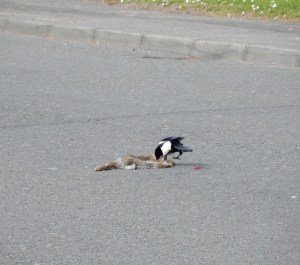
On the other side of the road, a magpie picks at the carcass of a dead squirrel.
≈≈≈
Appendix
Present day map showing the boundary lines and key sites of the Battle of Inverkeithing. (Historic Scotland/Ordnance Survey).

Now playing: June Tabor – ‘Sir Patrick Spens’ from An Echo of Hooves.
or a more jaunty version: Fairport Convention – ‘Sir Patrick Spens’ from Full House.
References:
Marc Augé, Non-places: Introduction to an Anthropology of Supermodernity (London and New York: Verso, 1995).
Charles Holme (ed), The International Style, Vol. 1 No. 1 (New York: The Bodley Head, March 1897).
Helen Meller, Patrick Geddes: Social Evolutionist and City Planner (London and New York: Routledge, 1993).
Wisława Szymborska, Map: Collected Poems and Last Poems (Boston and New York: Mariner Books, Houghton Mifflin Harcourt, 2016).
Ben Wheatley Dir. A Field in England (Film4, 2013). Film.
Area Combined HQ Rosyth – Pitreavie Castle (Flag Officer, Rosyth, RN & AOC No 18 Group, RAF Coastal Command) on Subterranea Britannica
The Inventory of Historic Battlefields – Battle of Inverkeithing, Historic Scotland, 14th December, 2012.
 Murdo Eason - From Hill to Sea