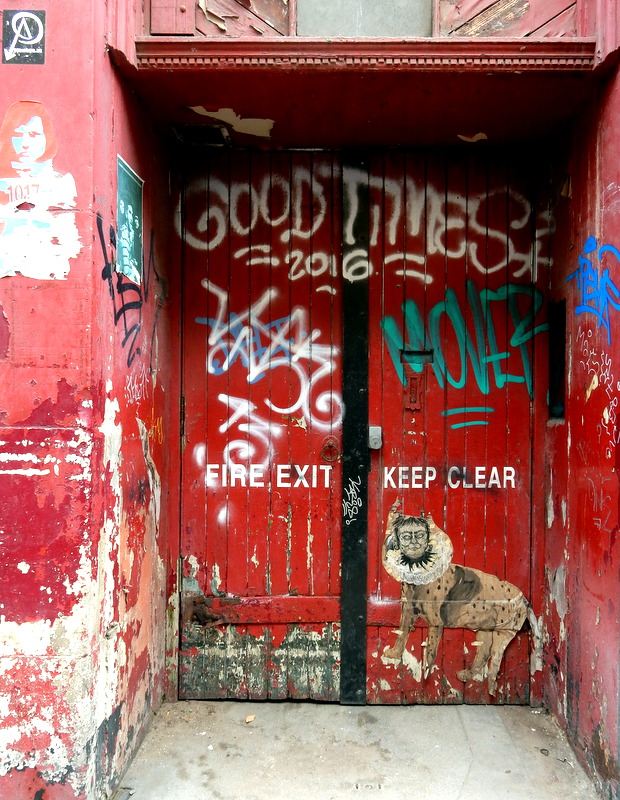
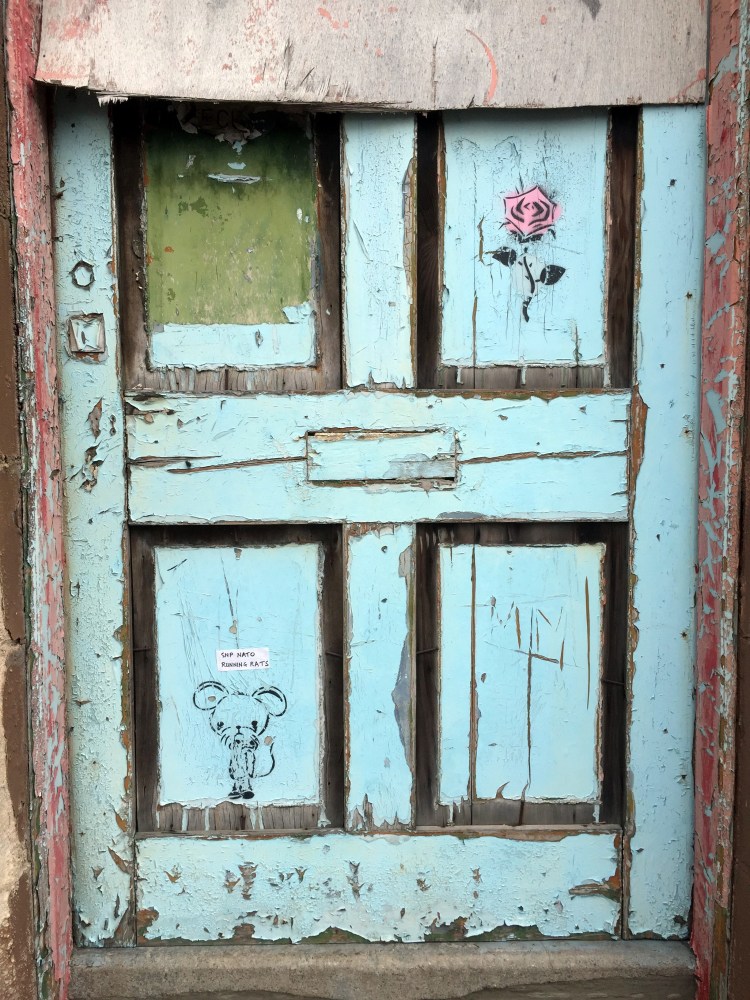
Perhaps just another graffiti strewn doorway but the phrase “Good Times = 2016 =” called out. I doubt that there are many people I know who would readily conflate 2016 and ‘good times’. So just a throwaway action with a spray can? irony? a small act of resistance?
Possibly it was just a coincidence but passed this doorway during the Edinburgh Festival. A time when the city opens its arms to the world in a celebration of all the performing arts, bringing together audiences and artists. Just walking the streets, soaking up the creative energy can bring sustenance. Good Times indeed.
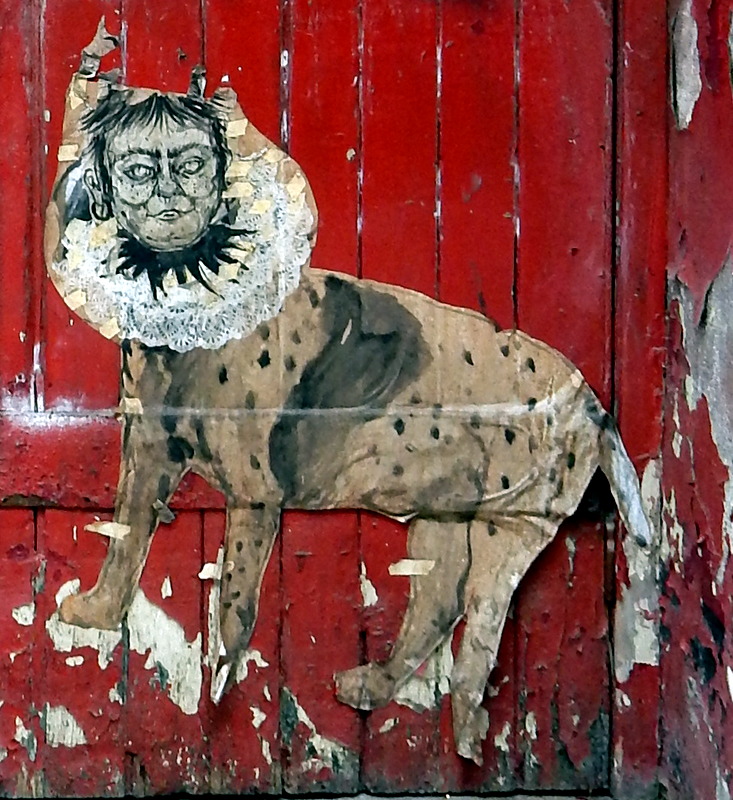
And what about that figure on the bottom right?
Now playing: King Champion Sounds – To Awake in That Heaven of Freedom (Thanks to Teesside Psychogeography for altering me to this. Check out their excellent blog Smell of Water).
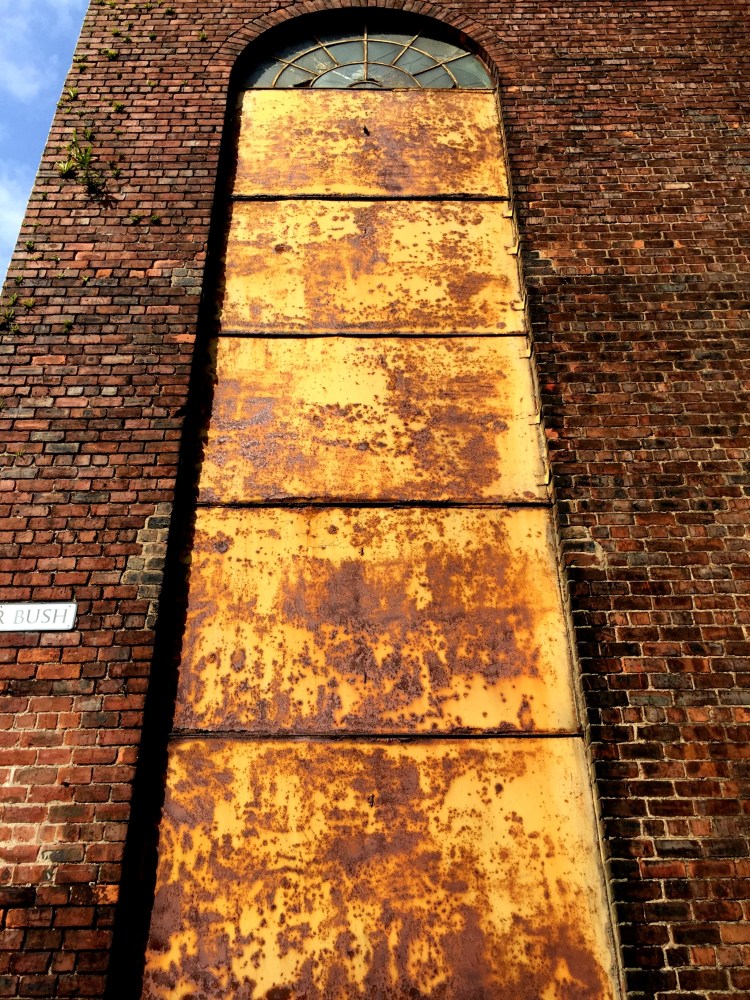
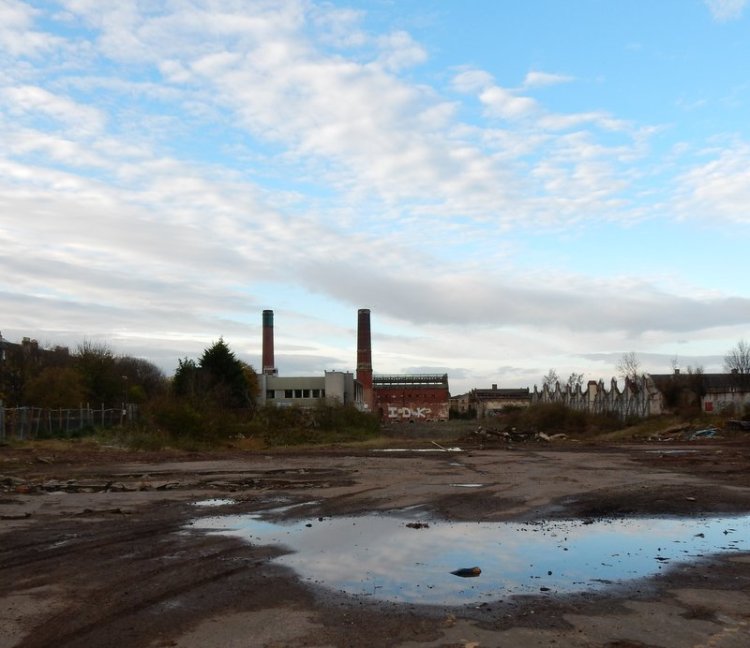
Looking from Leith Walk, Edinburgh, on 25th November towards the vestiges of the Shrubhill tramway workshops and power station. The power station opened in 1898 and housed the haulage engines for cable-tramway operations. By 1922 the power station had closed with the tramway workshops continuing in use until 1956.
The site was also once known as the Gallow Lee where a gibbet stood for public executions. There are numerous accounts of murderers, Covenanters, warlocks and witches being executed and buried on the site between 1570 and 1752.
.
.
Waves of molten lava
breaking – on
the blue shore
≈
An early morning sky over Limekilns, Fife on 25th November 2015. The sky as apocalyptic beach.
.
.
View from the train – take that #BlackFriday
≈
On the East Coast mainline. Taken and posted on Twitter on 27th November 2015.
We have already written a fairly long piece on the painter William Gear (1915 – 1997). Gear was one of only two British members of the post-war, European, avant-garde movement CoBrA in the 1940s. He went on to produce some of the most radical and controversial paintings of the 1950s.
In the centenary year of his birth, a major retrospective of his work has recently arrived in Edinburgh. Previously shown at The Towner Art Gallery, Eastbourne, where Gear was curator from 1958-1964, it is a fabulous retrospective show and a privilege to see so many of his works collected together. From early dabblings with Surrealism through to the radical monochrome abstractions of the 1950s and the singing colours and sculptural forms of his mature style from the 1960s to his death in 1997.
The exhibition is showing at City Art Centre until 14th February 2016 and comes highly recommended. Rather than write a full review, we would only suggest that you consider visiting the exhibition if you can.
Walking around for the first time a few phrases caught the ear and eye:
I was born and brought up on the Fife Coast. Harbours, boats, the sea. It is in the blood.
I was a Parisian now.
(Gear moved to Paris in the late 1940swhere he held his first solo shows and joined CoBrA after meeting Appel, Constant, Corneille and Jorn. Reading this line particularly struck a chord after the brutal terrorist attacks on Paris on Friday 13th 2015. An attack on a city that has always drawn artists to it and excels in celebrating both the highest pleasures and everyday joys of life).
I cannot say in truth that my painting is entirely non-representational, though at no point am I ever obsessed with the rendering of objects in front of me or remembered as such. I continually find that my pictures, when finished, are evocative of something within my visual experience. It may be the corner of my studio, or the view from the window of trees and the Seine and the buildings of the Île de la Cité opposite, or a generalised landscape, interior or assembly of forms.
Trees and boulders take on the menacing form of hidden terror. Imagination plays tricks with the eyes.
In conjunction with a fine exhibition catalogue, a magisterial new book has been written by Andrew Lambirth which is particularly strong on placing Gear within an international context.
We were also delighted and gobsmacked to stumble across a mention of our essay in the Afterword:
William Gear (1915 – 1997): The painter that Britain forgot – City Art Centre Edinburgh, until 14th February 2016. (Free).
It often happens. A sensation at the edge of perception. A glint of light, a fluttering of movement. The feeling that some-thing has flitted across the threshold of the senses.
Something there – but not there.
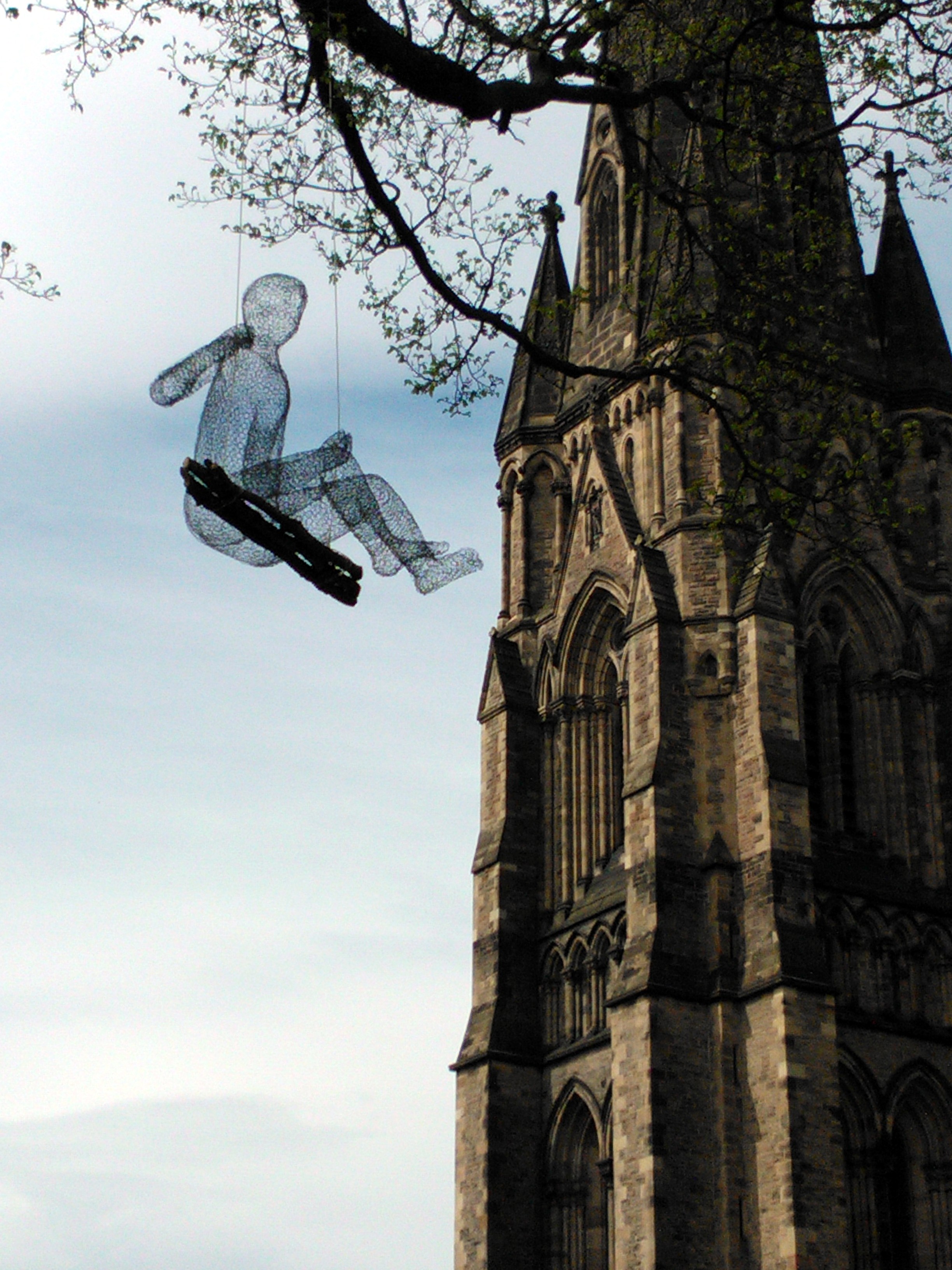
And so it was, walking along the tree-lined footpath by St Mary’s Cathedral in Edinburgh. Looking up, amongst the trees it was difficult to see it clearly at first. Something metallic, floating, but also appearing to be entwined amongst the branches, merged with the sky. It was only when a light breeze, initiated a gentle rocking movement that the suspended human form fully emerged.
From another angle, the drifting figure resembled a pencil drawing sketched on to the sky. A shaded human form floating against the blue canvas, slowly dissolving back into leaf and branch.
The gentle motion, both hypnotic and dreamlike conjured up thoughts of Solveig Dommartin’s character, Marion, in Wim Wenders’ Wings of Desire. A lonely trapeze artist, inhabiting the space between ground and sky, who entices an angel down to Earth.
.
Solveig Dommartin as Marion in Wings of Desire
.
I have subsequently read other people describe the St Mary’s work as “sinister, creepy or disturbing” and it certainly startles you when you first look up and see it. An experience that I’m sure would be intensified if you encountered it in the dark under moonlight. However, for me, the figure conjured up a sensation of something otherworldly, yet strangely familiar. A fluid form of substance and air, swinging silently, and like ‘Marion’ suspended between the earth and sky.
From a distance I watched for a short time as many people passed along the footpath. The vast majority did not look up or see the figure suspended amongst the leaves. Silently watching, waiting to transform the everyday city into an encounter with the uncanny.
≈
Now playing: Nick Cave and the Bad Seeds – The Carny
I have found out that the sculpture is a work called Spirit by Aliisa Hyslop, a Finnish/Scottish artist. Spirit is presently part of an exhibition at the Arusha Art Gallery.
The quotation from Rilke’s Duino Elegies are the last lines of the translation by David Young (New York: W.W. Norton & Company, 1978). Wim Wenders cites Duino Elegies as the initial inspiration for Wings of Desire.












 Murdo Eason - From Hill to Sea