” ‘Nature’ is not to be understood as that which is just present-at-hand …”
Martin Heidegger
It is difficult to convey a sense of scale.
Perched on the edge of a collapsed harbour wall, the vestiges break from the blue expanse ahead like a stone-flippered sea serpent, emerging from the depths.
At this height, the field of vision is a wash of blues and greens, daubs of cloud. Dark emerald maps trace imaginary continents on the sea floor; an atlas of time and tide. Drowned oceans, swirls of bottle green bleeding through ultramarine. Hints of International Klein Blue. As a couple of herring gulls swoop close by and aim for the water, there is a fleeting urge to emulate Yves Klein’s leap …
A whisper of wind, pulls the gaze back to the horizon and acts as a useful reminder that to leap from this vantage point would be unlikely to end well. I press my back firmly against the narrow, elevated ledge and watch the clouds scudding east.
Whilst we could be gazing out across the Mediterranean, we are looking out over the Firth of Forth at Seafield, just west of Kirkcaldy. The collapsed harbour arm in front of us is an industrial folly dating from 1899. The harbour was never completed and looking towards the banks of serrated rock teeth, just to the west, it is perhaps not surprising why. It is difficult to envisage safe passage for any vessel across this bay.
We are also aware that underneath these coastal waters, subterranean entrails of hollowed out ‘black diamonds’ reach far out below the Forth. Behind us is a landscape of absence with no visible trace of the Seafield pit which once dominated this coastline. Seafield was the last of the Fife coalfield ‘superpits’ and was one of the largest undersea mines in Europe. It linked up underground, beneath the Forth estuary, with its sister pit, ‘The Frances’, situated to the North of Kirkcaldy.
Preparatory work on sinking a mine shaft at Seafield began in 1954 with production starting in 1965. The pit was one of Egon Riss’s (1901 – 1964) modernist designs for The National Coalboard Scottish Division, which also included: Bilston Glen, Killoch, and Rothes, with Seafield and Monktonhall being completed after his death. Riss was an Austrian of Jewish descent who had studied at The Bauhaus and was acquainted with Oskar Kokoschka and Paul Klee.
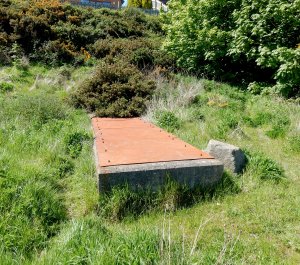
Seafield just managed to survive the fallout from the Miner’s Strike, but closed four years later in 1988 with all of the above-ground infrastructure erased from the landscape in 1989. A relatively short industrial life of 45 years from conception to dust. Walking the landscape today there is no trace of the pit having ever existed. A new housing development sits up on the hill where Riss’s modernist landmark towers once stood. As we consider the marvellous views that these houses must command, we alight on a tomb-like structure on the side of the hill, complete with what could be a memorial stone. All is blank.
At the time of writing, (December 2015), the COP21 Paris climate deal has just been agreed, which at least outlines an intent and ambition to secure a low-carbon future for Planet Earth. We can’t help thinking that, like the oft cited butterfly of chaos theory that flaps it’s wings and causes a hurricane in another part of the globe, the burning of the first lump of carbon produced its own unforeseen effects over a longer time scale.
“It was my first acquaintance (1859) with the geology of Fife, and furnished me with many fresh and striking manifestations of volcanic phenomena – a foretaste of the rich harvest which the county was afterwards to yield in the same field”.
Sir Archibald Geikie (1859)
Our sense of human time, industrial time and earth-time is given a further jolt as we start to walk along the rock strewn beach towards Kinghorn. This part of the Fife coastline offers some dramatic examples of rock formations and lava flows dating back to early Carboniferous times of between 360 – 320 million years ago. The Binn (hill) which overlooks nearby Burntisland is believed to be the source of these lava flows.
.
Any rock is an index of deep time. Liquid lava movement arrested by abrupt cooling. Intense heat solidifying, fracturing, frozen in time.
Inevitably, our stroll along the beach throws up some interesting items:
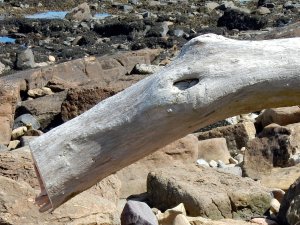
We wonder if we have come across the staff of the Spear of Neptune:
Unfortunately a search for the trident is unfruitful.
On any beach, these days, there is always at least one tyre:
A sea-smoothed anteater:
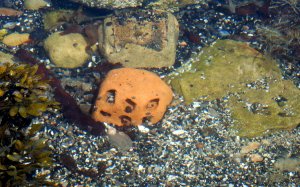
and a rock pool submerged sea skull:
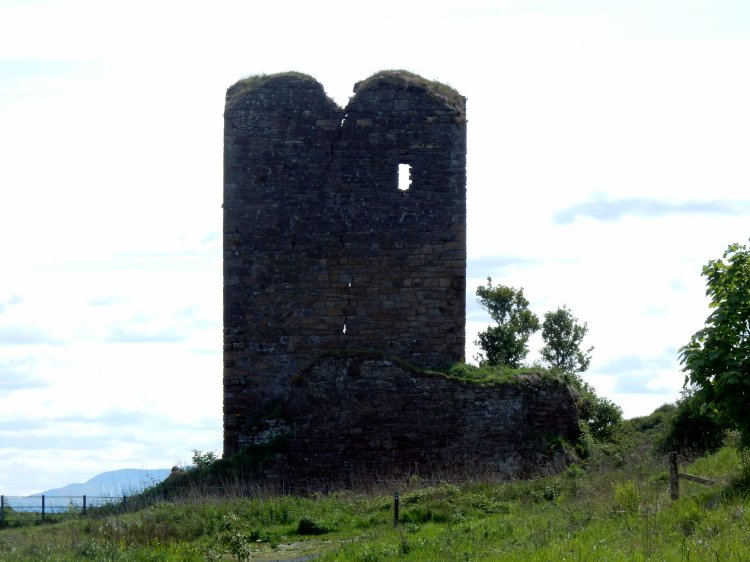
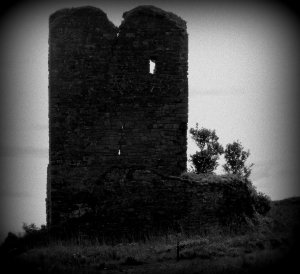
We leave the beach and pick up the footpath that leads to Kinghorn. Up ahead we can see the outline of Seafield Tower with the outer wall remaining largely intact.
For how long the tower will remain standing is another matter given the clearly visible fracture running down the middle like a poorly executed appendix scar. It feels as if a really strong wind could cleave the structure in two.
The tower is believed to date from the early 16th century and was the stronghold of the Moultrays of Seafield until 1631 when the estates were sold to the Archbishop of Glasgow. More intriguingly, a 1774 plan shows the enclosing courtyard walls and a circular tower at the NE angle described as the ‘Devil’s Tower’ although the derivation of this is unclear. The local coastline was known to be the haunt of smugglers in the eighteenth and early nineteenth centuries. Perhaps it would do no harm to circulate rumours about a devil’s tower to keep people well away.
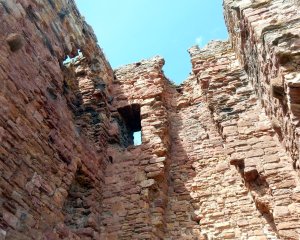
Built of red sandstone, the tower has not weathered well and now resembles a crumbling, hollowed out old tooth:
.
The Devil’s Tower?
On a day as radiant as this one, the tower doesn’t feel too devilish and the red sandstone softens the sun which is high overhead and beating down. This should favour one of the key reasons for our trip and we head further along the coast to see if we are in luck.
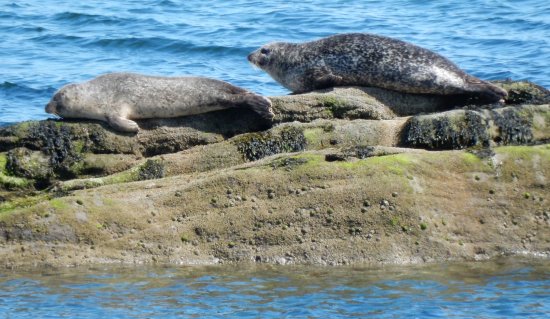
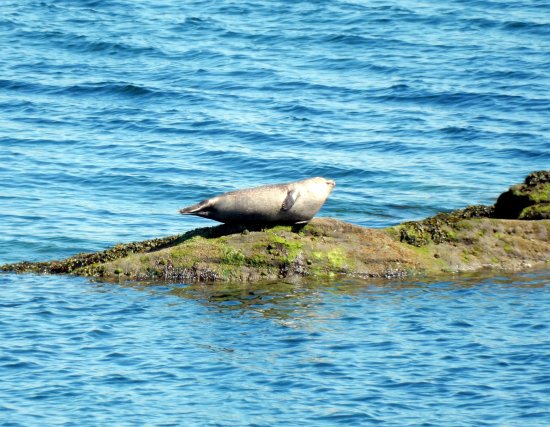
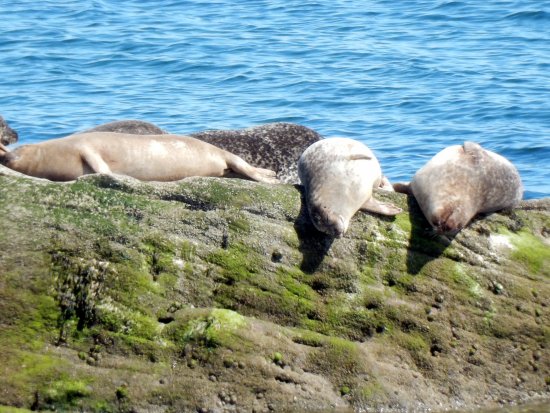
It is fairly common to see seals bobbing around the Fife coast, but we rarely see them congregate together. Today they are revelling in the sunshine, lounging on a series of rocks not too far from the shore. Occasionally, one will slide into the water and bob around closer to shore, clearly curious but feeling well protected by the aforementioned waves of rock teeth to discourage anyone trying to get too close. This is also a very quiet part of the coast. The railway hugs the coastline between Kirkcaldy and Kinghorn which prevents any access to the path other than by foot from either end. Even on a day such as this, with glorious weather, we encounter less than a handful of people on the path. There are the usual dog walkers who populate the entrance and exit areas but otherwise it is a remarkably quiet stretch.
Not surprisingly, the area is also rich in bird life. Oystercatchers puddle around the shore, whilst common gulls and herring gulls criss-cross the air in constant movement. Further out cormorants dry their wings, as if juggling a pair of half extended umbrellas. Our identification skills are insufficient to precisely identify many other species but the area is known as a rich haven for guillemots, razorbills, kittiwakes and fulmars.
Above our heads, a bunch of swifts engage in frantic aerobatics, explosions of kinetic energy and zig-zag movement. In stark contrast, a grey heron appears to slow the world to a standstill as it descends from the sky. The silent movement of its wings dissolving time in a held breath as it gracefully glides to a halt.
A more puzzling conundrum is the discovery of a still feathered wing caught up in some thick bramble thorns. Had the bird just inadvertently flown in to the thicket and become trapped or been attacked by a bird of prey? Or was it some totemic symbol carrying a message for the initiated or marking some form of threshold?
As the path ascends to higher ground, it looks over some fairly steep cliffs and runs parallel with the railway line for a stretch with expansive views over the Forth and onwards towards Kinghorn itself.
The presence of so many seals, earlier, conjures up visions of their close relatives in folklore whose stories pepper this coastline. As we look out to Inchkeith island we think of Kelpies and mermaids:
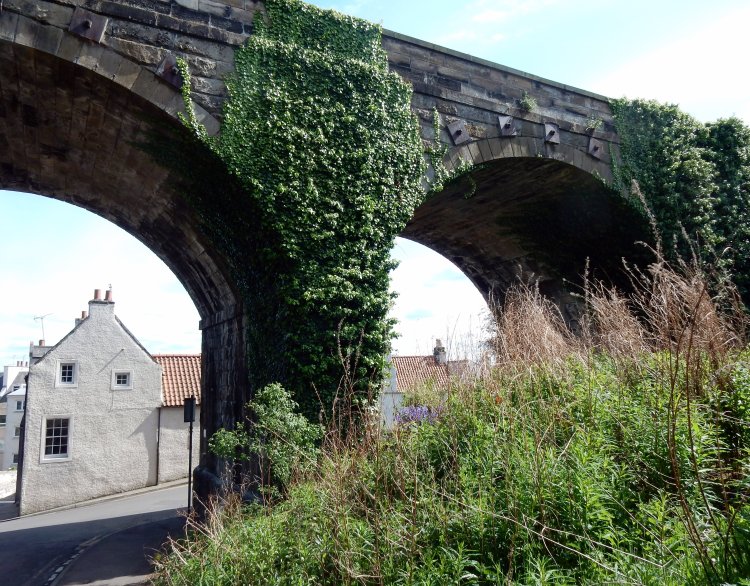
We eventually reach Kinghorn as the railway arches soar over our heads.
Kinghorn will have its own post at some future time, but as we walk down to the harbour we are reminded that Pettycur Bay nestles under a prominent crag known as ‘Witches Hill’:
≈≈≈
When the time comes to make the return walk back to Kirkcaldy, the sun has sunk low and we encounter no-one on the path. The landscape becomes more auditory than visual: the repetitive lip lip lip of a rock pool; the fizz of the receding tide. But it’s a low groaning drone that begins to fill the air. A deep and doleful lament rising to a eerie howl.
The seals are singing.
Is it a warning? a wake? Or do we hear the call of shape-shifting selkies, shedding their sealskins to assume human form …
We walk on quickly …
≈≈≈
Coda:
Tired of dreaming
the sun slipped
from the sky
in the dying light
a fizzle of water
a settling of sand.
Now playing: Kevin Drumm – The Sea Wins
The walk was undertaken in late May 2015. Written up in December 2015.
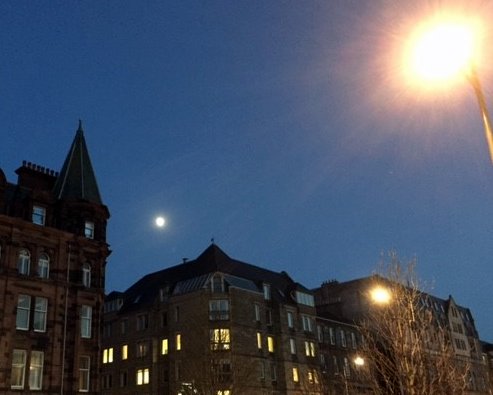
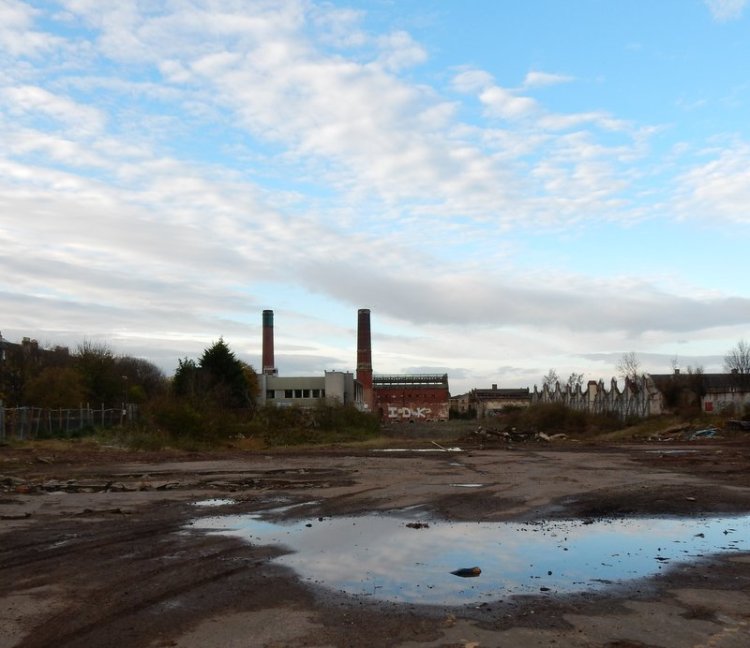
Looking from Leith Walk, Edinburgh, on 25th November towards the vestiges of the Shrubhill tramway workshops and power station. The power station opened in 1898 and housed the haulage engines for cable-tramway operations. By 1922 the power station had closed with the tramway workshops continuing in use until 1956.
The site was also once known as the Gallow Lee where a gibbet stood for public executions. There are numerous accounts of murderers, Covenanters, warlocks and witches being executed and buried on the site between 1570 and 1752.
.
.
Waves of molten lava
breaking – on
the blue shore
≈
An early morning sky over Limekilns, Fife on 25th November 2015. The sky as apocalyptic beach.
.
.
View from the train – take that #BlackFriday
≈
On the East Coast mainline. Taken and posted on Twitter on 27th November 2015.
We have already written a fairly long piece on the painter William Gear (1915 – 1997). Gear was one of only two British members of the post-war, European, avant-garde movement CoBrA in the 1940s. He went on to produce some of the most radical and controversial paintings of the 1950s.
In the centenary year of his birth, a major retrospective of his work has recently arrived in Edinburgh. Previously shown at The Towner Art Gallery, Eastbourne, where Gear was curator from 1958-1964, it is a fabulous retrospective show and a privilege to see so many of his works collected together. From early dabblings with Surrealism through to the radical monochrome abstractions of the 1950s and the singing colours and sculptural forms of his mature style from the 1960s to his death in 1997.
The exhibition is showing at City Art Centre until 14th February 2016 and comes highly recommended. Rather than write a full review, we would only suggest that you consider visiting the exhibition if you can.
Walking around for the first time a few phrases caught the ear and eye:
I was born and brought up on the Fife Coast. Harbours, boats, the sea. It is in the blood.
I was a Parisian now.
(Gear moved to Paris in the late 1940swhere he held his first solo shows and joined CoBrA after meeting Appel, Constant, Corneille and Jorn. Reading this line particularly struck a chord after the brutal terrorist attacks on Paris on Friday 13th 2015. An attack on a city that has always drawn artists to it and excels in celebrating both the highest pleasures and everyday joys of life).
I cannot say in truth that my painting is entirely non-representational, though at no point am I ever obsessed with the rendering of objects in front of me or remembered as such. I continually find that my pictures, when finished, are evocative of something within my visual experience. It may be the corner of my studio, or the view from the window of trees and the Seine and the buildings of the Île de la Cité opposite, or a generalised landscape, interior or assembly of forms.
Trees and boulders take on the menacing form of hidden terror. Imagination plays tricks with the eyes.
In conjunction with a fine exhibition catalogue, a magisterial new book has been written by Andrew Lambirth which is particularly strong on placing Gear within an international context.
We were also delighted and gobsmacked to stumble across a mention of our essay in the Afterword:
William Gear (1915 – 1997): The painter that Britain forgot – City Art Centre Edinburgh, until 14th February 2016. (Free).
At no other time (than autumn) does the earth let itself be inhaled in one smell, the ripe earth; in a smell that is in no way inferior to the smell of the sea, bitter where it borders on taste, and more honeysweet where you feel it touching the first sounds. Containing depth within itself, darkness, something of the grave almost
Rainer Maria Rilke
.
.
all around
a shedding of leaves
my green cloak
growing heavier
.
.
I notice that Autumn is more the season of the soul than of nature
Friedrich Nietzsche
.
.
Even decay is a form of transformation into other living things, part of the great rampage of becoming that is also unbecoming
Rebecca Solnit
.
.
almost dark
listen – in(g)
to the huddled whispers
of the forest flock
.
.
autumnal portal
a suggestion of russet
.
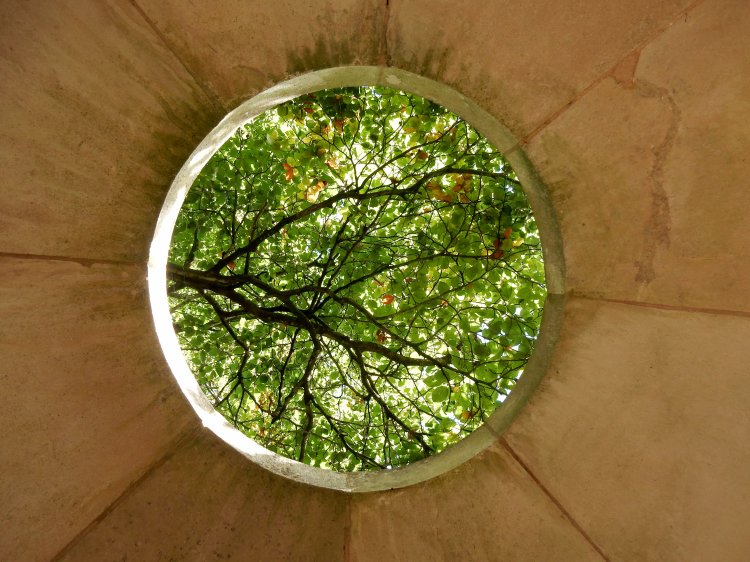
Above the roof of Ian Hamilton Finlay’s ‘Temple of Apollo’ at Jupiter Artland
.
.
Flooding the fissures
of the stone house
Liquid light
rippling the air
.
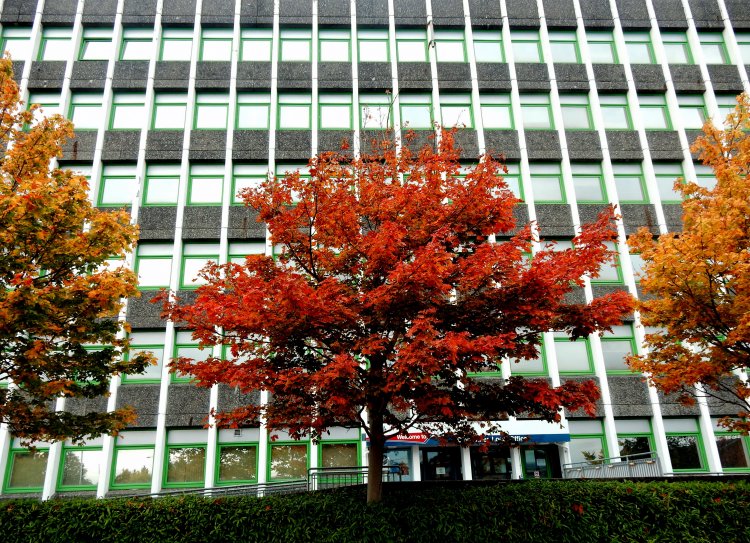
(Redux) When natural cycles turn, brutalist windows can dream of (autumn) trees…
.
Now playing: Laura Cannell – ‘Born from the Soil’ from Beneath Swooping Talons.
We are delighted to be part of this years Edinburgh Independent & Radical Book Fair, organised by the wonderful Word Power Books. The festival runs from Wednesday 28th October through to Sunday 1st November. The full programme is available here. All of the events take place at Out of the Blue Drill Hall, 36 Dalmeny Street, just off Leith Walk.
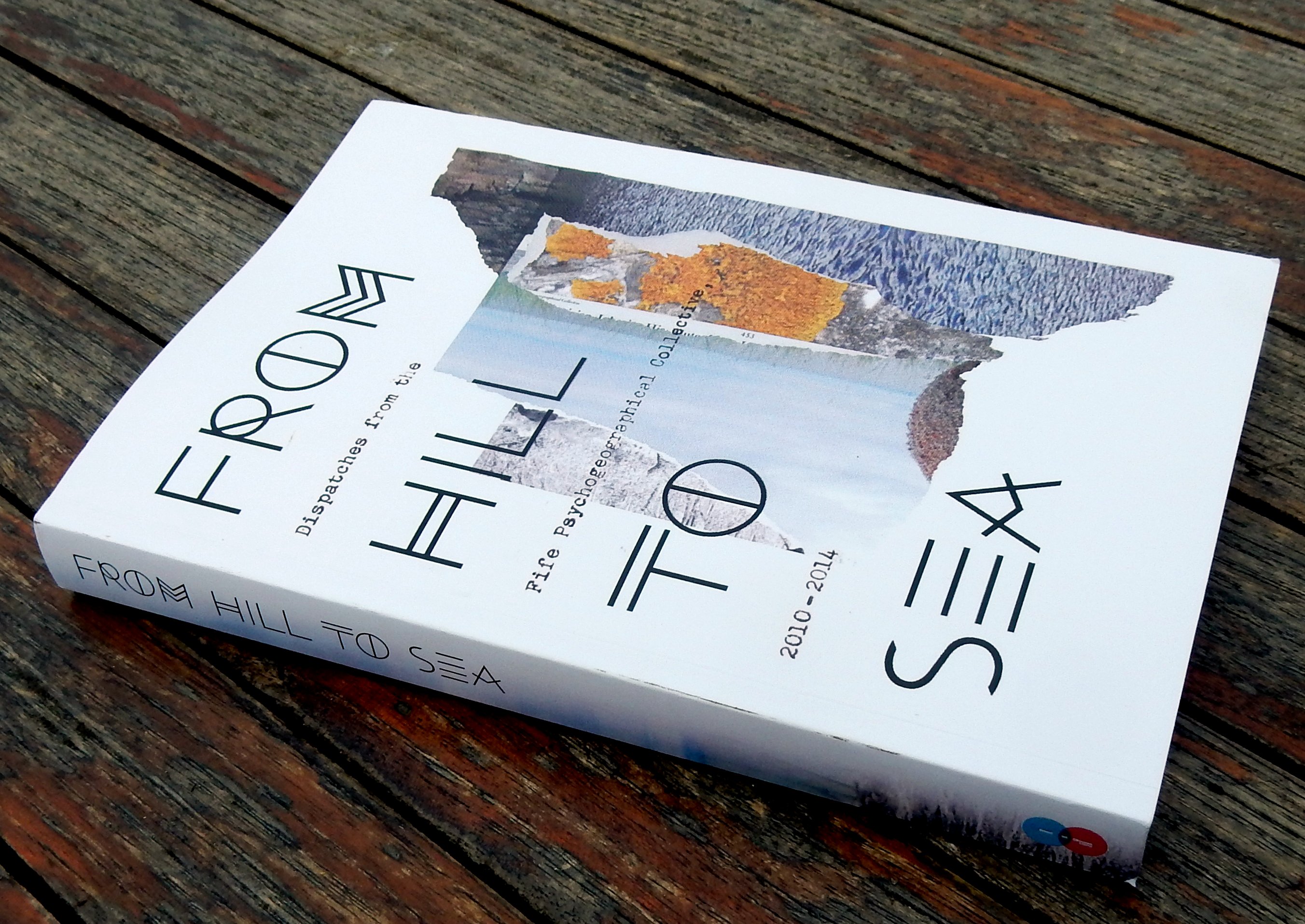
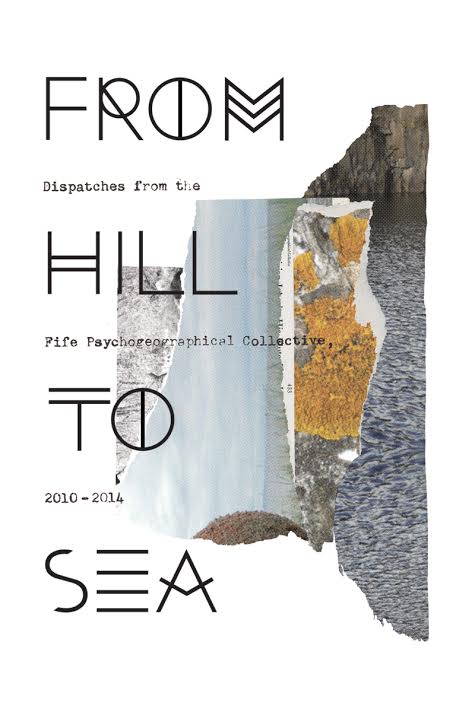
On Friday 30th October at 5.45pm, Murdo Eason introduces From Hill to Sea: Dispatches from the Fife Psychogeographical Collective 2010-2014.
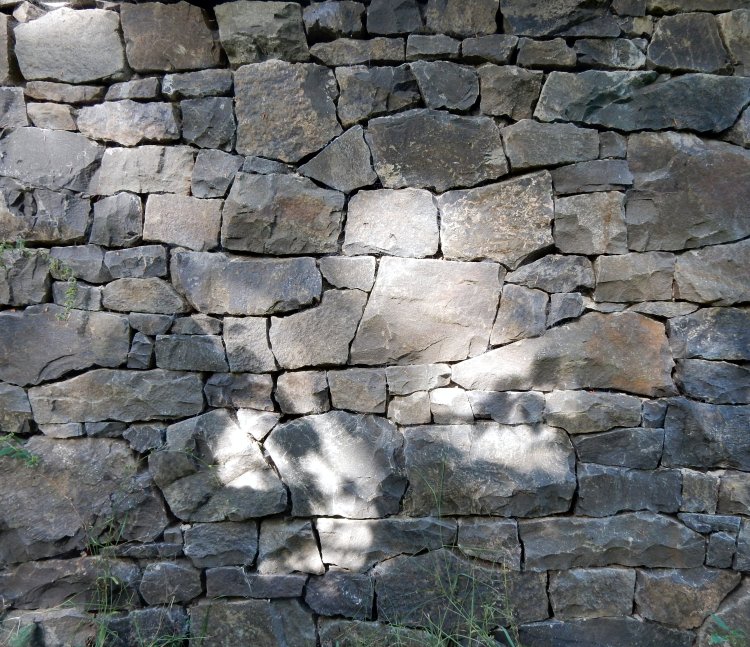
Also, for the duration of the book festival, there will be an exhibition of images and texts by the Fife Psychogeographical Collective: Walls / Objects / Structures.
If you do attend, and get the chance, please say hello.
We are delighted to announce that our book, From Hill to Sea, will be published in November 2015 by Bread and Circuses Publishing. (Tom Vague, King Mob, Guy Debord etc). Details about the book’s content and a ten minute film can be viewed on the Bread and Circuses website here.
There will be an initial, full colour, limited edition print run and also an eBook. Further information about the book will be posted here and on the Bread and Circuses website when available. If you are interested in reserving a copy of the numbered, limited edition print run, or being kept informed about the book’s publication, please email:
info [at] breadandcircusespublishing.com
What started out as a short trailer for the book, expanded to a ten minute film. Any rational person may have tried to edit this down but we have left it to view in whole or in part. If nothing else, you can enjoy the sounds of Oneohtrix Point Never and The Durutti Column.
Murdo Eason will also be doing some readings from the book at various forthcoming events. We will post details on this blog and on twitter @fifepsy
Thanks to everyone who has been supportive and encouraging of our endeavours to date. It is greatly appreciated.
Up above, the sound is like a collision of thunder arriving from north and south. Traffic heading to unknown destinations, running up and down the asphalt spine of the M90 motorway. Here, underneath the flyover, the concrete walls have become vast, abstract-expressionist assemblages. Layer upon layer of weather effects, pollution spray, pigment and human mark-making. It is only the walker who will notice these. Why, would you dwell, to look, if travelling in a car?
Has any disorientated walker followed the arrow east TO DIVIT, or west TO THE RO?
Unusual names – DIVIT, THE RO.
Consulting any official map will be of little help. There will be no record of these places. Perhaps we are standing on a territorial boundary line. DIVIT being a local name for Inverkeithing to the east. THE RO is Rosyth to the west. That human compulsion to establish borders and territories. Points of entry or exit. Lines pronouncing otherness, even when invisible and local.
Not far away, a universally recognised symbol. How many times has a heart shape been inscribed on a surface across time and space? From Cro-Magnon cave walls, via the ancient Greeks – a symbol of life and morality and possibly an association with Dionysus and love – to the more familiar symbol of romantic love emerging in the 1200s. Anyone using social media will recognise ❤ ❤ <3.
Under this motorway flyover, a black heart in brush stroke, partly over-painted in white. The shape immediately recognisable, a symbol we can all ‘understand’. But does the nuance of its meaning remain with the mark maker? We connect through common language but subtleties of difference always escape, to be either celebrated or repressed.
Is that a human figure we see enclosed within the heart? Possibly kneeling? Who can say?This small detail, on the patina of concrete canvas, remains a daub of mystery. A symbol as elusive and remote from the casual observer as the Pictish symbols, found further up the Fife coast, carved in the Wemyss Caves around 600 – 700 AD.
The difference between the who and the what at the heart of love, separates the heart. It is often said that love is the movement of the heart. Does my heart move because I love someone who is an absolute singularity, or because I love the way that someone is?
Jacques Derrida
Now playing: Julian Priester Pepo Mtoto – Love, Love
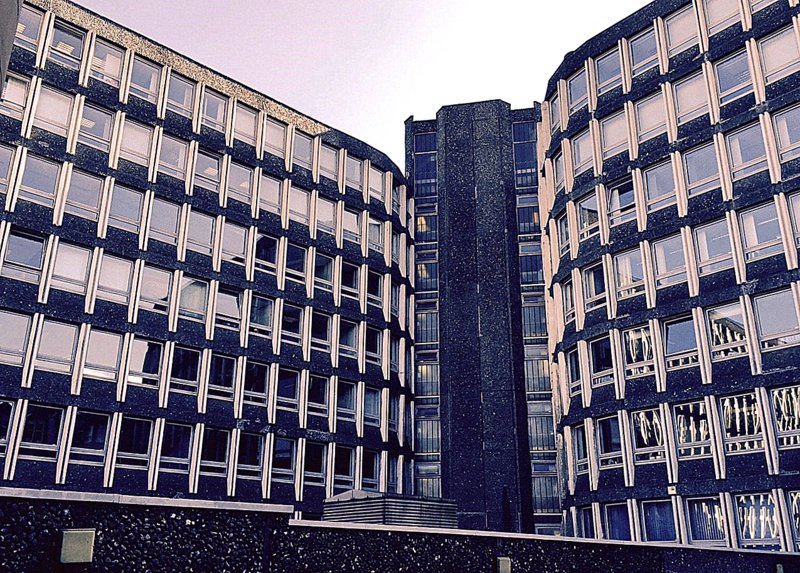
Walking up Lady Lawson Street in Edinburgh, I stopped for a closer look at Argyle House, an office block dating from 1968, designed by the architectural practice of Michael Laird & Partners. The building has many critics and is often described as an ‘eyesore’ and one of Edinburgh’s ‘ugliest buildings’. It appears to exist under a constant threat of erasure from property developers, and the City of Edinburgh Council, proposing new (re)development schemes.
The façade which borders the north side of West Port and the junction of Lady Lawson Street is very much of the brutalist box style. All right angles, rectangular windows and the material heft of concrete and harling.
Today, walking in behind the building, I see it from a different angle. The hidden curves, the windows as light reflecting scales. It takes on the appearance of some brutalist insect, flexing its wings, as if about to fly.
We were recently asked to select a few tracks and talk about them for Cut Grass, the music show on totallyradio, hosted by Grasscut.
For anyone not familiar, Grasscut are the landscape-focused, musical duo of composer/producer/vocalist/musician Andrew Phillips and manager/musician Marcus O’Dair. As Grasscut, they have released two albums on Ninja Tune, with their third album Everyone Was a Bird – ‘an album born of footfall’ – recently released on Lo Recordings. Sleeve notes are by none other than Robert Macfarlane.
Grasscut have performed across Europe and worked with musicians including Robert Wyatt, John Surman and the Kronos Quartet. Marcus has also written a highly acclaimed, authorised biography of Robert Wyatt, Different Every Time, published in 2014.
The tracks we selected for the show were by: John Cage, Wire, Vashti Bunyan, Black Box Recorder, Barry Guy and Laura Cannell. There is a host of other great music featured and also extracts of readings by the poet Charles Olson.
We also wrote a piece for the Grasscut blog, loosely based around several themes connecting music and landscape:
In a Landscape
Secular Pilgrimage
Specific Places
Sound in Spaces
Arterial Connectivity
Apocalyptic Landscapes
The piece outlines in more detail the reasons for our track selections and pulls in a whole range of other music including: Patti Smith, Sandy Denny, Áine O’Dwyer, Brötzmann & Bennink, La Monte Young and Corrupted. You can read the piece here and/or read a couple of extracts below.
In a Landscape
Silence is not acoustic. It is a change of mind, a turning around.
John Cage
In a Landscape, a composition by John Cage is, arguably, one of the more ‘tuneful’ of his works. Written for solo piano or harp, it throws a nod towards Satie and borders on Impressionism. The title as an existential statement could hardly be bettered. Not walking through a landscape, but the conscious realisation of (being) in a landscape. It is also worth noting that Cage’s (in)famous silent piece 4’33” was first performed in a landscape. The Maverick Concert Hall is an open-air theatre, on the outskirts of Woodstock, New York, which was built in 1916 to present ‘Music in the Woods’. Kyle Gann notes that there about as many seats outside of the hall, as in, and that oak, maple hemlock and shagbark-hickory trees intrude gently upon the listening space. On the evening of Friday, 29th August 1952, the pianist David Tudor opened and closed the piano list as instructed by the score. The merits or otherwise of the ‘silent piece’, 4’33”, have and will continue to be debated, but if nothing else, our view is that it is an invitation to really listen and become aware of your surroundings. Cage himself notes that the sounds he heard during the performance included the wind stirring, raindrops patterning the roof and the noise of people as they walked out …
Kay Larson says: “before anything else, (4’33”) is an experience.” It is a proposition that says, in notational shorthand: stop for a moment and look around you and listen; stop and look; stop and listen. “Something” and “Nothing” can never be divided.
Perhaps a useful thought for any landscape wanderer to ponder …
≈≈≈
Secular Pilgrimage
We have always been attracted to the idea of the motivated journey, or secular pilgrimage such as Werner Herzog’s walk from Munich to Paris recounted in Of Walking in Ice. The other dimension is the juxtaposition of an idea or image of a place, constructed before arriving, and the lived reality of actually experiencing it. In early 1970s New York, a young Patti Smith, obsessed with the poet Arthur Rimbaud, hatched a plan to travel to Harar in Ethiopia to find Rimbaud’s (imagined) lost valise:
I would return with the contents of the mysterious case, preserved in Abyssinian dust, and present it to the world.
Attempts to raise funding for the trip from “publishers, patrons and literary foundations” were met with bemused nods and Smith concluded that “the imagined secret papers of Rimbaud were not a fashionable cause.” However, Smith did manage to scrape up enough funds to head to Charleville in France, the place where the poet was born and buried. Smith recounts her experiences in a short text Charleville:
“I carried my raincoat and ventured into the Charleville night. It was quite dark and I walked the wide and empty quai Rimbaud. I felt a little afraid but then suddenly in the distance I saw a tiny light, a small neon sign — Rimbaud Bar. I stopped and took a breath, unable to believe my good fortune. I advanced slowly afraid it would disappear like a mirage in a desert…”
A bar where she would feed the jukebox with a: “crazy mix of Charles Aznavour, Hank Williams and Cat Stevens”.
This short book is a combination of the idealised image of a place, carried by Smith and the reality of her lived experiences such as finding the Rimbaud museum closed and bringing some blue glass beads from Harar to Rimbaud’s grave. “I felt that, since he was unable to return to Harar, I should bring a bit of Harar to him.”
Of course Smith’s pilgrimage experience seeps into much of her subsequent writing. The power of place imagined, experienced and carried within:
























 Murdo Eason - From Hill to Sea
