” ‘Nature’ is not to be understood as that which is just present-at-hand …”
Martin Heidegger
It is difficult to convey a sense of scale.
Perched on the edge of a collapsed harbour wall, the vestiges break from the blue expanse ahead like a stone-flippered sea serpent, emerging from the depths.
At this height, the field of vision is a wash of blues and greens, daubs of cloud. Dark emerald maps trace imaginary continents on the sea floor; an atlas of time and tide. Drowned oceans, swirls of bottle green bleeding through ultramarine. Hints of International Klein Blue. As a couple of herring gulls swoop close by and aim for the water, there is a fleeting urge to emulate Yves Klein’s leap …
A whisper of wind, pulls the gaze back to the horizon and acts as a useful reminder that to leap from this vantage point would be unlikely to end well. I press my back firmly against the narrow, elevated ledge and watch the clouds scudding east.
Whilst we could be gazing out across the Mediterranean, we are looking out over the Firth of Forth at Seafield, just west of Kirkcaldy. The collapsed harbour arm in front of us is an industrial folly dating from 1899. The harbour was never completed and looking towards the banks of serrated rock teeth, just to the west, it is perhaps not surprising why. It is difficult to envisage safe passage for any vessel across this bay.
We are also aware that underneath these coastal waters, subterranean entrails of hollowed out ‘black diamonds’ reach far out below the Forth. Behind us is a landscape of absence with no visible trace of the Seafield pit which once dominated this coastline. Seafield was the last of the Fife coalfield ‘superpits’ and was one of the largest undersea mines in Europe. It linked up underground, beneath the Forth estuary, with its sister pit, ‘The Frances’, situated to the North of Kirkcaldy.
Preparatory work on sinking a mine shaft at Seafield began in 1954 with production starting in 1965. The pit was one of Egon Riss’s (1901 – 1964) modernist designs for The National Coalboard Scottish Division, which also included: Bilston Glen, Killoch, and Rothes, with Seafield and Monktonhall being completed after his death. Riss was an Austrian of Jewish descent who had studied at The Bauhaus and was acquainted with Oskar Kokoschka and Paul Klee.
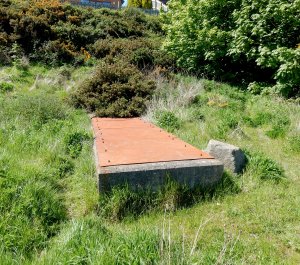
Seafield just managed to survive the fallout from the Miner’s Strike, but closed four years later in 1988 with all of the above-ground infrastructure erased from the landscape in 1989. A relatively short industrial life of 45 years from conception to dust. Walking the landscape today there is no trace of the pit having ever existed. A new housing development sits up on the hill where Riss’s modernist landmark towers once stood. As we consider the marvellous views that these houses must command, we alight on a tomb-like structure on the side of the hill, complete with what could be a memorial stone. All is blank.
At the time of writing, (December 2015), the COP21 Paris climate deal has just been agreed, which at least outlines an intent and ambition to secure a low-carbon future for Planet Earth. We can’t help thinking that, like the oft cited butterfly of chaos theory that flaps it’s wings and causes a hurricane in another part of the globe, the burning of the first lump of carbon produced its own unforeseen effects over a longer time scale.
“It was my first acquaintance (1859) with the geology of Fife, and furnished me with many fresh and striking manifestations of volcanic phenomena – a foretaste of the rich harvest which the county was afterwards to yield in the same field”.
Sir Archibald Geikie (1859)
Our sense of human time, industrial time and earth-time is given a further jolt as we start to walk along the rock strewn beach towards Kinghorn. This part of the Fife coastline offers some dramatic examples of rock formations and lava flows dating back to early Carboniferous times of between 360 – 320 million years ago. The Binn (hill) which overlooks nearby Burntisland is believed to be the source of these lava flows.
.
Any rock is an index of deep time. Liquid lava movement arrested by abrupt cooling. Intense heat solidifying, fracturing, frozen in time.
Inevitably, our stroll along the beach throws up some interesting items:
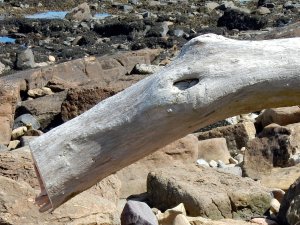
We wonder if we have come across the staff of the Spear of Neptune:
Unfortunately a search for the trident is unfruitful.
On any beach, these days, there is always at least one tyre:
A sea-smoothed anteater:
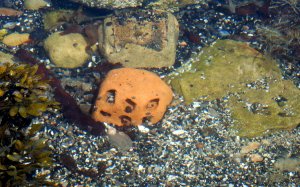
and a rock pool submerged sea skull:
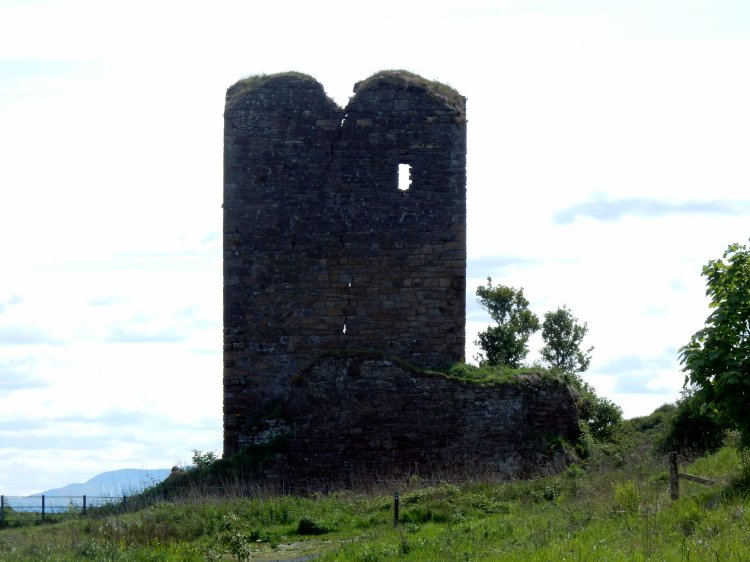
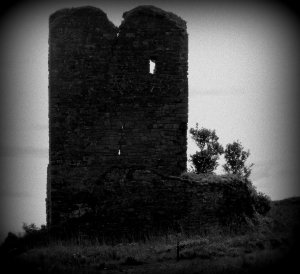
We leave the beach and pick up the footpath that leads to Kinghorn. Up ahead we can see the outline of Seafield Tower with the outer wall remaining largely intact.
For how long the tower will remain standing is another matter given the clearly visible fracture running down the middle like a poorly executed appendix scar. It feels as if a really strong wind could cleave the structure in two.
The tower is believed to date from the early 16th century and was the stronghold of the Moultrays of Seafield until 1631 when the estates were sold to the Archbishop of Glasgow. More intriguingly, a 1774 plan shows the enclosing courtyard walls and a circular tower at the NE angle described as the ‘Devil’s Tower’ although the derivation of this is unclear. The local coastline was known to be the haunt of smugglers in the eighteenth and early nineteenth centuries. Perhaps it would do no harm to circulate rumours about a devil’s tower to keep people well away.
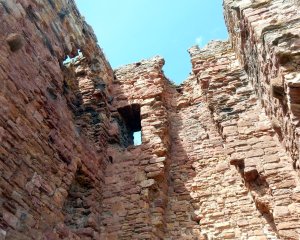
Built of red sandstone, the tower has not weathered well and now resembles a crumbling, hollowed out old tooth:
.
The Devil’s Tower?
On a day as radiant as this one, the tower doesn’t feel too devilish and the red sandstone softens the sun which is high overhead and beating down. This should favour one of the key reasons for our trip and we head further along the coast to see if we are in luck.
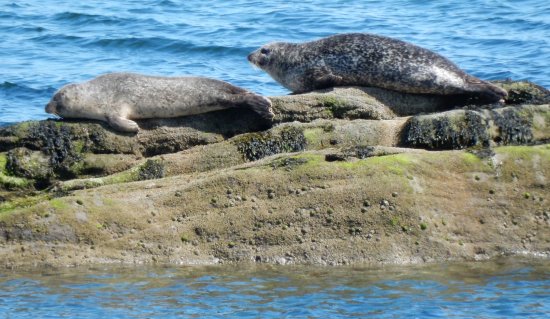
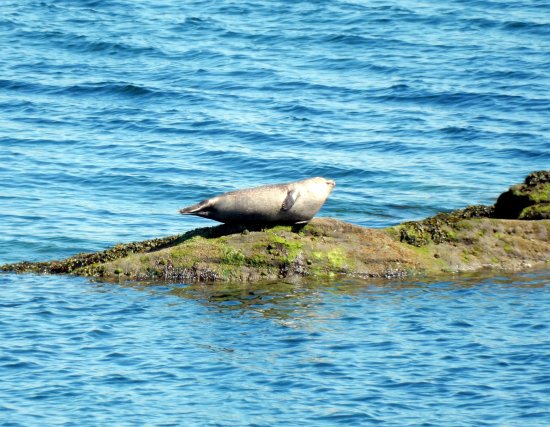
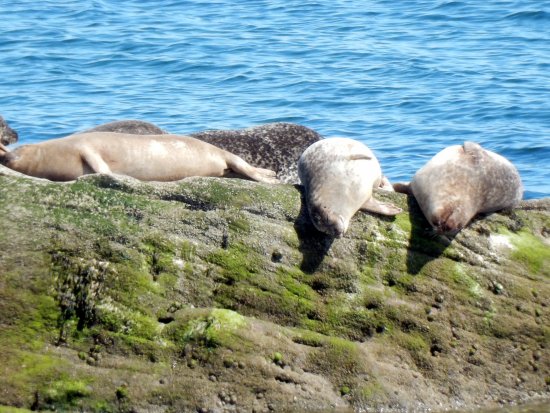
It is fairly common to see seals bobbing around the Fife coast, but we rarely see them congregate together. Today they are revelling in the sunshine, lounging on a series of rocks not too far from the shore. Occasionally, one will slide into the water and bob around closer to shore, clearly curious but feeling well protected by the aforementioned waves of rock teeth to discourage anyone trying to get too close. This is also a very quiet part of the coast. The railway hugs the coastline between Kirkcaldy and Kinghorn which prevents any access to the path other than by foot from either end. Even on a day such as this, with glorious weather, we encounter less than a handful of people on the path. There are the usual dog walkers who populate the entrance and exit areas but otherwise it is a remarkably quiet stretch.
Not surprisingly, the area is also rich in bird life. Oystercatchers puddle around the shore, whilst common gulls and herring gulls criss-cross the air in constant movement. Further out cormorants dry their wings, as if juggling a pair of half extended umbrellas. Our identification skills are insufficient to precisely identify many other species but the area is known as a rich haven for guillemots, razorbills, kittiwakes and fulmars.
Above our heads, a bunch of swifts engage in frantic aerobatics, explosions of kinetic energy and zig-zag movement. In stark contrast, a grey heron appears to slow the world to a standstill as it descends from the sky. The silent movement of its wings dissolving time in a held breath as it gracefully glides to a halt.
A more puzzling conundrum is the discovery of a still feathered wing caught up in some thick bramble thorns. Had the bird just inadvertently flown in to the thicket and become trapped or been attacked by a bird of prey? Or was it some totemic symbol carrying a message for the initiated or marking some form of threshold?
As the path ascends to higher ground, it looks over some fairly steep cliffs and runs parallel with the railway line for a stretch with expansive views over the Forth and onwards towards Kinghorn itself.
The presence of so many seals, earlier, conjures up visions of their close relatives in folklore whose stories pepper this coastline. As we look out to Inchkeith island we think of Kelpies and mermaids:
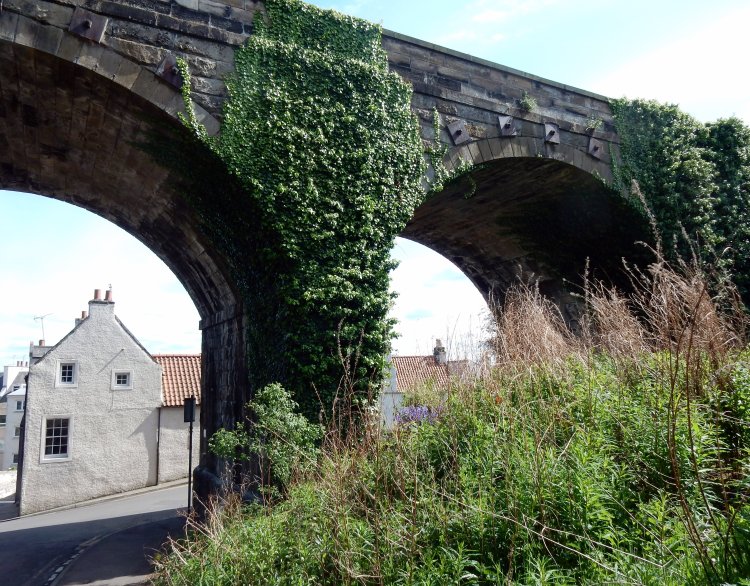
We eventually reach Kinghorn as the railway arches soar over our heads.
Kinghorn will have its own post at some future time, but as we walk down to the harbour we are reminded that Pettycur Bay nestles under a prominent crag known as ‘Witches Hill’:
≈≈≈
When the time comes to make the return walk back to Kirkcaldy, the sun has sunk low and we encounter no-one on the path. The landscape becomes more auditory than visual: the repetitive lip lip lip of a rock pool; the fizz of the receding tide. But it’s a low groaning drone that begins to fill the air. A deep and doleful lament rising to a eerie howl.
The seals are singing.
Is it a warning? a wake? Or do we hear the call of shape-shifting selkies, shedding their sealskins to assume human form …
We walk on quickly …
≈≈≈
Coda:
Tired of dreaming
the sun slipped
from the sky
in the dying light
a fizzle of water
a settling of sand.
Now playing: Kevin Drumm – The Sea Wins
The walk was undertaken in late May 2015. Written up in December 2015.
We have already written a fairly long piece on the painter William Gear (1915 – 1997). Gear was one of only two British members of the post-war, European, avant-garde movement CoBrA in the 1940s. He went on to produce some of the most radical and controversial paintings of the 1950s.
In the centenary year of his birth, a major retrospective of his work has recently arrived in Edinburgh. Previously shown at The Towner Art Gallery, Eastbourne, where Gear was curator from 1958-1964, it is a fabulous retrospective show and a privilege to see so many of his works collected together. From early dabblings with Surrealism through to the radical monochrome abstractions of the 1950s and the singing colours and sculptural forms of his mature style from the 1960s to his death in 1997.
The exhibition is showing at City Art Centre until 14th February 2016 and comes highly recommended. Rather than write a full review, we would only suggest that you consider visiting the exhibition if you can.
Walking around for the first time a few phrases caught the ear and eye:
I was born and brought up on the Fife Coast. Harbours, boats, the sea. It is in the blood.
I was a Parisian now.
(Gear moved to Paris in the late 1940swhere he held his first solo shows and joined CoBrA after meeting Appel, Constant, Corneille and Jorn. Reading this line particularly struck a chord after the brutal terrorist attacks on Paris on Friday 13th 2015. An attack on a city that has always drawn artists to it and excels in celebrating both the highest pleasures and everyday joys of life).
I cannot say in truth that my painting is entirely non-representational, though at no point am I ever obsessed with the rendering of objects in front of me or remembered as such. I continually find that my pictures, when finished, are evocative of something within my visual experience. It may be the corner of my studio, or the view from the window of trees and the Seine and the buildings of the Île de la Cité opposite, or a generalised landscape, interior or assembly of forms.
Trees and boulders take on the menacing form of hidden terror. Imagination plays tricks with the eyes.
In conjunction with a fine exhibition catalogue, a magisterial new book has been written by Andrew Lambirth which is particularly strong on placing Gear within an international context.
We were also delighted and gobsmacked to stumble across a mention of our essay in the Afterword:
William Gear (1915 – 1997): The painter that Britain forgot – City Art Centre Edinburgh, until 14th February 2016. (Free).
At no other time (than autumn) does the earth let itself be inhaled in one smell, the ripe earth; in a smell that is in no way inferior to the smell of the sea, bitter where it borders on taste, and more honeysweet where you feel it touching the first sounds. Containing depth within itself, darkness, something of the grave almost
Rainer Maria Rilke
.
.
all around
a shedding of leaves
my green cloak
growing heavier
.
.
I notice that Autumn is more the season of the soul than of nature
Friedrich Nietzsche
.
.
Even decay is a form of transformation into other living things, part of the great rampage of becoming that is also unbecoming
Rebecca Solnit
.
.
almost dark
listen – in(g)
to the huddled whispers
of the forest flock
.
.
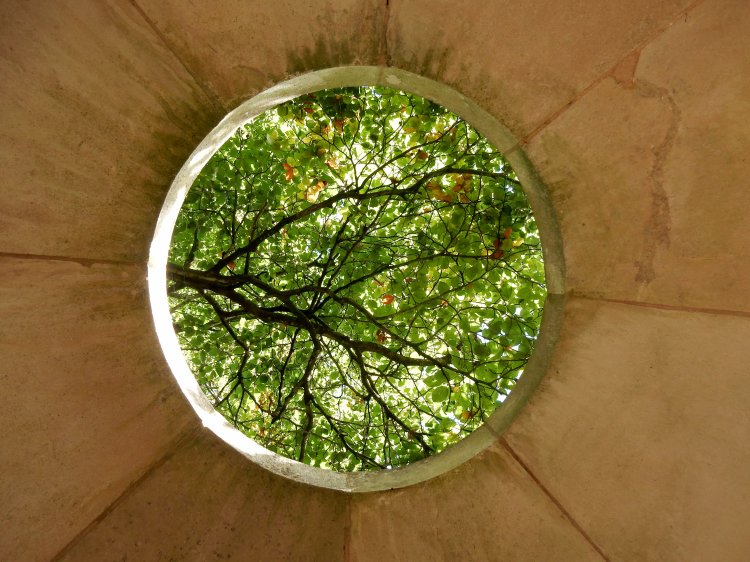
autumnal portal
a suggestion of russet
.
Above the roof of Ian Hamilton Finlay’s ‘Temple of Apollo’ at Jupiter Artland
.
.
Flooding the fissures
of the stone house
Liquid light
rippling the air
.
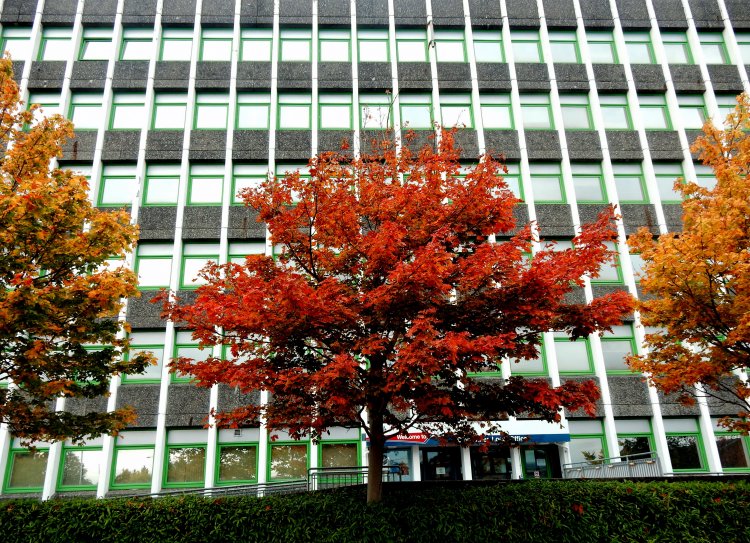
(Redux) When natural cycles turn, brutalist windows can dream of (autumn) trees…
.
Now playing: Laura Cannell – ‘Born from the Soil’ from Beneath Swooping Talons.
Up above, the sound is like a collision of thunder arriving from north and south. Traffic heading to unknown destinations, running up and down the asphalt spine of the M90 motorway. Here, underneath the flyover, the concrete walls have become vast, abstract-expressionist assemblages. Layer upon layer of weather effects, pollution spray, pigment and human mark-making. It is only the walker who will notice these. Why, would you dwell, to look, if travelling in a car?
Has any disorientated walker followed the arrow east TO DIVIT, or west TO THE RO?
Unusual names – DIVIT, THE RO.
Consulting any official map will be of little help. There will be no record of these places. Perhaps we are standing on a territorial boundary line. DIVIT being a local name for Inverkeithing to the east. THE RO is Rosyth to the west. That human compulsion to establish borders and territories. Points of entry or exit. Lines pronouncing otherness, even when invisible and local.
Not far away, a universally recognised symbol. How many times has a heart shape been inscribed on a surface across time and space? From Cro-Magnon cave walls, via the ancient Greeks – a symbol of life and morality and possibly an association with Dionysus and love – to the more familiar symbol of romantic love emerging in the 1200s. Anyone using social media will recognise ❤ ❤ <3.
Under this motorway flyover, a black heart in brush stroke, partly over-painted in white. The shape immediately recognisable, a symbol we can all ‘understand’. But does the nuance of its meaning remain with the mark maker? We connect through common language but subtleties of difference always escape, to be either celebrated or repressed.
Is that a human figure we see enclosed within the heart? Possibly kneeling? Who can say?This small detail, on the patina of concrete canvas, remains a daub of mystery. A symbol as elusive and remote from the casual observer as the Pictish symbols, found further up the Fife coast, carved in the Wemyss Caves around 600 – 700 AD.
The difference between the who and the what at the heart of love, separates the heart. It is often said that love is the movement of the heart. Does my heart move because I love someone who is an absolute singularity, or because I love the way that someone is?
Jacques Derrida
Now playing: Julian Priester Pepo Mtoto – Love, Love
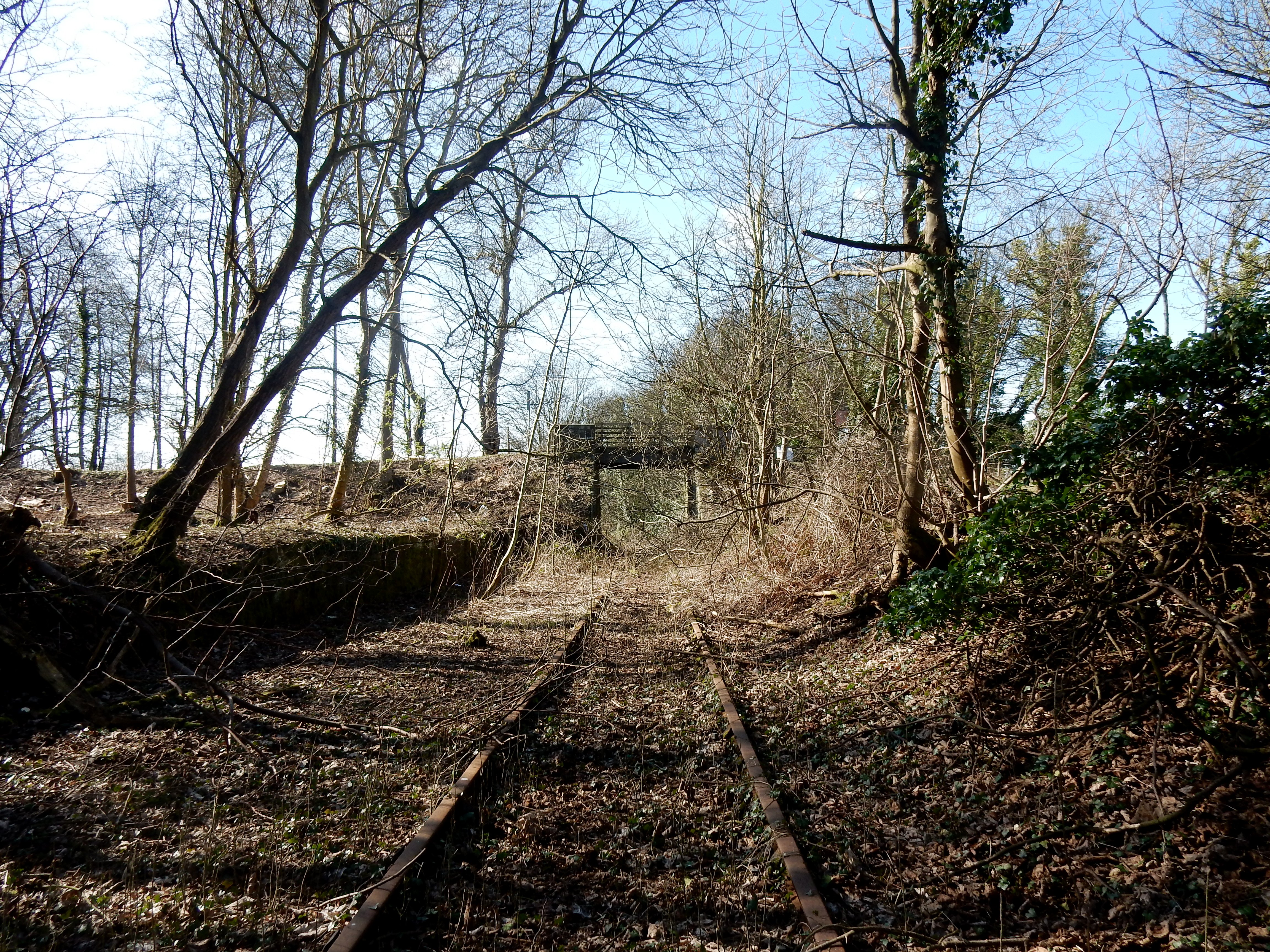
The small part of the track that we had walked at the end of last year was overgrown but easily passable. The rails and sleepers still intact. We returned a few weeks ago on a day heralding early intimations of another spring to come. That change in light, the soft drone of an awakening insect world and pointillistic bursts of unseen and unidentified bird calls.
The paradox of being off the well-trodden path and yet only following a line to wherever it may eventually lead. We are not sure how far it goes and whether it will be entirely passable.
We almost fail immediately as we soon encounter impenetrable thickets of bramble bushes. (noted for autumn). This leaves no option but to take a slight detour and pick up the line again by sliding down an embankment beside a small road bridge. This looks more promising. The line stretches out ahead. Blue pools trap the sky whilst shadow branches sweep across the cut in the light breeze.
This incision through the landscape is just another example of a history of human activity that leaves its traces and stories embedded in the earth. Field enclosures, drystane dykes, managed woodlands, roads and a network of railways have all left enduring marks on the landscape from the pre-agrarian to the post-industrial.
Prior to construction of this railway line, ox-drawn wagons delivered coal from the Dunfermline pits to the nearest harbour at Brucehaven a distance of around five miles on primitive roads. By the end of the 18th century, growth of the lime industry at Charlestown – which relied on large amounts of coal – led to the construction of the Elgin Wagonway which laid down wooden and then, in 1812, iron rails on which heavy horses pulled coal wagons. By 1852 a fully functioning steam railway carrying freight and passengers connected Dunfermline and Charlestown. Passenger trains continued to run up until 1938 (with a break in continuity between 1863 and 1894). The line was apparently maintained and kept usable to service the Royal Naval Armaments Depot at Crombie, if required, but it is clear from our walk that no train has passed this way for a very long time.
.
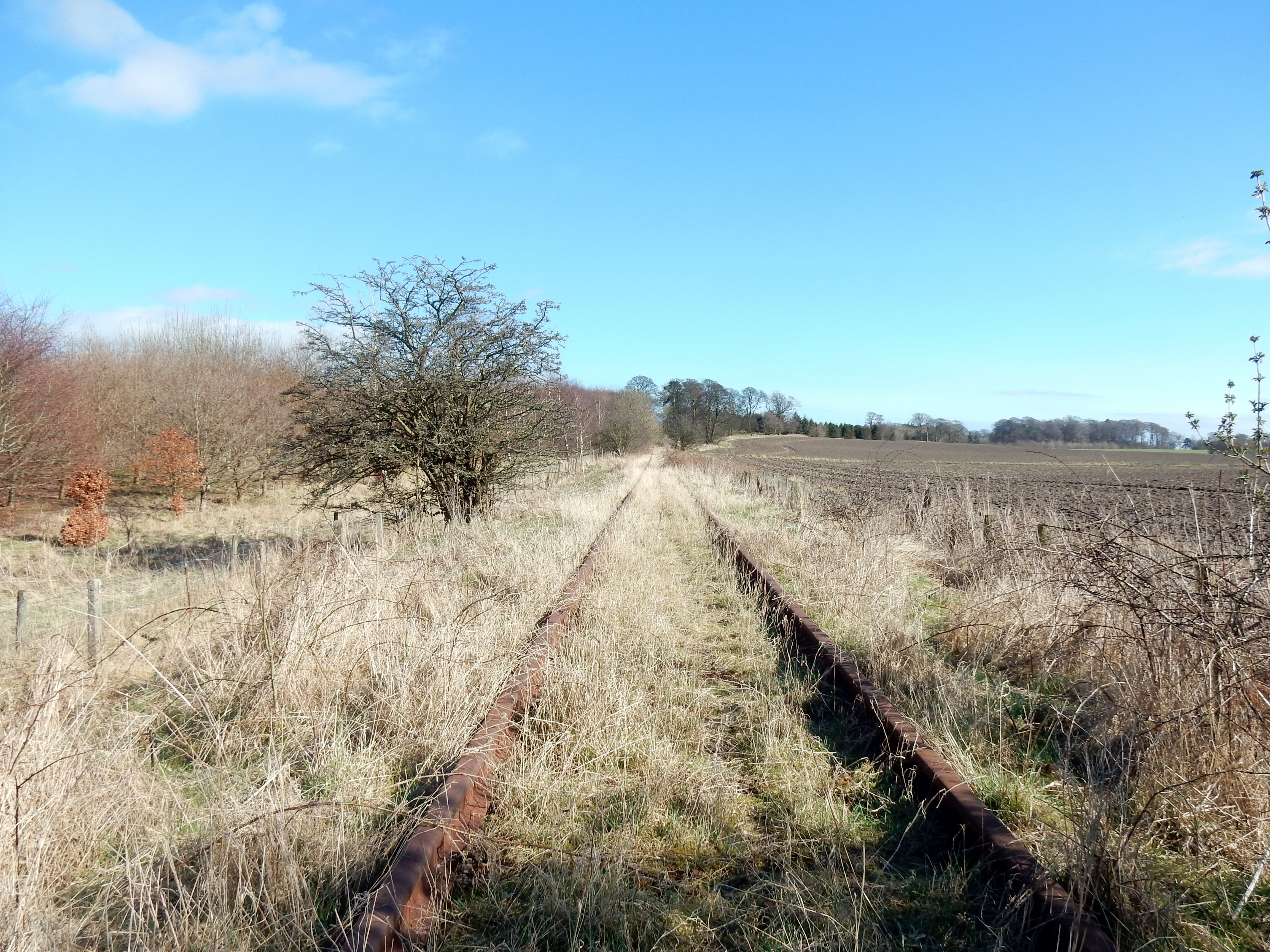
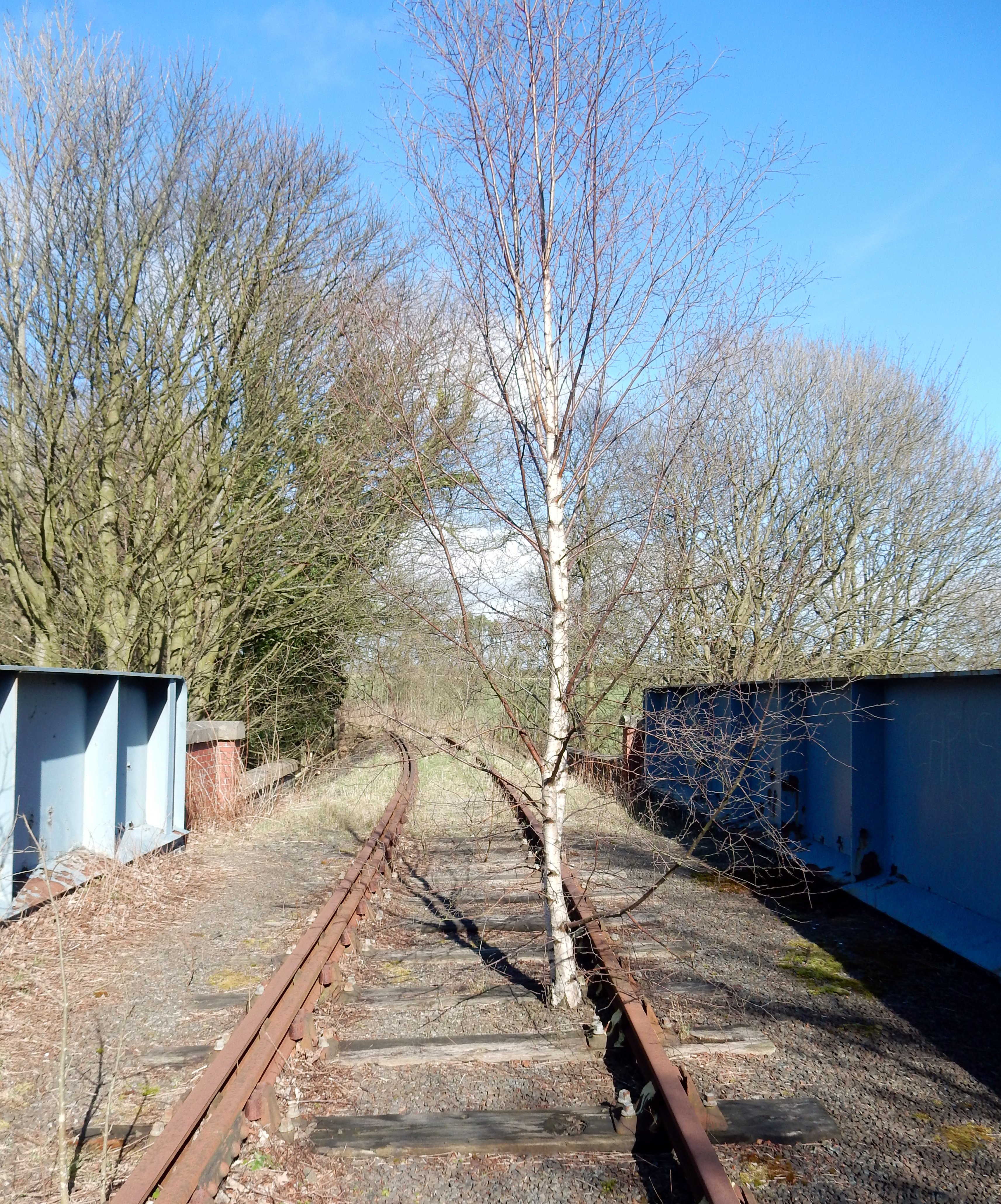
Whilst not the smoothest of conditions underfoot, many stretches offer pleasant walking. The iron rails guiding us under abandoned bridges and then on to long straight tracks that disappear into the horizon.
.
.
But this is no isolated rural idyll. To the north, the line runs parallel to the A985, one of the busiest trunk roads in Scotland and the white-noise throb of passing traffic is our soundtrack for a mile or so. To the south, the views are over agricultural land, recently ploughed. In the foreground a suggestion of trees:
.
Occasionally we have to navigate over, under or through some obstacles:
.
.
and traverse abandoned level crossings:
.
Forgotten mileage markers barely stand upright as we walk high over earth-piled embankments:
.
.
A rooftop eyrie. What creature could inhabit this green island in an ocean of blue?
.
We wonder how long it has been since anyone has walked the entire line. You are not actively encouraged to walk it with each entry and exit point fenced off. Not surprisingly we encounter no-one. Our only constant companions are the buzzards who circle high in the sky and the occasional explosion of displaying pheasants. We guess they are escapees from the nearby Elgin Estate where they are bred and shot by corporate middle managers who like to go ‘hunting’.
.
Tuning forks
sounding out
vibrations
of the sun
.
As the line curves northwards towards Dunfermline, we approach the bridge which crosses the A985:
.
.
Echoes of a painted relief by Ben Nicholson?
.
Shadows and rust:
.
.
Old branch line
new branches
.
.
Tracing the cut northwards, we become submerged within the landscape as if walking through a post-industrial holloway. A waterlogged, sodden stretch with tumbled trees conjures up visions of Tarkovsky’s Stalker. Our views of the surrounding land obscured as we walk into The Zone, following the rusting red rails.
.
.
And when we walk, we stroll alongside retrieved memories but also construct new ones. Small pebbles collected and stored: the sun warmed lichen; that particular apparition of trees; the smell of an emerging spring; laces in boots being shredded by brambles.
.
⇒⇒⇒⇒⇒⇒⇒⇒⇒⇒⇒⇒⇒⇒⇒⇒
¦¦¦¦¦¦¦¦¦¦¦¦¦¦¦¦¦¦¦¦¦¦¦¦¦¦¦¦¦¦¦¦¦¦¦¦
⇒⇒⇒⇒⇒⇒⇒⇒⇒⇒⇒⇒⇒⇒⇒⇒
.
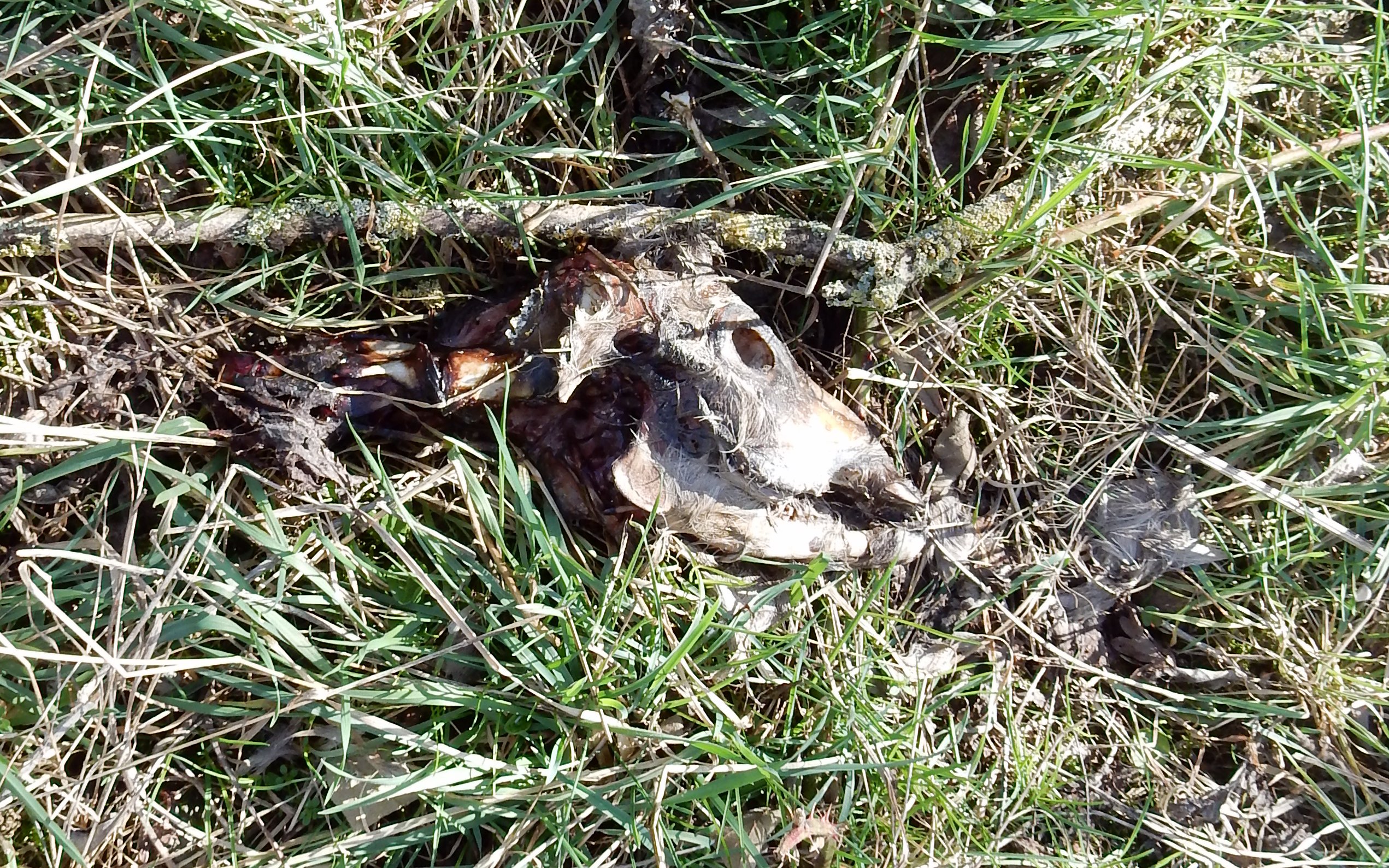
The sun reflects from the elegant curve of bleached white bone amongst a bed of grey feathers. Ribs sparkle like some primitive xylophone and still attached to the leg, a small dark hoof. The sweep of bones and sinew appear to retain some residue of movement; of a life-force that has been so abruptly arrested. Who knows what happened to this (we guess) young deer?
Detached and slightly further away lies the white skull, stripped and pecked clean. The downy feather bed suggests that some of the birds who came to feast on the carcass ended up being part of someone else’s meal.
.
Fur, feather, rib, bone
Old Nature Writing
.
We eventually come to the end of the track alongside a well maintained and clearly operational train line. We later find out that this is Elbowend Junction where the track to Charlestown branched off from the Dunfermline and Alloa line.
The connection is now clearly severed.
.
Another mark, a cut, embedded in the landscape, made by human activity and reflecting the ebb and flow of industry and capital. Slowly merging back into the earth a corridor of memory and potential new futures. An incision slowly being repurposed by nature once again.
Now playing: Andrew Chalk – Blue Eye of the March
Reference:
Norman Fotheringham, Charlestown, Built on Lime (Charlestown: Charlestown Lime Heritage Trust, 1997).
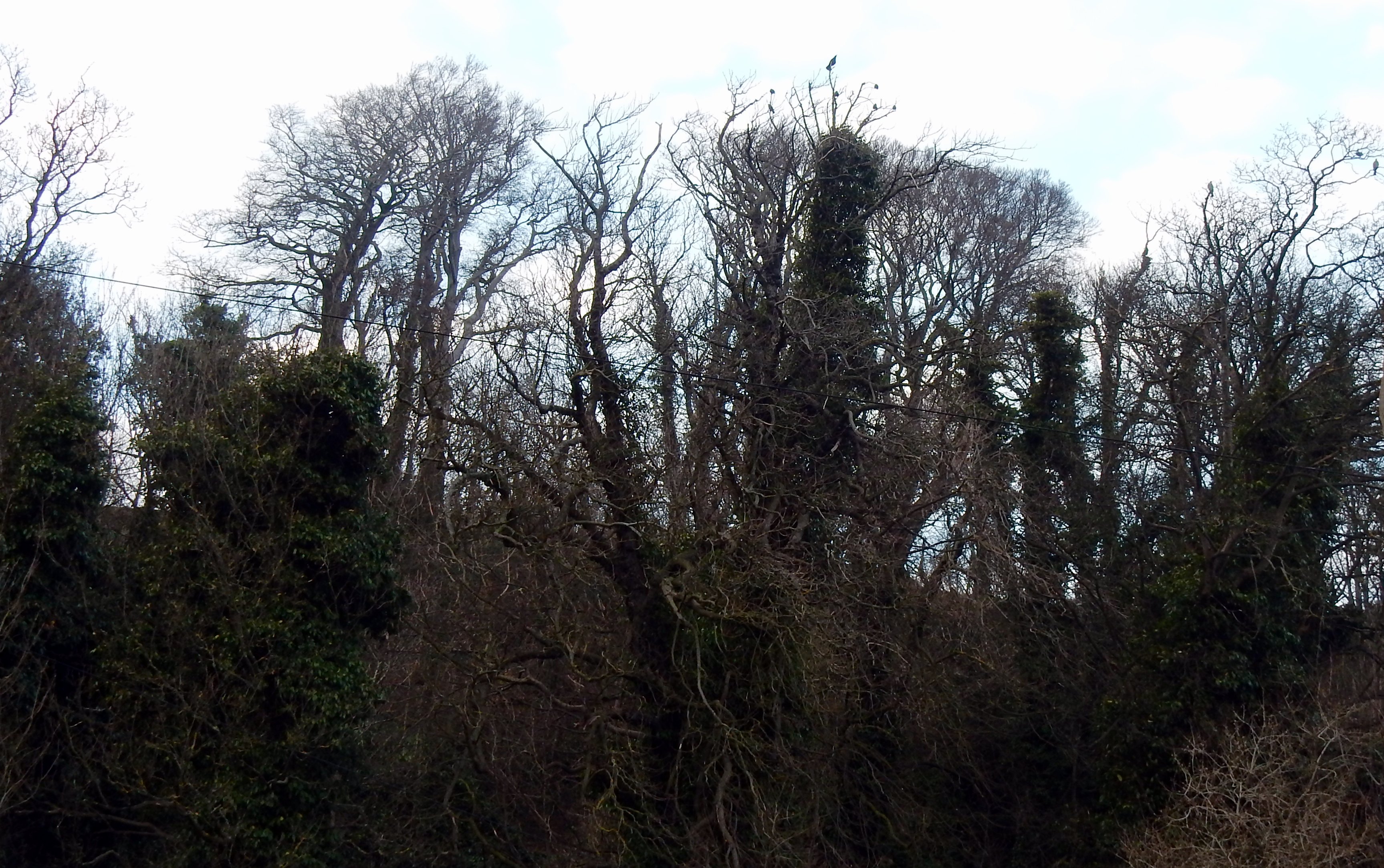
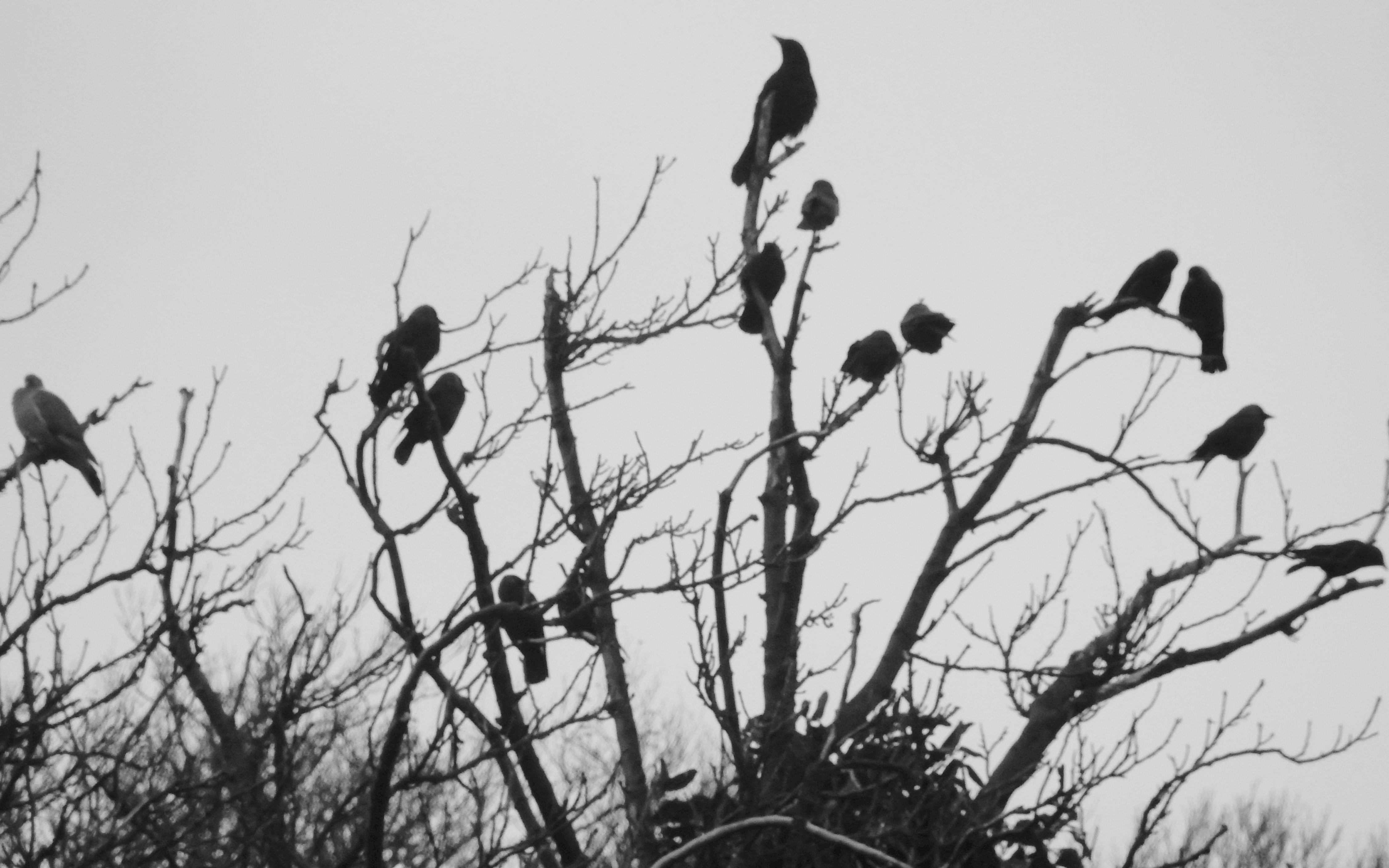
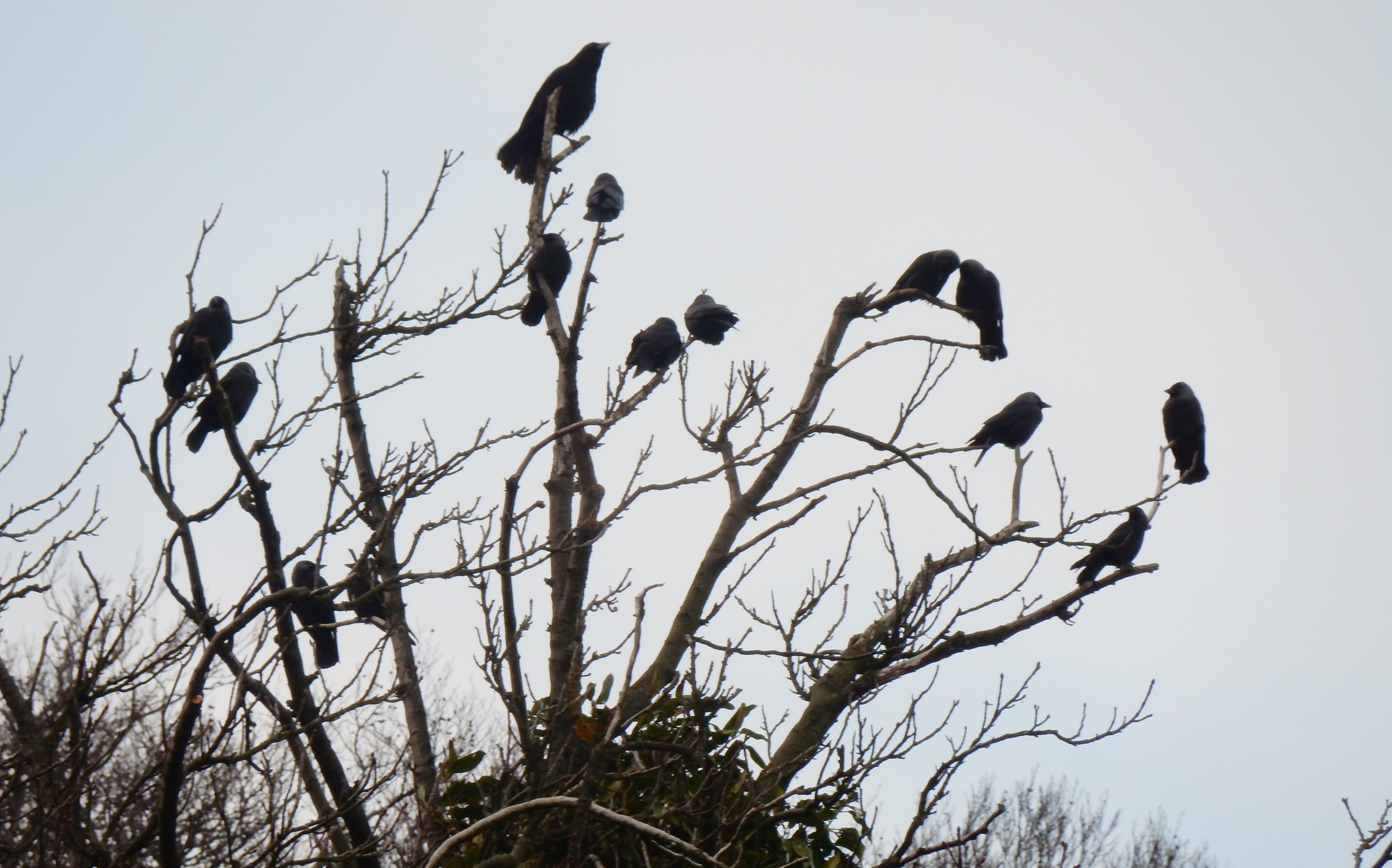
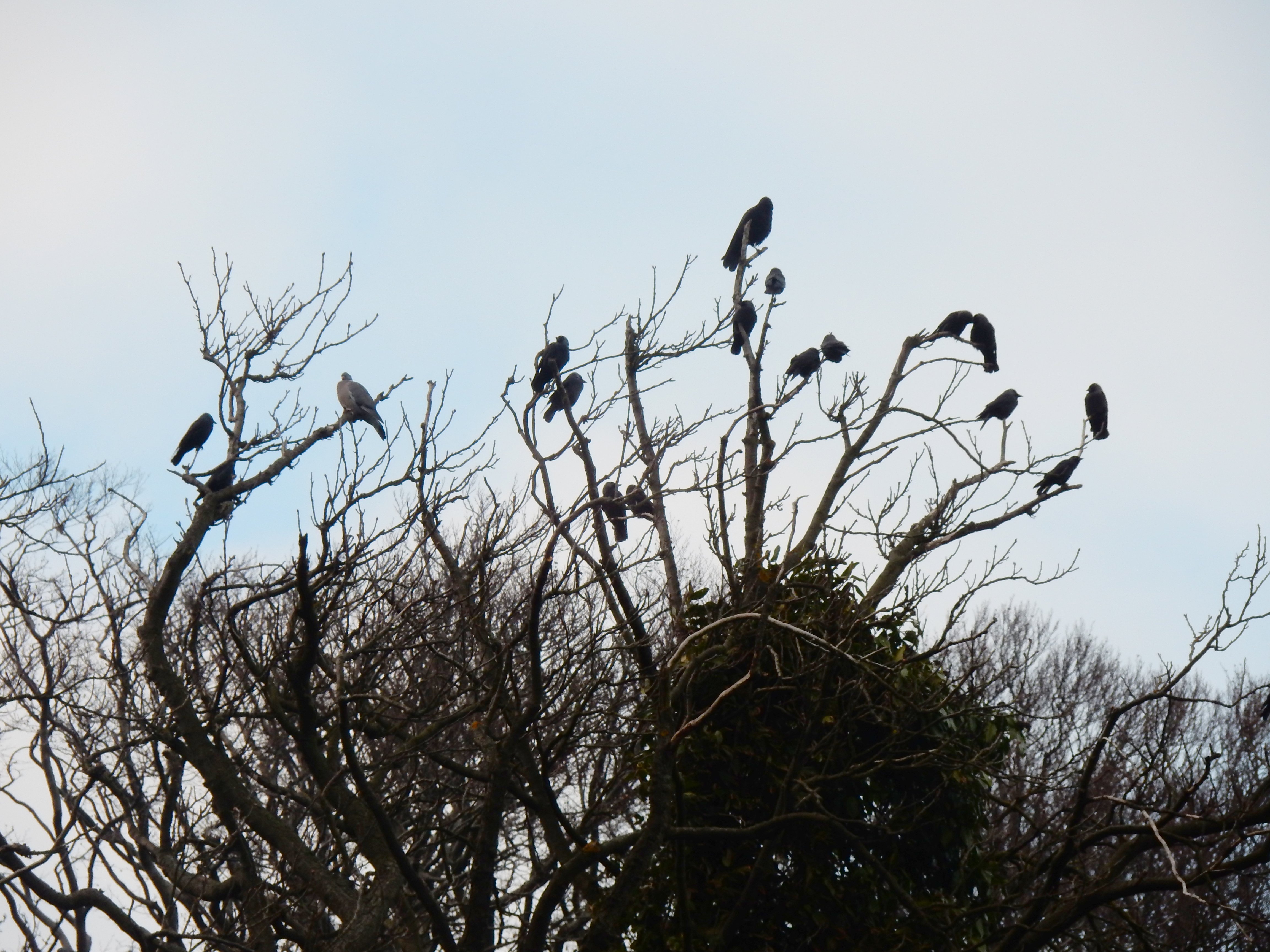
“Out of all of them, it has been the corvids, the rook, magpie and crow, who have altered for ever my relationship to the rest of the world, altered my view of a hierarchy of form, intellect, ability; my concept of time”.




































 Murdo Eason - From Hill to Sea